
Ecommerce Website Development Cost in India: Complete 2026 Pricing Breakdown
How much does an ecommerce website cost in India in 2026? Complete pricing breakdown for Shopify, WooCommerce, and custom stores. Plus hidden costs and budgeting tips.
VidyaSaaS Team
Super Administrator
Meta Description: How much does an ecommerce website cost in India in 2026? Complete pricing breakdown for Shopify, WooCommerce, and custom stores. Plus hidden costs and budgeting tips.
Introduction
Here's a question we get every single week at VidyaSaaS: "I want to start selling online. How much will a website cost me?"
It sounds simple. But the answer is never simple. For a deeper dive, see wordpress vs shopify vs custom website: which platform .
Because the cost isn't a number. It's a range. A wide range. And picking the wrong point in that range can mean the difference between a store that pays for itself in a month and one that bleeds money for years.
Walk into this conversation without preparation, and here's what happens: you ask three different agencies for a quote. One says ₹25,000. Another says ₹1.5 lakhs. The third says ₹5 lakhs. Now you're confused, suspicious, and probably tempted to go with the cheapest option.
That's a mistake. For a deeper dive, see our complete SEO guide.
In this guide, we'll break down exactly what ecommerce websites cost in India in 2026. Platform by platform. Feature by feature. You'll understand why prices vary so much and, more importantly, where your money should go based on what you're actually building.
The Factors That Determine Cost
Before we talk numbers, let's talk variables. Every ecommerce project is different, and the price depends on several key factors.
Platform Choice
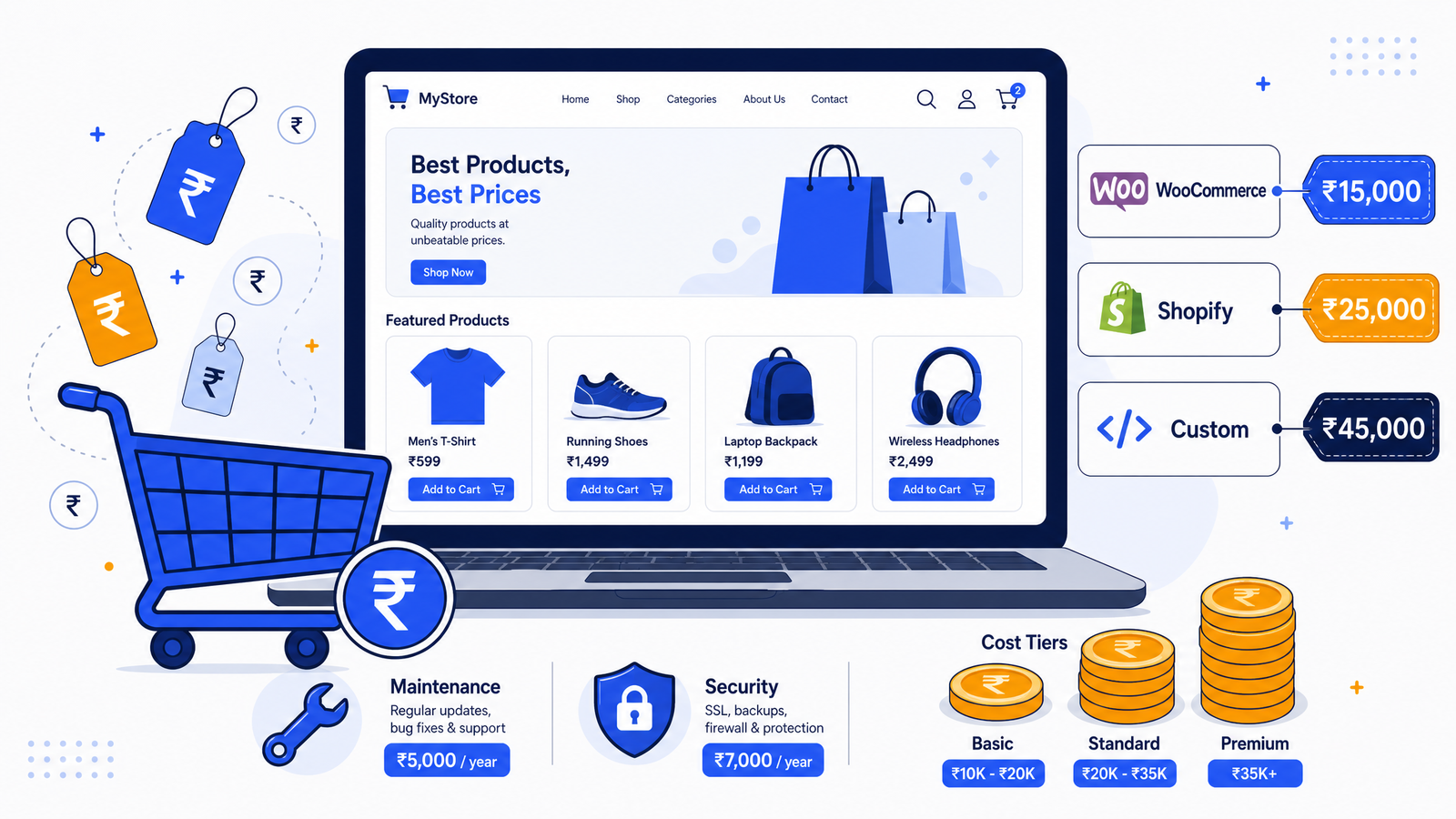
Your platform is the biggest cost driver. We covered this in our WordPress vs Shopify vs Custom guide, but specifically for ecommerce:
- WooCommerce (WordPress): Lower upfront cost, more flexibility, but ongoing maintenance costs
- Shopify: Predictable monthly cost, limited customization, transaction fees
- Custom Development: Highest upfront cost, unlimited possibilities, higher ongoing costs
Design Complexity
A template-based store with minor customizations will cost significantly less than a fully custom-designed store. If you want a unique look that stands out from competitors, budget more for design.
Template-based: ₹10,000 – ₹40,000 Custom-designed: ₹50,000 – ₹3,00,000+
Number of Products
More products mean more setup time, more data entry, more images to optimize, and more pages to create.
- 1-50 products: Minimal setup cost
- 50-500 products: Moderate setup cost (may need bulk import)
- 500+ products: Significant setup cost (definitely need bulk import, possible custom development for product filtering)
Features and Functionality
Basic stores cost less. Complex stores cost more. Here are features that add to the cost:
- Basic product listings + cart + checkout → Standard
- Multi-currency, multi-language → Extra
- Subscription/recurring payments → Extra
- Custom product configurators → Extra
- Reviews and ratings → Usually standard
- Wishlist, gift cards → Usually standard plugins/apps
- Custom shipping rules → Extra
- ERP/CRM integration → Significant extra
- Multi-vendor marketplace → Major extra
Integrations
Need to connect your store to:
- Your accounting software (Tally, Zoho Books, QuickBooks)?
- Your inventory management system?
- Your CRM (Salesforce, Zoho, HubSpot)?
- A third-party logistics provider (Shiprocket, Delhivery, Ecom Express)?
- An ERP (SAP, Oracle, Microsoft Dynamics)?
Each integration adds development and testing time.
Payment Gateway
In India, you'll likely use Razorpay, Cashfree, PayU, or Instamojo. Most platforms support these natively, but custom payment flows or gateway-specific requirements can add to costs.
Price Range Breakdown by Platform
Here's what you can expect to pay for an ecommerce website in India in 2026, broken down by platform type.
WooCommerce (WordPress)
WooCommerce is the most popular ecommerce platform for Indian businesses. It's flexible, cost-effective for most stores, and offers great SEO capabilities.
| Item | Budget Store | Mid-Range Store | Premium Store | |------|-------------|----------------|---------------| | Domain | ₹800 | ₹800 | ₹800 | | Hosting (1 year) | ₹5,000 | ₹15,000 | ₹40,000 | | Theme | ₹3,000 | ₹10,000 (premium) | ₹35,000+ (custom) | | Essential Plugins | ₹8,000/yr | ₹20,000/yr | ₹50,000/yr | | Development | ₹15,000 | ₹50,000 | ₹1,50,000+ | | SSL Certificate | Free (Let's Encrypt) | Free or ₹3,000/yr | ₹5,000/yr | | Gateway Setup | Free | Free | Free | | Year 1 Total | ₹30,000 – ₹50,000 | ₹90,000 – ₹1,50,000 | ₹2,50,000 – ₹5,00,000 | | Annual Ongoing | ₹15,000 – ₹25,000 | ₹35,000 – ₹50,000 | ₹75,000 – ₹1,50,000 |
Best for: Service-based businesses adding ecommerce, content-driven stores, businesses wanting full control, mid to large product catalogs.
Shopify
Shopify is a hosted platform — you pay monthly and get a fully managed store in return.
| Item | Basic Shopify | Shopify | Advanced Shopify | |------|-------------|---------|-----------------| | Monthly Plan | ₹2,000/month | ₹7,000/month | ₹20,000/month | | Domain | ₹800 | ₹800 | ₹800 | | Theme | Free or ₹2,500 | ₹5,000 – ₹15,000 | Custom ₹50,000+ | | Apps (monthly) | ₹2,000 – ₹5,000 | ₹5,000 – ₹15,000 | ₹15,000 – ₹40,000 | | Development | ₹10,000 – ₹25,000 | ₹30,000 – ₹60,000 | ₹75,000 – ₹2,00,000 | | Year 1 Total | ₹55,000 – ₹80,000 | ₹1,50,000 – ₹2,50,000 | ₹4,00,000 – ₹7,00,000 | | Annual Ongoing | ₹50,000 – ₹80,000 | ₹1,40,000 – ₹2,50,000 | ₹4,00,000 – ₹7,00,000+ |
Note the ongoing costs. Shopify never gets cheaper. You pay every month, and app subscriptions add up fast.
Best for: Physical product brands, D2C startups, non-technical founders, small to medium catalogs.
Custom Development
Custom ecommerce development gives you complete control but at the highest cost.
| Item | Basic Custom | Mid-Range | Enterprise | |------|-------------|-----------|------------| | Development | ₹1,50,000 – ₹3,00,000 | ₹3,00,000 – ₹7,00,000 | ₹7,00,000 – ₹20,00,000+ | | Domain | ₹800 | ₹800 | ₹800 | | Hosting/Server | ₹15,000 – ₹30,000/yr | ₹30,000 – ₹80,000/yr | ₹80,000 – ₹3,00,000/yr | | SSL | Free or ₹3,000 | ₹5,000/yr | ₹10,000/yr | | Year 1 Total | ₹1,70,000 – ₹3,50,000 | ₹3,50,000 – ₹8,00,000 | ₹8,00,000 – ₹23,00,000+ | | Annual Maintenance | ₹30,000 – ₹75,000 | ₹75,000 – ₹1,50,000 | ₹1,50,000 – ₹5,00,000+ |
Best for: Large catalogs (10,000+ products), complex business models (multi-vendor, subscriptions, custom workflows), enterprises with in-house tech teams.
Hidden Costs You Need to Know About
The numbers above cover the obvious costs. But ecommerce stores have sneaky expenses that many first-time store owners don't anticipate.
1. Payment Gateway Fees
Payment gateways in India charge 1.5% to 3% per transaction, plus GST. On a ₹10,000 sale, that's ₹200-400 gone. On a business doing ₹50 lakhs in annual revenue, that's ₹75,000 to ₹1.5 lakhs in fees per year.
Some gateways also charge:
- Setup fee: ₹0 – ₹5,000 (one-time)
- Annual maintenance: ₹0 – ₹3,000
- Refund charges: 1-2% of refunded amount
2. Shipping Costs
Shipping is not a technology cost, but your platform choice affects shipping management. Good shipping integrations (Shiprocket, Pickrr, Delhivery) cost ₹3,000 to ₹15,000 per year.
3. Transaction Fees (Shopify)
If you don't use Shopify Payments (which many Indian merchants can't or shouldn't use), Shopify charges an additional 0.5% to 2% fee on every transaction. On ₹50 lakhs in sales, that's ₹25,000 to ₹1 lakh in extra fees.
4. SSL Certificate Renewal
Free SSL certificates (Let's Encrypt) work fine for most stores. But some businesses prefer paid SSL for higher warranty amounts. Budget ₹2,000-₹5,000/year.
5. Domain Renewal
Your ₹800 domain will renew at ₹1,000-₹1,500/year. Not a big cost, but easy to forget.
6. Backup Services
If your host doesn't include automated backups, you'll need to pay for a backup service. ₹3,000-₹12,000/year.
7. Security
Ecommerce sites are prime targets for hackers. Security plugins, monitoring services, and regular security audits add ₹5,000-₹20,000/year.
8. Email Services
Transactional emails (order confirmations, shipping updates) need a reliable email service. ₹2,000-₹6,000/year for reasonable volume.
9. Marketing Tools
Upselling apps, email marketing integrations, abandoned cart recovery — these are essential for a successful store but cost money. ₹10,000-₹50,000/year depending on tools.
10. Legal and Compliance
GST invoices, tax calculation, privacy policies. Not strictly a website cost, but essential for operating legally in India.
How to Budget Smartly
Rather than asking "how much does an ecommerce website cost?", ask "what budget will give me a store that actually works?" Here's our framework for setting the right budget.
Step 1: Define Your Minimum Viable Store
What's the absolute minimum you need to start selling? For most businesses:
- Product pages (10-50 products)
- Shopping cart and checkout
- Payment gateway (Razorpay or Cashfree)
- Shipping integration
- Basic SEO setup
- Mobile-responsive design
This core setup covers about 80% of what a small ecommerce business needs. You can add features later as you grow.
Step 2: Add Non-Negotiables
- Professional product photography (₹5,000-₹30,000)
- Decent product descriptions (₹5,000-₹20,000 for copywriting)
- Trust badges and security certificates
Step 3: Budget for Traffic
Many new store owners spend everything on the website and nothing on getting people to visit. Budget at least 30-50% of your website cost for initial marketing — ads, SEO, social media promotion.
Step 4: Build a Contingency
Add 15-20% to your budget for unexpected expenses. Integration delays, additional features you didn't anticipate, design revisions — they happen.
Smart Budget Example
Let's say you're a small business with 50 products, using WooCommerce:
| Item | Budget | |------|--------| | Basic WooCommerce setup | ₹40,000 | | Premium theme | ₹8,000 | | Product photography | ₹10,000 | | Copywriting | ₹10,000 | | First year hosting + domain | ₹15,000 | | Essential plugins (1 year) | ₹10,000 | | Initial marketing budget | ₹40,000 | | Contingency (15%) | ₹20,000 | | Total Budget | ₹1,53,000 |
This gives you a solid, working store with budget left for traffic. Not fancy. Not cutting-edge. But functional and effective.
Questions to Ask Developers Before Hiring
Before you hand over money to anyone for your ecommerce store, ask these questions.
Technical Questions
- Which platform do you recommend for my specific needs? If they only recommend one platform (only Shopify or only custom), ask why. A good agency will honestly assess which platform fits your business.
- What's included in the price? Get a detailed scope of work. Pages, features, revisions, post-launch support.
- What's not included? Hidden costs kill budgets. Make them list exclusions.
- Who will host the site? Do they recommend a specific host? Do they include setup?
- How do you handle SEO? URL structure, meta tags, schema markup, page speed.
- Is the design mobile-responsive? This should be a given, but confirm.
Process Questions
- What's the timeline? Get a project timeline with milestones.
- How many revisions are included? Design revisions, feature revisions.
- How do we communicate? Email, project management tool, weekly calls?
- What happens after launch? Post-launch support, bug fixes, maintenance options.
Red Flag Answers
- "₹15,000 for a complete ecommerce store" — They're likely using a nulled theme and cutting every corner.
- "We don't need a contract" — A professional relationship should be documented.
- "SEO is automatic with our platform" — SEO is never automatic.
- "No ongoing costs" — Every website needs maintenance.
- "Launch in 3 days" — A proper ecommerce store cannot be built in 3 days.
Where to Spend and Where to Save
Smart budgeting means spending on what matters and saving where it doesn't.
Spend Money On
- Good hosting. Cheap hosting kills ecommerce stores. Spend ₹15,000-₹40,000/year on reliable hosting.
- Professional design. Your store's look directly impacts trust and conversion.
- Solid product photos. Blurry phone photos of products scream "unprofessional."
- Speed optimization. Every second of load time costs you sales.
- Security. A hacked ecommerce store is a nightmare. Spend on security.
Save Money On
- Premium plugins/apps you don't need. Start with the minimum. Add features only when you need them.
- Unnecessary custom features. You probably don't need a custom product configurator on day one.
- Expensive themes. A ₹3,000 theme plus ₹15,000 of customization beats a ₹50,000 custom design for most stores.
- Over-engineering. Your store doesn't need serverless architecture and a microservices backend. Start simple.
- Fancy animations. They look good in the demo but slow down your site and distract from purchasing.
Real Indian Business Case Studies
Let's look at three real scenarios to put the numbers in context.
Case 1: Small Service Business Adding Ecommerce
Business: A small organic spice brand in Kerala Products: 20 spice varieties Platform: WooCommerce Total Cost: ₹65,000 (Year 1)
They started with a simple store, basic packaging, and a WordPress site with WooCommerce. Focused on content marketing about the health benefits of organic spices. Results: ₹3.2 lakhs in sales within the first six months. The store paid for itself in two months.
Key lesson: A basic store works if your product is good and your marketing is targeted.
Case 2: D2C Fashion Brand
Business: A mid-range fashion label from Jaipur Products: 200+ clothing items Platform: Shopify Total Cost: ₹2.1 lakhs (Year 1)
They needed Shopify for its easy product management and social media integrations. Invested in professional product photography and a premium theme customised to their brand. Used Instagram ads heavily. Results: ₹12 lakhs in Year 1, growing to ₹35 lakhs in Year 2.
Key lesson: Shopify's higher ongoing cost was justified by faster time-to-market and easy Instagram selling.
Case 3: B2B Industrial Supplier
Business: An industrial equipment distributor from Pune Products: 5,000+ SKUs with complex pricing Platform: Custom development Total Cost: ₹7.5 lakhs (Year 1)
They needed custom features: tiered pricing for different customer groups, integration with their existing Tally ERP, complex shipping rules, and a request-quote system instead of direct checkout. Off-the-shelf platforms couldn't handle this. Results: Online channel contributed ₹45 lakhs in Year 1.
Key lesson: Custom development was expensive but necessary. The ROI justified the investment within three months.
📚 Related Articles You Might Like:
Conclusion
An ecommerce website in India can cost anywhere from ₹30,000 to ₹20 lakhs or more. The right budget for you depends on your product, your platform choice, and the features you need.
The key is to be honest about what you actually need. Most new ecommerce stores don't need enterprise-level features. A well-built WooCommerce store with good product photos and targeted marketing will outperform a ₹10 lakh custom store with no traffic strategy.
Spend on what matters: good hosting, solid design, reliable platform. Save on what doesn't: unnecessary features, expensive themes, over-engineering.
And remember: the cost of the website is just the beginning. Your success will depend more on your products and your marketing than on the platform you choose.
Ready to build your ecommerce store? The team at VidyaSaaS has built ecommerce stores across WooCommerce, Shopify, and custom platforms. We'll help you choose the right platform for your budget and build a store that actually sells. Schedule a free ecommerce consultation.
Want Results Like This?
Get a free digital marketing audit and custom growth plan for your business.
Get Free AuditVidyaSaaS Team
Super AdministratorPart of the VidyaSaaS team — a group of digital marketing strategists, content specialists, and growth experts helping businesses across India achieve measurable results through data-driven marketing.
More about our teamRelated Articles
Handpicked content to help you grow your business

Solapur Textile Town 2.0: Web Design and Digital Presence for Maharashtra Manufacturing Hub
Solapur towels and bed sheets supply hotels across India. Its textile mills run 24/7. But its websit...

Bhavnagar Port City Potential: Web Design and Digital Presence for Gujarat Diamond and Ship-Breaking Hub
Bhavnagar diamond polishers supply global markets. Alang ship-breakers recycle the world vessels. Bu...

Erode Turmeric to Textiles: Web Design That Sells for Tamil Nadu Agricultural Powerhouse
Erode turmeric sells in 40 countries. Its textile mills supply global brands. But most businesses he...
Ready to Grow Your Business?
Let's discuss how we can create a data-driven digital marketing strategy tailored to your goals.