
WordPress vs Shopify vs Custom Website: Which Platform Is Right for Your Indian Business?
WordPress, Shopify, or custom development? Compare costs, scalability, SEO, and more for Indian businesses. Find the right platform for your needs and budget.
VidyaSaaS Team
Super Administrator
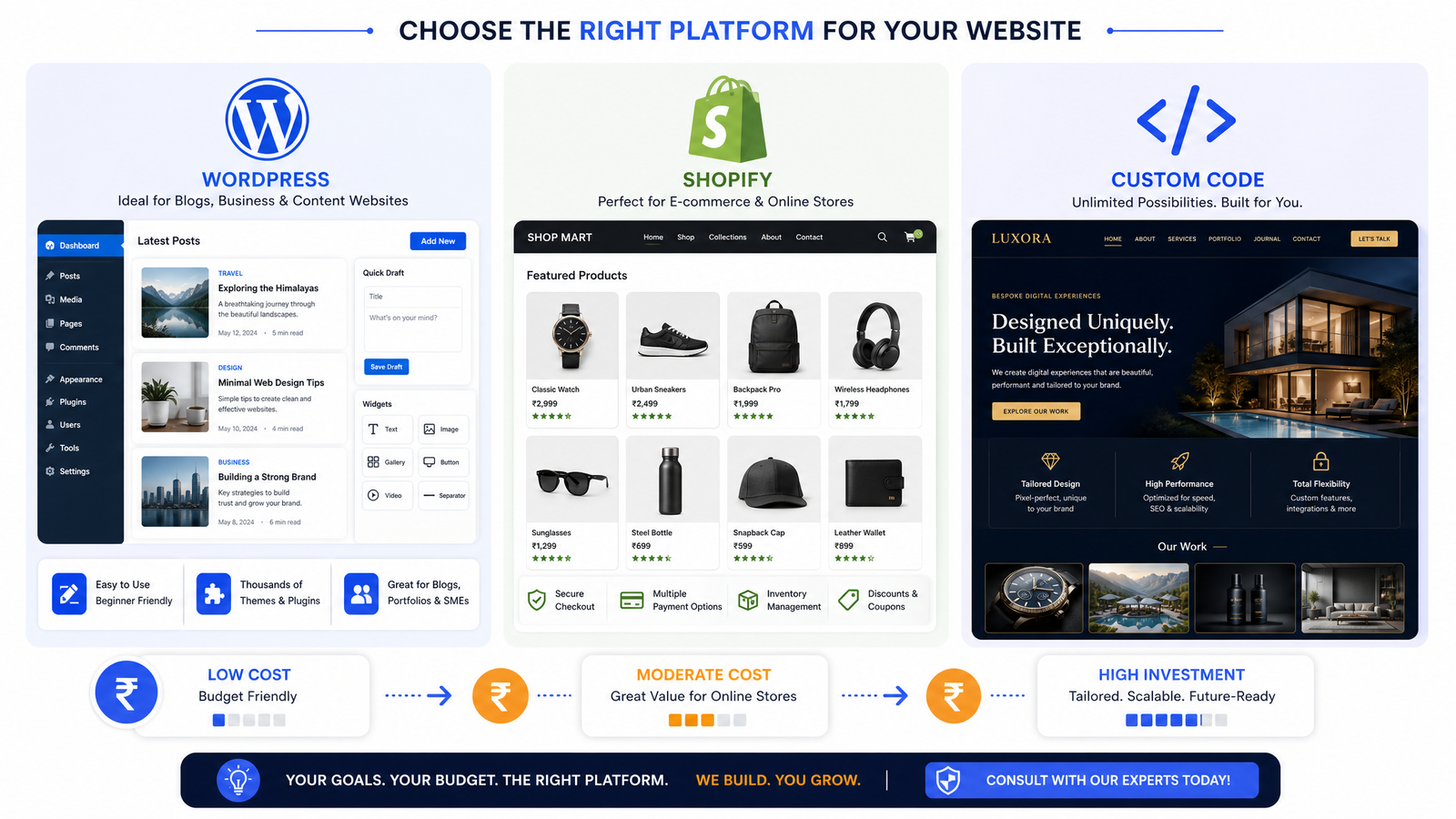
Meta Description: WordPress, Shopify, or custom development? Compare costs, scalability, SEO, and more for Indian businesses. Find the right platform for your needs and budget.
Introduction
You've decided you need a website. Good call. But then comes the question that stops every Indian business owner cold: what platform should I build it on?
Walk into any room of entrepreneurs and you'll get different answers. The freelancer in the corner swears by WordPress — "it's the most flexible, you own everything." The startup founder building a D2C brand says Shopify is the only way — "set it up in a day, start selling tomorrow." And the agency owner (that's us) will tell you that custom development has its place too. For a deeper dive, see ecommerce website development cost in india: complete 2.
So who's right? All of them. And none of them.
The right answer depends on your specific business — what you're selling, who you're selling to, how much technical comfort you have, and most importantly, what your budget looks like in rupees.
At VidyaSaaS, we've built websites on every major platform over the last seven years. We've seen businesses nail their choice and others waste lakhs on the wrong platform. This guide will help you make the right decision the first time. For a deeper dive, see lead generation tactics.
WordPress: The Power of Flexibility
WordPress powers over 40% of all websites on the internet. Yes, you read that right. Almost half the web runs on WordPress. It's open-source, self-hosted, and ridiculously flexible.
What WordPress Does Well
Total content control. If you want a blog, a services page, a case study section, an ecommerce store, a membership area, and a forum — all on the same site — WordPress can do that. No other platform gives you this level of flexibility without custom coding.
SEO supremacy. WordPress is built for content marketing. SEO plugins like Yoast and RankMath give you granular control over every meta tag, schema markup, and XML sitemap. If SEO is a priority (and it should be), WordPress gives you the most tools to win.
Ownership. You own your site completely. Your data, your content, your design. You can move hosts, change themes, or hire a different developer whenever you want. There's no platform lock-in.
Massive ecosystem. Over 60,000 plugins and thousands of themes. Need a booking system? There's a plugin. Need a membership paywall? Plugin. Need to integrate with a CRM in India? Plugin. You can extend WordPress to do almost anything.
Where WordPress Falls Short
Maintenance is on you. WordPress requires updates — core, themes, plugins — and if you don't keep up, your site becomes a security risk. You either learn to manage this or pay someone to do it.
Performance can degrade. A WordPress site with fifty poorly-coded plugins will be slow. You need to be disciplined about what you install and how you optimize.
Learning curve. While WordPress is user-friendly for content editing, initial setup and customization require technical knowledge. You'll likely need help setting it up right.
Best For WordPress
WordPress is ideal for:
- Content-heavy businesses (blogs, media, educational sites)
- Service-based businesses (consultants, agencies, local professionals)
- Businesses that want full control over design and functionality
- Sites that need to scale content-wise (hundreds of blog posts, case studies, portfolios)
- Indian businesses planning to invest in SEO long-term
Real Cost Estimate (₹)
| Item | Cost Range | |------|-----------| | Domain (1 year) | ₹700 – ₹1,200 | | Hosting (1 year) | ₹3,000 – ₹25,000 | | Premium Theme | ₹3,000 – ₹8,000 (one-time) | | Essential Plugins | ₹5,000 – ₹15,000/year | | Developer Setup | ₹15,000 – ₹60,000 | | Year 1 Total | ₹25,000 – ₹1,05,000 | | Annual Maintenance | ₹10,000 – ₹30,000/year |
Shopify: Ecommerce Made Simple
Shopify is a hosted ecommerce platform. You pay a monthly fee, and in return, you get a fully functional online store that's secure, fast, and constantly updated.
What Shopify Does Well
Zero technical hassle. You don't need to worry about hosting, security updates, or server maintenance. Shopify handles all of that. You focus on selling, not sysadmin work.
Out of the box ecommerce. Product management, inventory tracking, payment gateway integration, shipping calculators, tax settings — everything is built in. With WordPress, you'd need WooCommerce plus a bunch of plugins to match this.
App ecosystem. Shopify's app store has thousands of integrations for email marketing, review collection, social selling, and more. Most apps work seamlessly.
Great for fast launch. If you have products ready and want to start selling within a week, Shopify is your best bet. The store setup is remarkably fast.
Indian payment gateways. Shopify supports Razorpay, Cashfree, PayU, and other Indian payment processors natively. This wasn't always the case, but recent improvements make it viable for Indian sellers.
Where Shopify Falls Short
Monthly costs add up. Shopify's basic plan starts at about ₹2,000/month. But you'll likely need apps for things like advanced SEO, email marketing, or custom shipping rules. App subscriptions can add ₹3,000 – ₹10,000/month easily.
Limited customization. You can customize Shopify's themes, but you're working within their framework. Deep customizations require Liquid (Shopify's templating language) and can be expensive to build.
Transaction fees. Shopify charges transaction fees unless you use Shopify Payments. Since Shopify Payments may not be optimal for Indian businesses using local gateways, you could be paying an extra 0.5% to 2% on every transaction.
Content limitations. Shopify's blogging and content management capabilities are basic compared to WordPress. If content marketing is central to your strategy, Shopify will feel limiting.
You don't own your store. It lives on Shopify's platform. If you violate their terms or they change policies, you could face disruptions. Migration to another platform is also complex.
Best For Shopify
Shopify is ideal for:
- D2C brands selling physical products
- Businesses that want a quick ecommerce launch
- Non-technical founders who don't want to manage hosting
- Businesses with a moderate product catalog (10-500 products)
- Indian brands selling internationally (Shopify handles multi-currency well)
Real Cost Estimate (₹)
| Item | Cost Range | |------|-----------| | Shopify Basic Plan | ₹2,000/month (₹24,000/year) | | Shopify Advanced Plan | ₹20,000/month for larger stores | | Domain | ₹700 – ₹1,200 | | Theme (premium) | ₹2,000 – ₹20,000 (one-time) | | Apps (monthly) | ₹3,000 – ₹15,000/month | | Year 1 Total (Basic) | ₹55,000 – ₹1,80,000 | | Annual Ongoing | ₹55,000 – ₹1,50,000+ |
Custom Website Development: Total Control, Maximum Investment
Custom development means building your website from scratch using code. No themes, no templates, no platform constraints. Just pure, tailored code.
What Custom Development Does Well
Unlimited possibilities. You want a custom booking flow with dynamic pricing? A unique checkout experience? Integration with your legacy ERP system? Custom development can do anything. There are no platform limitations.
Performance optimization. Since every line of code is written specifically for your needs, a custom site can be incredibly fast and lightweight. No bloated plugins, no unnecessary features.
Unique design. Your site will look like nothing else. In competitive industries where differentiation matters, this can be a real advantage.
Complete ownership and security. Total control over your code. No third-party vulnerabilities from plugins. Your IP stays with you.
Where Custom Development Falls Short
High upfront cost. Custom development is expensive. A basic business website starts at ₹1-2 lakhs. A complex ecommerce platform can easily cross ₹5-10 lakhs.
Longer timeline. Development, testing, revisions — expect 6-16 weeks depending on complexity.
Ongoing maintenance. You need a developer or team to maintain the site. Updates, security patches, bug fixes — these don't stop.
Harder to update. Content changes may require developer involvement unless a CMS is built in. Modern custom builds often include headless CMS, but that adds complexity and cost.
Best For Custom Development
Custom development is ideal for:
- Large enterprises with complex requirements
- Businesses needing unique functionality not available on any platform
- Companies with existing technical teams
- High-traffic sites where performance is critical
- Businesses that need custom integrations with ERP, CRM, or legacy systems
Real Cost Estimate (₹)
| Item | Cost Range | |------|-----------| | Initial Development | ₹1,00,000 – ₹10,00,000+ | | Domain | ₹700 – ₹1,200 | | Hosting/Server | ₹15,000 – ₹1,00,000/year | | SSL Certificate | ₹2,000 – ₹10,000/year | | Year 1 Total | ₹1,20,000 – ₹11,00,000+ | | Annual Maintenance | ₹30,000 – ₹1,50,000+ |
Head-to-Head Comparison
Let's put all three platforms side by side on the factors that matter most.
Ease of Use
| Factor | WordPress | Shopify | Custom | |--------|-----------|---------|--------| | Setup time | 1-3 weeks | 3-10 days | 6-16 weeks | | Tech skills needed | Moderate | Low | High | | Content editing | Easy (Gutenberg) | Okay (limited) | Varies | | Daily management | Easy | Very easy | Complex |
Winner: Shopify for non-technical users. WordPress if you want editing flexibility.
SEO Capabilities
| Factor | WordPress | Shopify | Custom | |--------|-----------|---------|--------| | Built-in SEO | Good with plugins | Basic | Depends on dev | | Content marketing | Excellent | Okay | Excellent | | Schema markup | Full control | Limited | Full control | | Speed optimization | Moderate (plugin-dependent) | Good (managed hosting) | Excellent |
Winner: WordPress for content-driven SEO. Custom if built with SEO in mind.
Cost (Long-Term)
| Platform | Year 1 | Year 2-5 (per year) | |----------|--------|-------------------| | WordPress | ₹25k – ₹1L | ₹15k – ₹35k | | Shopify | ₹55k – ₹2L | ₹55k – ₹2L+ | | Custom | ₹1.2L – ₹11L+ | ₹30k – ₹1.5L |
Winner: WordPress for long-term cost efficiency. Shopify for operational simplicity.
Scalability
| Factor | WordPress | Shopify | Custom | |--------|-----------|---------|--------| | Adding products | Easy (WooCommerce) | Very easy | Complex | | Adding features | Plugin-dependent | App-dependent | Unlimited | | Traffic handling | Hosting-dependent | Managed | Custom | | Multi-language | Good plugins | Limited | Unlimited | | Multi-vendor | Complex | App available | Full control |
Winner: Custom for unlimited scale. Shopify for quick scaling on ecommerce. WordPress for content scale.
How to Choose: A Framework
Here's a practical framework to make your decision. Answer these questions honestly.
1. What's your primary goal?
- Selling physical products online? → Shopify or WooCommerce (WordPress)
- Generating leads through content? → WordPress
- Building a unique platform with custom processes? → Custom
- Need a simple brochure site? → WordPress
2. What's your budget?
- Under ₹30,000 to start? → WordPress with a good theme
- ₹50,000 – ₹1,00,000 for ecommerce? → Shopify
- ₹1,00,000+ with complex needs? → Custom or high-end WordPress
- Want to minimize ongoing costs? → WordPress
3. How technical is your team?
- Non-technical founder, no agency support? → Shopify
- Have a tech person or agency managing it? → WordPress
- Have developers on staff? → Custom or WordPress
- Don't want to think about tech at all? → Shopify
4. How important is SEO and content?
- SEO is your main growth channel? → WordPress, no contest
- Content marketing is central? → WordPress
- SEO is secondary to ads? → Shopify or custom can work
Hosting Considerations in India
Hosting is often overlooked but critical. Indian businesses frequently make the mistake of choosing the cheapest hosting, and it costs them severely in performance and reliability.
For WordPress in India:
- Avoid shared hosting from budget Indian providers. The cheap ₹99/month plans will crash if you get more than 50 visitors simultaneously.
- Recommended: Cloudways (managed cloud hosting starting ₹1,500/month), SiteGround (₹3,000/month), or Kinsta (₹6,000+/month).
- Local option: Hostinger India (performance is decent for the price).
For Shopify:
- Hosting is included. No decision to make. This is Shopify's biggest advantage.
- Your only concern is CDN performance for Indian users. Shopify uses Cloudflare globally, so this is generally fine.
For Custom Sites:
- AWS, Google Cloud, or DigitalOcean are standard choices. Expect to pay ₹3,000 – ₹20,000/month for a decent setup.
- Or use an Indian provider like Netmagic if compliance requires data localization.
When Cheap Is Expensive
This is the most important section in this guide. Indian businesses love a bargain. But with websites, cheap almost always costs you more in the long run.
The ₹5,000 website from a freelancer on Instagram: Built on a nulled (pirated) theme, no SSL, no backup, no SEO. It will break within six months. You'll pay ₹15,000 to fix it and eventually rebuild.
The ₹299/month shared hosting: Your site takes five seconds to load. Google penalizes you. Customers leave. You lose ₹50,000 in potential sales to save ₹3,500 on hosting.
The free Shopify theme modified badly: Your store looks generic. Trust suffers. Conversion rates are 2% instead of 4%. You're losing half your potential revenue.
When we talk to Indian business owners who are unhappy with their website, the root cause almost always traces back to trying to save money upfront. A professional website is an investment, not an expense. Spend what it's worth, or spend twice later.
Migration Between Platforms
What if you start on one platform and need to move later? It's possible, but not painless.
WordPress to Shopify
Common scenario: you start with WooCommerce, outgrow it, and want Shopify's performance and ease.
The migration involves exporting products, customers, and orders from WooCommerce, then importing to Shopify. This works for basic data. But themes, designs, and custom functionality have to be rebuilt. SEO impact is significant — URLs change, redirects need to be mapped.
Shopify to WordPress/WooCommerce
Less common but happens when businesses want more control or want to avoid Shopify's monthly costs.
This migration is harder. Shopify locks data in its system. Export tools exist but are limited. Again, design and SEO are affected.
Any Platform to Custom
This is where having a clean installation matters. Well-organized content, proper URL structures, and clean data make migration much smoother.
The lesson: choose wisely the first time. Migration is possible but costly in time, money, and SEO traffic.
Our Recommendation
If we had to give one answer to every Indian business owner who asked "What should I use?", here it is:
For 80% of Indian businesses, the answer is WordPress.
Why? Because WordPress gives you the best balance of control, cost, SEO capability, and scalability. You can start with a simple ₹25,000 site and grow it into a full ecommerce platform handling thousands of daily visitors. Your content marketing can thrive. You own everything. And your ongoing costs are minimal.
For ecommerce-first businesses, Shopify is excellent. If you're a D2C brand or a product-based business with zero interest in technical management, Shopify's ease of use makes it a compelling choice. The monthly cost is worth the peace of mind.
Custom development is for the exceptions. When you need something that cannot be done on a standard platform, custom is the answer. But it's expensive and requires ongoing investment. Most businesses don't need it.
At VidyaSaaS, we build on all three platforms. But we always advise our clients honestly. We don't push custom development when WordPress would work. We don't recommend WordPress to someone who clearly needs Shopify's ecommerce simplicity.
📚 Related Articles You Might Like:
Conclusion
There's no single best platform for every Indian business. The right choice depends on your goals, budget, technical comfort, and growth plans. WordPress offers unmatched flexibility and SEO power. Shopify delivers simplicity and fast ecommerce setup. Custom development provides unlimited possibilities for complex needs.
The wrong choice can cost you lakhs in lost time, wasted development, and missed sales. The right choice becomes the foundation of your online growth.
Take your time. Evaluate honestly. And if you need help deciding, talk to people who build on all platforms — not someone who sells only one solution.
Not sure which platform is right for your business? The team at VidyaSaaS can help you evaluate your needs and recommend the best approach. With over 2,000 projects delivered and expertise across WordPress, Shopify, and custom development, we'll help you make a choice you won't regret. Schedule a free consultation today.
Want Results Like This?
Get a free digital marketing audit and custom growth plan for your business.
Get Free AuditVidyaSaaS Team
Super AdministratorPart of the VidyaSaaS team — a group of digital marketing strategists, content specialists, and growth experts helping businesses across India achieve measurable results through data-driven marketing.
More about our teamRelated Articles
Handpicked content to help you grow your business

Solapur Textile Town 2.0: Web Design and Digital Presence for Maharashtra Manufacturing Hub
Solapur towels and bed sheets supply hotels across India. Its textile mills run 24/7. But its websit...

Bhavnagar Port City Potential: Web Design and Digital Presence for Gujarat Diamond and Ship-Breaking Hub
Bhavnagar diamond polishers supply global markets. Alang ship-breakers recycle the world vessels. Bu...

Erode Turmeric to Textiles: Web Design That Sells for Tamil Nadu Agricultural Powerhouse
Erode turmeric sells in 40 countries. Its textile mills supply global brands. But most businesses he...
Ready to Grow Your Business?
Let's discuss how we can create a data-driven digital marketing strategy tailored to your goals.