Facebook Ads vs Instagram Ads: Which Works Better for Indian Brands?
Facebook Ads vs Instagram Ads for Indian brands in 2026. Audience demographics, ad formats, cost comparison, and how to split your ad budget for maximum ROI.
VidyaSaaS Team
Super Administrator
Introduction
You're running a business in India. You've heard everyone tell you that you need to be on social media. You've probably tried running ads on both Facebook and Instagram, or maybe you're confused about where to start. Every agency you talk to gives you a different answer. One says Facebook is where the real buyers are. Another swears Instagram is the only platform that matters anymore.
Let me simplify this for you.
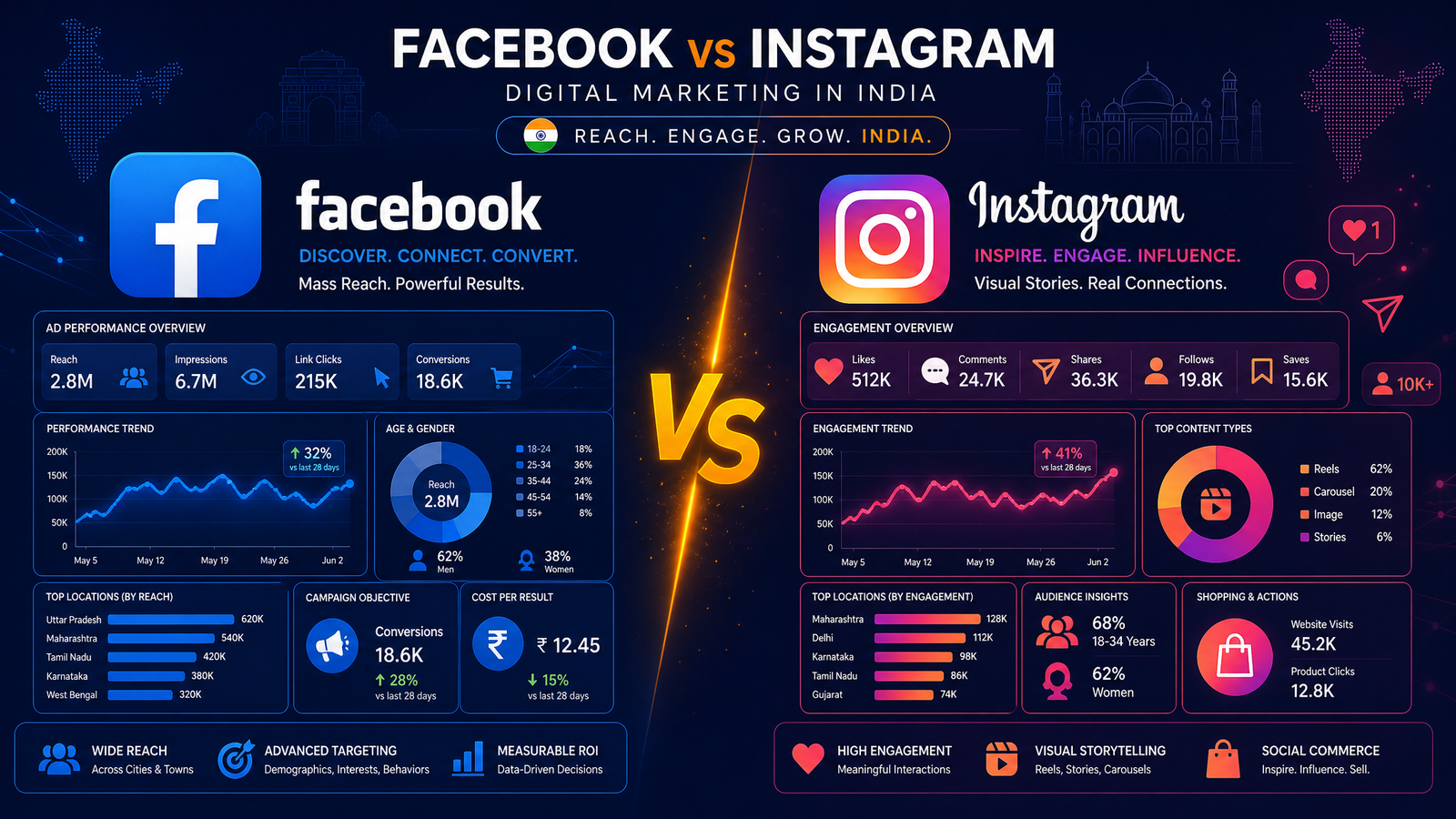
Both platforms are owned by Meta. They share the same ad system. But they serve different purposes, attract different audiences, and work differently for different types of businesses. Spending your entire budget on one without understanding the other is like opening a shop in a crowded market without checking who walks by. For a deeper dive, see Google Ads strategies.
I've worked with over 50 Indian brands on their Meta ad strategies — from e-commerce stores in Mumbai to clinics in Indore to real estate developers in Bhopal. The answer to "Facebook or Instagram?" is never the same for two businesses. But there are patterns. And in this blog, I'm going to lay them out for you with real numbers, real scenarios, and the kind of straight talk you won't get from someone trying to sell you a package.
The Indian Social Media Landscape in 2026
Before we compare the two platforms, let's set the context.
Facebook in India still has over 350 million users. That's massive by any standard. But the growth has flatlined in metro cities. The real growth is happening in tier 2 and tier 3 cities — places like Gorakhpur, Udaipur, Ranchi, and Guwahati. The Facebook user in 2026 is older, more settled, and more likely to be a decision-maker for household and business purchases. For a deeper dive, see Instagram marketing strategy.
Instagram, on the other hand, crossed 400 million users in India and is still growing. The user base skews younger — 18-34 is the sweet spot. The growth is happening across all city tiers, but the engagement levels are significantly higher on Instagram. People spend more time per session on Instagram compared to Facebook.
Here's the crucial difference that most marketers miss: Facebook is a discovery platform for India's "next billion" internet users. Instagram is an aspiration platform for India's urban and semi-urban youth. They serve different parts of your sales funnel.
Audience Demographics: Who's on Each Platform?
Facebook's Indian Audience
The average Facebook user in India in 2026 is between 30-55 years old. They're likely married, have a stable income, and make purchasing decisions for their family. Small business owners, professionals, government employees, and housewives — these are your Facebook users. For a deeper dive, see social media advertising on a budget: getting results w.
Men slightly outnumber women on Facebook in India, but the gap is narrowing. Metro cities like Mumbai, Delhi, and Bangalore have higher female engagement, while tier 2 cities see more male-dominated usage.
What do Facebook users do? They scroll their feed while commuting, check groups for recommendations, browse Marketplace for deals, and engage with content from pages they follow. They're more likely to click on ads that look like news or articles. They trust recommendations from friends and family above everything else.
For businesses, this means Facebook works well for:
- Products and services targeting older demographics (home loans, insurance, real estate)
- B2B services where decision-makers are 35+
- Local service businesses (plumbers, electricians, clinics)
- Products targeting married women (home decor, kitchen appliances, kid's products)
- Automotive, finance, education, and healthcare
Instagram's Indian Audience
Instagram's Indian user base is younger — 18-34 is the core group. College students, young professionals, entrepreneurs, and influencers dominate the platform. Women have a strong presence, especially in beauty, fashion, and lifestyle content.
What sets Instagram users apart is their intent. They're not just scrolling — they're actively looking for inspiration, trends, and products. They follow brands, save posts, and click on shopping tags. The average Instagram user in India has purchased something through the platform in the last six months.
For businesses, Instagram works exceptionally well for:
- Fashion, beauty, and lifestyle brands
- Food and beverage businesses
- Fitness and wellness services
- Travel and hospitality
- Premium and luxury products
- D2C brands targeting young consumers
- Creative services (photography, design, art)
- Event-based businesses
Ad Formats: What's Available and What Works
Facebook Ad Formats
Feed Ads: The classic image or video ad in the news feed. These work well for awareness and consideration. Use high-quality images with minimal text overlay. Facebook's algorithm optimises for the format people engage with most on their feed.
Video Ads: In-feed video ads that autoplay. These are effective for storytelling and demonstrations. Facebook users watch videos with sound on more often than Instagram users — use this to your advantage with narration-heavy content.
Carousel Ads: Multiple images or videos in a single ad unit. Perfect for showcasing multiple products or telling a step-by-step story. Real estate developers love this — show different properties or different rooms in one ad.
Collection Ads: A cover image or video with smaller product images below. When tapped, it opens an Instant Experience (full-screen mobile experience). This is gold for e-commerce brands.
Messenger Ads: Ads that open a conversation in Messenger. High engagement rates because it feels personal. Great for service businesses where consultation is part of the sales process.
Lead Generation Ads: Forms that open within Facebook. User doesn't leave the app. For Indian businesses, this is a game-changer because mobile data can be unreliable. Keeping users in-app means higher completion rates.
Marketplace Ads: Product listings in Facebook Marketplace. Low cost, high relevance for local businesses. Unbelievably underutilised by most Indian brands.
Instagram Ad Formats
Feed Ads: Similar to Facebook but with a key difference — Instagram feed ads need to be visual-first. Text-heavy creatives perform poorly here. The image or video needs to stop the scroll.
Stories Ads: Full-screen vertical ads between user Stories. These disappear after viewing, which creates urgency. Stories ads have some of the highest swipe-up rates among Instagram formats.
Reels Ads: Full-screen vertical video ads that appear between Reels in the Reels tab and in the feed. This is Instagram's fastest-growing ad format. Reels ads get more organic distribution because Instagram boosts Reels content aggressively.
Explore Ads: Appear in the Explore tab when users are actively discovering new content. High intent audience — they're looking for something new. Higher CPC but often higher conversion rates.
Shopping Ads: Product tags that appear in Feed, Stories, and the Shop tab. Users can tap to view product details and purchase. Essential for e-commerce brands on Instagram.
Carousel Ads: Swipeable multiple-image ads. Higher engagement than single-image ads on Instagram. Use for before-after sequences, product ranges, or story sequences.
Cost Comparison: Facebook vs Instagram Ads in India
Let's talk money because that's what everyone actually cares about.
In 2026, the average cost metrics for Indian advertisers look something like this:
Facebook Ads
- CPC (Cost Per Click): ₹8-25 depending on industry
- CPM (Cost Per 1000 Impressions): ₹80-250
- Lead Cost: ₹80-400 per lead (broadly, varies hugely by industry)
- CPA (Cost Per Acquisition): ₹500-3000+
Instagram Ads
- CPC: ₹12-40
- CPM: ₹150-400
- Lead Cost: ₹120-600
- CPA: ₹700-5000+
Instagram ads are generally more expensive per click and per impression. Why? Because engagement rates are higher, demand from advertisers is higher, and the audience is seen as more valuable by most brands.
But here's the thing — higher costs don't mean lower ROI. If Instagram ads convert at 2-3x the rate of Facebook ads for your business, then the higher CPC is worth it. And for many industries, especially fashion, beauty, and D2C, Instagram does convert better.
Why Facebook Can Be Cheaper
Facebook's auction is less competitive for most verticals. There's more inventory (more users, more screen time) and fewer advertisers per user in tier 2 cities. If your target audience includes tier 2 and tier 3 cities, your costs will be significantly lower on Facebook compared to Instagram.
This is why real estate, home services, and education brands often see better ROAS on Facebook. Their target demographic — homeowners, parents, professionals in their 30s and 40s — is saturated on Facebook with less competition from flashy D2C brands.
Which Industries Perform Better on Which Platform?
Based on actual campaign data across hundreds of Indian accounts I've managed or reviewed:
Facebook-First Industries
Real Estate: Facebook dominates. The audience is older, looking for investments, and more likely to engage with detailed property listings. Carousel ads with property photos + lead gen forms = winning combo.
Education and EdTech: Both platforms work, but Facebook has better cost efficiency for lead generation campaigns targeting parents (who are the actual decision-makers for education purchases).
Healthcare and Clinics: Facebook performs better for engagement and appointment bookings from an older demographic. Instagram works for cosmetic procedures and wellness brands targeting younger audiences.
B2B Services: Facebook hands down. The decision-makers in Indian B2B are typically in their 35-55 age range. LinkedIn is ideal but expensive. Facebook is a cost-effective B2B channel many ignore.
Automotive: Facebook wins for mass-market cars. Instagram wins for premium and luxury segments. Two-wheeler brands do well on Instagram because of the younger target audience.
Instagram-First Industries
Fashion and Apparel: Instagram is non-negotiable. Shopping ads + Reels + influencer collaborations = the formula for fashion success. Facebook supports it, but acquisition should start on Instagram.
Beauty and Skincare: Instagram is where beauty lives. Tutorials, before-afters, influencer reviews — this is Instagram's home turf. Facebook works for retargeting existing audiences.
Food and Beverage: Instagram drives discovery. Restaurants, cloud kitchens, packaged food brands all perform better on Instagram's visual-first platform. Stories and Reels showing food being made or served drive immediate cravings.
Fitness and Wellness: Instagram's aspirational nature fits perfectly. Transformation content, workout videos, meal prep shots — all Instagram territory.
Jewellery and Luxury: Instagram Shopping + influencer showcasing wins for jewellery brands. The visual nature of the product demands Instagram's format.
Travel and Hospitality: Stunning visuals drive bookings. Instagram's Explore and Reels are pure gold for travel brands. Facebook serves as a retargeting and remarketing channel.
The Balanced Approach
Most successful Indian brands run a split strategy: Instagram for top-of-funnel (awareness, engagement, new audiences) and Facebook for mid-to-bottom funnel (retargeting, lead generation, conversions).
This makes sense because Instagram is better at discovery and aspiration, while Facebook is better at conversion and retargeting. You catch them on Instagram with beautiful content, then convert them with a Facebook ad that reminds them why they need your product.
Placement Strategy: Beyond Just Feeds
One of Meta's biggest advantages is the placement ecosystem. When you create a campaign, you're not choosing between Facebook and Instagram anymore — you're choosing a combination of placements across Meta's network:
Facebook Feed: Core desktop and mobile feed. Best for detailed content. Good click-through rates.
Facebook Video Feeds: In-stream video ads. Good for longer-form video content. Lower CPMs than feed.
Facebook Marketplace: Listing-style ads. Low cost, local intent. Underused by most advertisers.
Instagram Feed: Visual-first, scroll-stopping content needed. Higher engagement but also higher competition.
Instagram Stories: Full-screen vertical. High swipe-up rates. Best for time-sensitive offers and retargeting.
Instagram Reels: Full-screen vertical, loop content. Newest placement, still has lower CPMs as Meta pushes adoption. This is where you should be testing your video content aggressively.
Messenger: Inbox ads. Personal feeling, high engagement. Best for businesses that can handle conversation-based sales.
Audience Network: Third-party apps and websites. Extensive reach but lower quality traffic. Use with caution — good for awareness, bad for conversion unless carefully managed.
The Smart Placement Strategy
Don't use "Automatic Placements" blindly. Meta's algorithm will spend your budget wherever it's cheapest, which often means Audience Network and low-quality placements.
Instead, manually select placements that match your campaign objective:
- Awareness campaigns: Instagram Feed + Reels + Explore
- Engagement campaigns: Instagram Stories + Feed
- Conversion campaigns: Facebook Feed + Instagram Feed + Messenger
- Retargeting: Facebook Feed + Instagram Stories + Messenger
Test and refine. Start broad, kill the losers, double down on winners.
Should You Split Your Budget or Focus on One?
This is the million-rupee question. Here's my honest answer:
Go Facebook-Only If:
- Your target audience is 35+ years old
- You're in B2B, real estate, education, or healthcare
- Your product requires detailed explanation
- Your customers are in tier 2/3 cities
- You have limited budget (under ₹50,000/month)
- Your business runs on relationship and trust over impulse
Go Instagram-Only If:
- Your target audience is 18-30 years old
- You're in fashion, beauty, food, or lifestyle
- Your product is visual and impulse-driven
- You have strong content creation capabilities
- You're building a brand, not just selling a product
- Your customers are in metro cities and tier 1 cities
Split Your Budget If:
- You have a budget of ₹1 lakh or more per month
- Your product appeals to both young and older demographics
- You want to use Instagram for awareness and Facebook for conversion
- You're running retargeting across both platforms
- Your business model combines online and offline (retail + e-commerce)
A common split that works: 60% Instagram, 40% Facebook for D2C brands. 70% Facebook, 30% Instagram for service businesses and B2B. These are starting points — test and adjust based on data.
Real Indian Market Scenarios
Scenario 1: Jaipur Jewellery Brand
A mid-range jewellery brand wanted to increase online sales. Target audience: women 25-45 in metro and tier 1 cities. Budget: ₹1.5 lakhs/month.
We ran Instagram-heavy for the first two months — Reels showcasing products, Shopping tags, Stories with limited-time offers. Cost per acquisition was ₹1,200 on Instagram. Good, but not great.
Added Facebook retargeting in month three. Users who engaged on Instagram but didn't buy got Facebook ads with testimonials and trust signals. CPA dropped to ₹780. Combined strategy won.
Lesson: Instagram for top of funnel, Facebook for retargeting.
Scenario 2: Indore Real Estate Developer
A developer launching a new residential project. Target audience: families and investors 30-55 in Indore and nearby cities. Budget: ₹3 lakhs/month.
Pure Facebook approach — Carousel ads showing project renderings, Lead Gen forms for site visit bookings, detailed description of amenities. CPA per site visit: ₹450. Extremely profitable.
Instagram was tested for brand awareness but the cost per lead was 2.5x higher. Facebook dominated.
Lesson: Real estate is Facebook territory. Don't fight the algorithm.
Scenario 3: Mumbai D2C Skincare Brand
Young brand targeting women 22-35. Budget: ₹80,000/month.
Instagram-first approach. Reels with skincare routines, influencer collaborations, Shopping tags. Strong organic growth combined with paid. But conversions were inconsistent — high engagement, moderate sales.
Added Facebook catalog sales campaigns with dynamic product ads. People who browsed products on Instagram but didn't buy saw Facebook ads with price drops or reviews. Conversion rate doubled.
Lesson: Instagram builds desire. Facebook closes the deal.
Setting Up Your Campaign Structure
Whether you choose Facebook, Instagram, or both, your campaign structure matters more than most people think.
Campaign Level: Set your objective (awareness, consideration, or conversion). Don't get creative here — pick the objective that matches your funnel stage.
Ad Set Level: This is where the magic happens. Define your audience, placements, budget, and schedule. One audience per ad set. Don't mix different targeting options in the same ad set.
Ad Level: Your creative and copy. Test multiple creatives per ad set. Let Meta's algorithm find the winner.
Budget Recommendations
Start small. ₹500-1000 per day per ad set. Let the algorithm learn for 3-5 days. Then scale winners by 20-30% every 3-4 days. Don't double budgets overnight — it resets the learning phase.
For Indian businesses, the sweet spot for testing is usually:
- Facebook CBO (Campaign Budget Optimisation): ₹15,000-30,000/month for meaningful data
- Instagram standalone campaigns: ₹10,000-25,000/month minimum
- Combined strategy: ₹40,000/month at minimum for both platforms
Common Mistakes Indian Brands Make
Using the Same Creative for Both Platforms. Facebook users read more. Instagram users look more. Your ad copy for Facebook can be 2-3 lines. Instagram copy should be shorter, punchier, and the visual should do most of the work.
Targeting Too Broad. "Women in India, age 18-65" is not a targeting strategy. You'll waste 80% of your budget. Layer interests, behaviours, and demographics.
Ignoring Mobile-First Design. 98% of Facebook and Instagram users in India access via mobile. Your creative should be mobile-first (vertical format, readable text, clear CTA button).
Not Using Retargeting. Most first-time visitors don't buy. If you're not retargeting them, you're burning money. Set up retargeting audiences from day one.
Judging Results Too Early. Give campaigns at least 7 days before making decisions. The learning phase needs data. Killing campaigns after 2 days is like planting a seed and digging it up to check if it's growing.
Not Tracking Conversions Properly. If you're not using the Meta Pixel or Conversions API properly, you're flying blind. Set up tracking before you spend a single rupee.
📚 Related Articles You Might Like:
Conclusion
There's no universal answer to "Facebook or Instagram?" The right answer depends on your business, your audience, your product, and your goals. But here's what I can tell you with confidence:
Facebook is a workhorse. It's reliable, cost-effective for the right audiences, and excellent for conversion-focused campaigns targeting older demographics. Instagram is an engine for brand building, discovery, and impulse purchases targeting younger, aspirational audiences.
The smartest Indian brands don't pick one over the other. They use both strategically — Instagram to attract and engage, Facebook to convert and retain. Test both, measure everything, and let data guide your budget allocation.
Need someone to set up, manage, and optimise your Meta ad campaigns? At VidyaSaaS, we've run over ₹5 crores in ad spend across Facebook and Instagram for Indian businesses. We know what works and what doesn't. Check out our Performance Marketing services or get in touch for a custom strategy built around your business goals.
Want Results Like This?
Get a free digital marketing audit and custom growth plan for your business.
Get Free AuditVidyaSaaS Team
Super AdministratorPart of the VidyaSaaS team — a group of digital marketing strategists, content specialists, and growth experts helping businesses across India achieve measurable results through data-driven marketing.
More about our teamRelated Articles
Handpicked content to help you grow your business
Kolhapur Footwear to Film City: Social Media Marketing for Maharashtra Cultural and Industrial Hub
Kolhapur chappals are worn across India. Its film industry produces 30+ Marathi films yearly. But it...
Tirunelveli Temple to Tech: Social Media Marketing for Tamil Nadu Education and Industry Hub
Tirunelveli Nellaiappar Temple has stood for 1300 years. Its engineering colleges produce thousands...
Beyond Krishna's Land: Social Media Marketing for Mathura's Pilgrimage Economy, Sweet Shops & Handloom Industry
Mathura's pedas are legendary, its temples are world-famous, and its handloom has adorned deities fo...
Ready to Grow Your Business?
Let's discuss how we can create a data-driven digital marketing strategy tailored to your goals.