Google Ads vs Meta Ads: Which Platform Should Your Business Use?
Google Ads or Meta Ads? Compare intent vs interest-based advertising, costs, targeting, and formats. Find the right platform for your Indian business in 2026.
VidyaSaaS Team
Super Administrator
Introduction
A restaurant owner in Nagpur once asked me a question I hear constantly: "Should I advertise on Google or Facebook? I have a limited budget and can only pick one."
It's the wrong question.
The right question is: "What do I want my advertising to achieve?"
Google Ads and Meta Ads (Facebook and Instagram) are fundamentally different advertising systems. They serve different purposes, reach users in different mindsets, and deliver different types of results. Choosing between them based on which is "better" is like asking whether a hammer is better than a screwdriver. Depends on what you're building. For a deeper dive, see calculate your ROAS.
In this guide, I'll break down exactly how Google Ads and Meta Ads work, when to use each, how costs compare in the Indian market, and how to decide where your advertising budget goes.
The Fundamental Difference: Intent vs Interest
Everything flows from one core distinction. For a deeper dive, see Instagram marketing strategy.
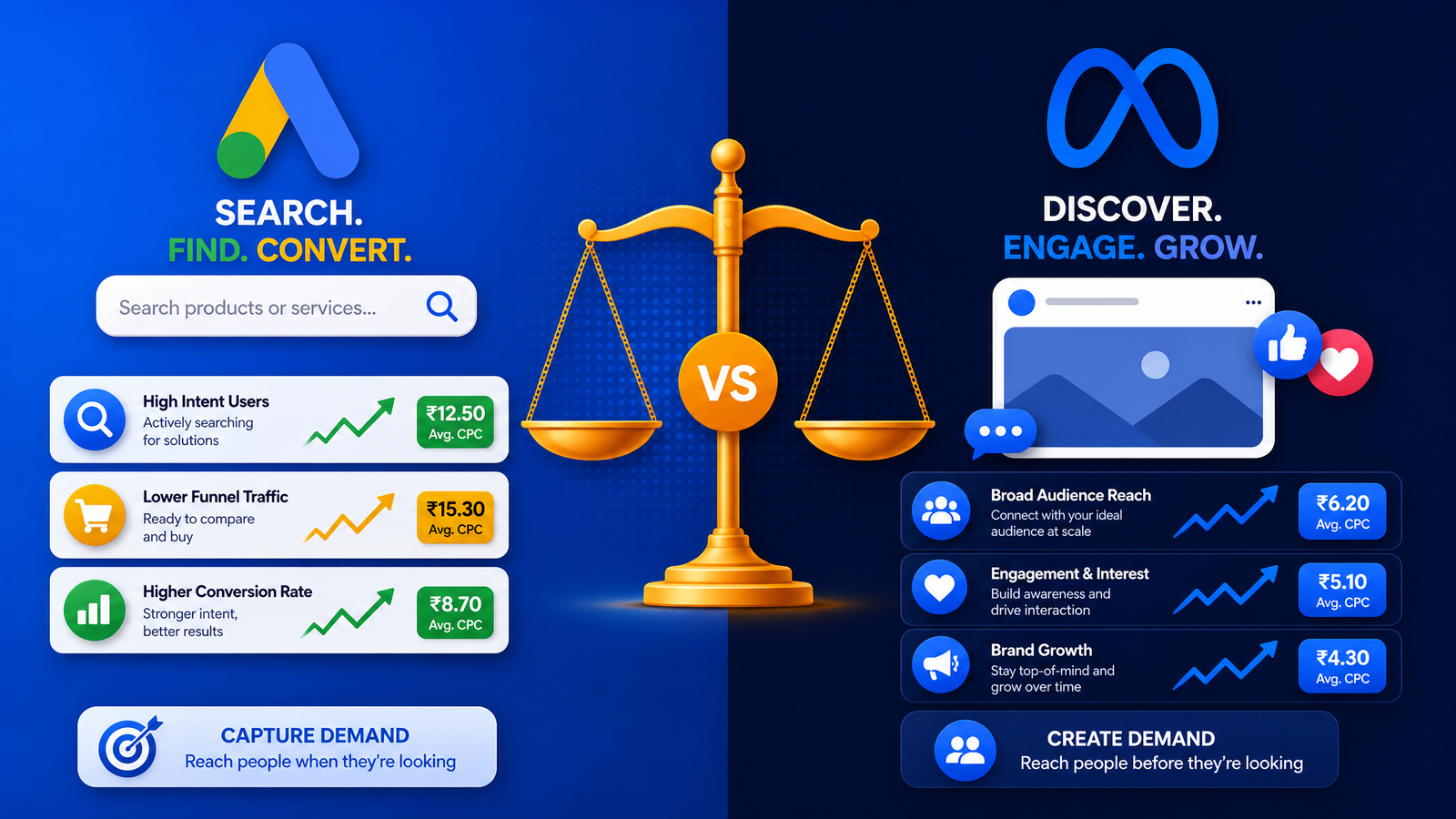
Google Ads: Intent-Based Advertising
When someone searches on Google, they have intent. They're looking for something specific:
- "Buy running shoes online"
- "AC repair near me"
- "Best digital marketing agency in Bhopal"
They've already decided they need something. They're actively looking for a solution. Your ad appears when they're ready to buy or book.
This intent makes Google Ads conversion-friendly. When someone clicks your search ad, they're already in "consideration" or "purchase" mode. You're not convincing them they need something — you're showing them you have what they're already looking for. For a deeper dive, see Google Ads strategies.
Best for: capturing demand that already exists.
Meta Ads: Interest-Based Advertising
When someone scrolls through Instagram or Facebook, they have zero intent related to advertising. They're there to see friends' photos, watch videos, read articles, and be entertained.
Your ad interrupts their scrolling. To work, it needs to be compelling enough to grab attention, interesting enough to earn a click, and convincing enough to create a desire for something they weren't looking for.
Meta's targeting is based on demographics, interests, behaviors, and lookalike audiences — not on real-time search intent.
Best for: creating demand that doesn't yet exist.
Google Ads in Detail
Campaign Types
Google Ads offers several campaign types:
Search Campaigns: Text ads that appear when someone searches for your keywords. This is the most common and most intent-driven option. You bid on keywords, write ad copy, and pay when someone clicks.
Display Campaigns: Visual banner ads that appear on websites across Google's Display Network (millions of sites). Lower intent but broader reach and lower cost.
Shopping Campaigns: Product listing ads that show product images, prices, and store names directly in search results. Essential for ecommerce stores.
Video Campaigns: Ads that run on YouTube before, during, or after videos. Good for brand awareness and demonstration.
Performance Max: Google's AI-driven campaign type that automatically distributes your ads across Search, Display, YouTube, Discover, and Gmail based on your goals.
How Google Ads Works for Indian Businesses
For a local business in India, Google Ads typically works best with Search and Local campaigns. When someone searches "pest control in Indore," your ad can appear above organic results. If your Google Business Profile is optimized, Local Service Ads can appear even above search ads.
Advantages for Indian businesses:
- Captures high-intent traffic (people ready to buy)
- Works for any business model (service, ecommerce, B2B, local)
- Very measurable — every rupee tracked
- Can start small — ₹300-500 per day minimum
Disadvantages:
- Can be expensive in competitive industries
- Requires ongoing optimization (not set-and-forget)
- Limited by search volume (if nobody searches, nobody sees your ad)
Meta Ads in Detail
Ad Formats
Meta Ads (Facebook + Instagram) offers multiple formats:
Image Ads: Single image with text, headline, and call-to-action. Simple and effective.
Video Ads: Short video content. Higher engagement rates than images on both Facebook and Instagram.
Carousel Ads: Multiple images or videos in a single ad that users can swipe through. Good for showcasing multiple products or telling a story.
Collection Ads: Mobile-only format that combines a cover video or image with multiple product images below.
Reels Ads: Full-screen vertical video ads on Instagram Reels. High engagement, especially with younger audiences.
Stories Ads: Full-screen vertical ads that appear between user stories.
Targeting Options
Meta's targeting is its superpower:
Demographic targeting: Age, gender, location, education, job title, relationship status.
Interest targeting: Based on what users like, follow, engage with on Facebook and Instagram. You can target "people interested in fitness" for a gym ad.
Behavior targeting: Purchase behavior, device usage, travel patterns.
Custom audiences: Upload your email list or website visitor data to target people who already know your business.
Lookalike audiences: Meta finds users similar to your existing customers. One of the most effective targeting options.
How Meta Ads Works for Indian Businesses
Meta is huge in India. Facebook has over 300 million Indian users; Instagram has over 250 million. The platform is particularly strong for:
- Consumer brands (clothing, beauty, home decor, food)
- Visual businesses (travel, hospitality, real estate, weddings)
- Local services & small businesses (through location targeting)
- Ecommerce (product catalogs, dynamic ads, shop integration)
Advantages for Indian businesses:
- Massive reach in India
- Sophisticated targeting options
- Lower CPC than Google on average
- Strong for visual brands
- Retargeting capabilities are excellent
Disadvantages:
- Users aren't actively looking to buy
- Results depend heavily on creative quality
- Algorithm changes can tank performance overnight
- Less forgiving for inexperienced advertisers
Cost Comparison: Google Ads vs Meta Ads in India
This is where the answer gets specific to India. Costs vary by platform, industry, location, and competition.
Google Ads Costs in India
| Campaign Type | Avg CPC (India) | Notes | |--------------|-----------------|-------| | Search (local services) | ₹20-80 | Lower in small cities, higher metros | | Search (competitive like insurance, loans) | ₹100-300+ | Very competitive terms can cost more | | Display Network | ₹2-15 | Much cheaper but lower intent | | Shopping | ₹5-30 | Depends on product category and competition | | YouTube | ₹0.50-5 per view | Cost-per-view pricing |
Meta Ads Costs in India
| Ad Format | Avg CPC / CPM | Notes | |-----------|---------------|-------| | Facebook Feed (CPC) | ₹5-20 | Lower cost, broad reach | | Instagram Feed (CPC) | ₹8-30 | Higher engagement, slightly higher cost | | Instagram Reels (CPM) | ₹50-150 per 1000 impressions | Growing format, competitive | | Facebook Stories (CPM) | ₹30-80 per 1000 impressions | Lower cost, higher frequency | | Retargeting (Meta) | ₹3-10 | Much cheaper than cold audience targeting |
General Cost Comparison
For most Indian businesses:
- Google Ads (Search): ₹20-80 CPC range
- Meta Ads (Feed): ₹5-20 CPC range
Meta is generally cheaper per click. But "cheaper" doesn't mean better ROI. The intent difference means a ₹50 Google click might convert at 10%, while a ₹10 Meta click converts at 1%. The Google click delivers a lower cost per lead despite higher CPC.
The metric that matters is cost per acquisition (CPA), not cost per click. Track what you actually pay per customer, not per click.
When to Use Google Ads
Your business is a service
Plumber, electrician, dentist, lawyer, gym, spa, salon — Google Ads captures people actively searching for your service. When someone Googles "emergency plumber in my area," they need a plumber now. Your ad at that moment is pure value.
You have a high-intent product
People searching for "buy iPhone 15 Pro online" have intent to purchase. Google Shopping ads are perfect for this.
Customers search for your category
If your industry has high search volume — "digital marketing agency," "interior designers in Bangalore," "Wedding photographers in Pune" — Google Ads lets you capture that existing demand.
You want measurable, trackable results
Google Ads integrates with Google Analytics seamlessly. Every click, call, and conversion is trackable. You know exactly where every rupee went and what it delivered.
When to Use Meta Ads
Your product is visually appealing
Clothing, jewelry, home decor, beauty products, food, travel — products that look good perform well on Instagram and Facebook.
You need to build brand awareness
If people don't know they need your product yet, Meta Ads can introduce them. A boutique skincare brand can target "women interested in organic beauty products" and showcase their products in Reels.
You have a compelling story or offer
Meta Ads reward creative content. If you can tell a story, demonstrate a benefit, or create an irresistible offer, Meta delivers.
You run an ecommerce store
Meta's dynamic product ads (DPA) and catalog sales campaigns are powerful for ecommerce. Users who visited your site but didn't buy can be retargeted with the exact products they viewed.
You want to retarget website visitors
This is where Meta excels. A user visits your website, doesn't buy, then sees your ad on Instagram later. Retargeting via Meta can dramatically improve conversion rates.
When to Use Both
For many Indian businesses, the answer isn't "either/or" — it's "both, but for different purposes."
The Funnel Strategy
Top of Funnel (Awareness) — Meta Ads:
- Reach new audiences who don't know you
- Build brand awareness with engaging content
- Drive traffic to your website or blog
- Collect audiences for retargeting
Middle of Funnel (Consideration) — Both:
- Google Search captures people researching your category
- Meta retargets people who visited your site
- Both platforms can nurture interest
Bottom of Funnel (Conversion) — Google Ads:
- Google Search captures purchase intent
- Google Shopping for product searches
- Maximize conversions from high-intent traffic
Example: A Real Estate Developer
A real estate developer in Pune could run:
Meta Ads: Instagram Reels showcasing property video tours. Facebook ads targeting "people interested in real estate" and "expats or working professionals in Pune." These build brand awareness and drive site visits.
Google Ads: Search ads for "apartments in Hinjewadi Pune" and "3 BHK flats in Kharadi." These capture people actively looking to buy. Also retargets site visitors who watched the video tours.
The result: Meta builds awareness and consideration. Google captures the conversion when the user is ready to book a site visit.
Indian Market Benchmarks
CPC Benchmarks by Industry (India, approximate)
| Industry | Google Ads Avg CPC | Meta Ads Avg CPC | |----------|-------------------|------------------| | Local Services | ₹25-60 | ₹8-18 | | Healthcare | ₹60-150 | ₹15-30 | | Education | ₹20-50 | ₹8-20 | | Real Estate | ₹40-100 | ₹12-25 | | Ecommerce (General) | ₹15-30 | ₹5-15 | | Finance/Insurance | ₹100-300 | ₹25-60 | | B2B Services | ₹50-120 | ₹15-35 | | Travel/Hospitality | ₹20-50 | ₹8-18 |
CTR Benchmarks
- Google Search Ads: 3-6% average CTR (higher for well-optimized ads)
- Google Display Ads: 0.3-0.8%
- Meta Feed Ads: 0.5-2%
- Meta Reels Ads: 1-3% (higher engagement)
Common Mistakes Indian Businesses Make
Mistake 1: Running the same ad on both platforms
Search intent and social intent are different. A Google ad that says "Best AC Repair in Delhi" works because someone searched for AC repair. The same copy on Instagram, where nobody searched for AC repair, makes no sense.
Fix: Write platform-specific ad copy. Google ads highlight relevance and solve the search query. Meta ads need to grab attention and create interest.
Mistake 2: Ignoring ad extensions (Google)
Google Search Ads support extensions — sitelinks, call buttons, location info, structured snippets. Many Indian advertisers skip these. Using all relevant extensions can improve CTR by 10-30%.
Mistake 3: Not using retargeting
Most website visitors don't convert on their first visit. If you're not retargeting them on Meta (or Google Display), you're leaving money on the table.
Mistake 4: Setting and forgetting
Both platforms require optimization. Poor-performing keywords need pausing. Winning audiences need increased budget. Creative needs refreshing. Every week, you should be making adjustments.
Mistake 5: Starting with too broad targeting
On Meta, targeting "everyone in Delhi" for a premium product is waste. Narrow your audience. On Google, using broad match keywords without negative keywords burns budget on irrelevant searches.
Mistake 6: Ignoring mobile
Over 75% of Google searches in India and over 90% of Meta usage in India happens on mobile. Your ad creative, landing pages, and checkout flow must be mobile-optimized.
How to Test and Decide
Not sure which platform suits your business? Here's a structured test:
- Set a test budget — ₹15,000 total (₹7,500 each platform)
- Run both for 30 days with well-optimized campaigns
- Track: Cost per lead, quality of leads, conversion rate
- Compare: Which platform delivered better results for your specific goal?
- Shift budget: Allocate 70% to the better performer, 30% to testing improvements on the other
Every business is different. A real estate agent might find Google Ads delivers premium leads while Meta brings in lower-quality inquiries. A fashion brand might find Meta drives 80% of sales while Google does nothing. Test and measure.
📚 Related Articles You Might Like:
Conclusion
The restaurant owner from Nagpur? She ended up doing both — but differently. Google Ads for "best pure veg restaurant Nagpur" and "family restaurant in Dharampeth" captured immediate dining search intent. Meta Ads showcased her restaurant's ambiance and food photography on Instagram, building brand awareness and driving reservations through Reels.
Each platform cost her about ₹12,000 per month. Google delivered immediate inquiries. Meta built a following that grew over time. Together, they transformed her restaurant's digital presence.
Google Ads and Meta Ads aren't competitors. They're tools for different jobs. Google captures demand. Meta creates it. Smart advertisers use both.
At VidyaSaaS, we help Indian businesses build performance marketing strategies that combine the right platforms for their specific goals. Our performance marketing services cover both Google and Meta (plus LinkedIn Ads for B2B) — custom-built for each client.
Ready to find the right advertising mix for your business? Contact VidyaSaaS for a free performance marketing consultation. We'll analyze your business, competitors, and goals to recommend the right platform mix. Call +91 97542 70102 or email info@vidyasaas.com.
Want Results Like This?
Get a free digital marketing audit and custom growth plan for your business.
Get Free AuditVidyaSaaS Team
Super AdministratorPart of the VidyaSaaS team — a group of digital marketing strategists, content specialists, and growth experts helping businesses across India achieve measurable results through data-driven marketing.
More about our teamRelated Articles
Handpicked content to help you grow your business

Hubli-Dharwad Twin Cities Digital: Performance Marketing for Karnataka Commercial Capital
Hubli-Dharwad is called Chota Mumbai for its commercial intensity. But its 5,000 MSMEs barely use Go...

Jamnagar Brass to Reliance: Performance Marketing for Gujarat Industrial and Marine Giant
Jamnagar hosts the world largest oil refinery and a 500-year-old brass industry. But its businesses...

Kakinada Port to Profit: Performance Marketing for Andhra Energy and Aquaculture Economy
Kakinada supplies 40% of India seafood exports and hosts the KG Basin gas operations. Yet most busin...
Ready to Grow Your Business?
Let's discuss how we can create a data-driven digital marketing strategy tailored to your goals.