
Influencer Marketing in India 2026: Nano, Micro, and Macro — Which Tier Is Right for You?
A complete guide to influencer marketing in India for 2026. Compare nano, micro, macro, and mega influencers — cost, engagement, ROI, and how to choose the right tier.
VidyaSaaS Team
Super Administrator
Introduction
Influencer marketing in India has grown from a experimental budget line item to a core marketing channel. By 2026, the Indian influencer marketing industry is estimated to cross ₹3,000 crore. Brands across every sector — from D2C startups to traditional FMCG companies — are allocating significant portions of their marketing budget to influencer collaborations.
But here's the problem most businesses face. They see a celebrity with 5 million followers charging ₹20 lakhs for a post and think "that's influencer marketing." Or they see a friend with 2,000 followers getting a free product and think "that's not real marketing."
Both perspectives are incomplete. The Indian influencer ecosystem has matured into distinct tiers, each serving a different purpose and delivering different results. The key is understanding which tier fits your business goals, budget, and target audience.
This guide breaks down everything — nano, micro, macro, and mega influencers — with real cost data, engagement benchmarks, and a framework to choose the right tier for your Indian business.
The Indian Influencer Ecosystem: An Overview
India's influencer ecosystem is massive and growing. Let's look at the numbers.
Market Size
The Indian influencer marketing industry has grown from roughly ₹900 crore in 2021 to an estimated ₹3,000+ crore in 2026. That's over 3x growth in five years. For comparison, traditional advertising in India has grown at barely 8-10% annually over the same period. For a deeper dive, see Instagram marketing strategy.
Platform Distribution
- Instagram: Still the dominant platform for influencer marketing in India. 75% of influencer campaigns involve Instagram. Reels content drives the highest engagement.
- YouTube: Second-largest platform, especially for long-form content, reviews, and tutorials. Strong for tech, education, automotive, and beauty.
- Moj/Josh/ShareChat: Short-video platforms that exploded after TikTok's ban. Massive reach in tier-2 and tier-3 cities. Lower CPE (cost per engagement) but different content quality standards.
- LinkedIn: Growing fast for B2B influencer marketing. Thought leadership content, industry insights.
- Facebook: Declining for influencer content but still relevant for older demographics and community groups.
The Creator Economy Shift
The biggest change in 2025-2026 is the professionalization of content creation. Ten years ago, influencers were accidental — people who got popular online and brands approached them. Today, thousands of Indians treat content creation as a full-time career. They have media kits, rate cards, agents, and content teams. This professionalization has made influencer marketing more reliable and measurable.
The Four Tiers of Influencers in India
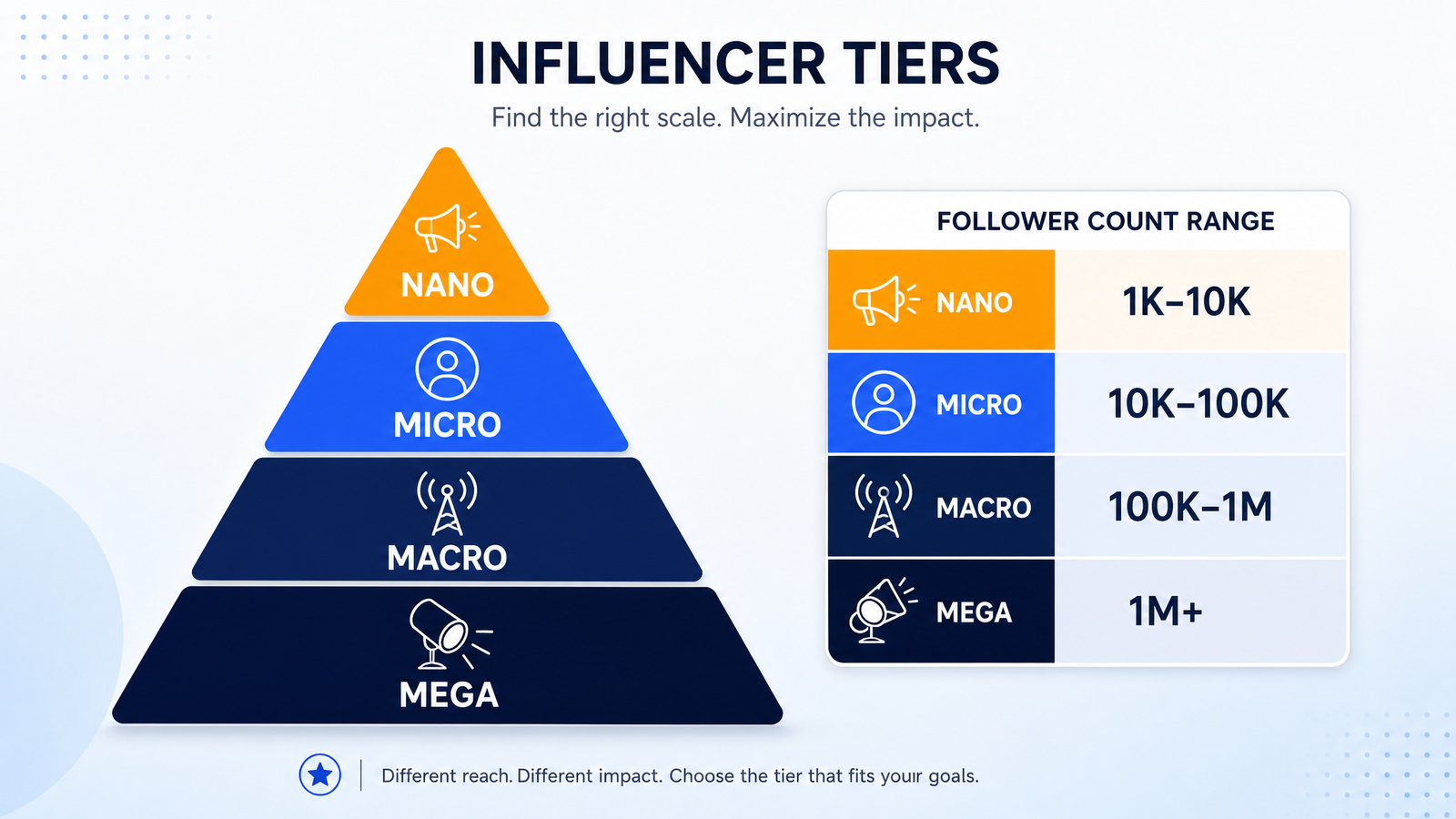
Let's define the tiers clearly. The follower count boundaries are approximate — different agencies use slightly different cutoffs — but the strategic differences are real.
Nano Influencers: 1,000 - 10,000 Followers
Who they are: Local creators, niche experts, real people with genuine followings. Often they're your actual customers — people who love your product and naturally share about it.
Cost per post in India (2026):
- Instagram post: ₹500 - ₹3,000
- Instagram Reel: ₹1,000 - ₹5,000
- YouTube video: ₹2,000 - ₹8,000
- Free product + ₹0-₹500 (many will work for product only)
Average engagement rate: 3-7% (highest of any tier) Follower trust level: Very high. Nanos know most of their followers personally or through direct interaction.
Why they work:
- Highest engagement rates in the ecosystem. Followers actually respond to their content.
- Most affordable. You can run 20 nano campaigns for the cost of one macro post.
- Best for hyperlocal targeting. A nano influencer in Indore reaches people in Indore.
- Authenticity. Nano content looks and feels real. It's not a polished ad. It's a recommendation from a friend.
Best for:
- Local businesses (restaurants, clinics, boutiques, salons)
- Product seeding and reviews
- Building grassroots buzz in specific locations
- Cost-efficient content creation (you can use nano content on your own channels too)
- Testing new products or markets with minimal risk
Micro Influencers: 10,000 - 100,000 Followers
Who they are: Niche authorities who have built serious credibility in specific areas. Food bloggers in Mumbai, fashion stylists in Delhi, tech reviewers in Bangalore, fitness coaches in Pune. They're not celebrities, but in their niche, they're well-known.
Cost per post in India:
- Instagram post: ₹3,000 - ₹15,000
- Instagram Reel: ₹5,000 - ₹25,000
- YouTube video: ₹8,000 - ₹40,000
- Brand ambassadorship (3-6 months): ₹50,000 - ₹2,00,000
Average engagement rate: 2-5% Follower trust level: High. Micro influencers engage actively with their followers and have built a community, not just an audience.
Why they work:
- The sweet spot of influencer marketing. You get genuine engagement at a reasonable price.
- Niche authority. A micro influencer with 25,000 followers who specializes in vegan skincare has more influence over that specific purchase decision than a celebrity with 5 million followers.
- Better content quality than nanos. They've invested in their craft.
- More reliable deliverables. Most micro influencers understand brand collaborations and meet deadlines.
Best for:
- D2C brands looking to enter specific niches
- Product launches in a specific category
- Building category authority (e.g., "the best running shoes for Indian roads")
- Regional campaigns targeting specific cities or states
- Brands with moderate budgets (₹1-5 lakhs/month for influencer marketing)
Macro Influencers: 100,000 - 1 Million Followers
Who they are: Well-known creators with significant reach. They're often full-time content creators with teams. Think top-tier food bloggers, popular lifestyle vloggers, established tech reviewers.
Cost per post in India:
- Instagram post: ₹15,000 - ₹1,00,000
- Instagram Reel: ₹20,000 - ₹1,50,000
- YouTube video: ₹40,000 - ₹3,00,000
- Integrated campaign (multiple posts + stories): ₹1,00,000 - ₹5,00,000
Average engagement rate: 1-3% (noticeably lower than micro/nano) Follower trust level: Moderate. Followers know they're following a professional creator. Endorsements are seen as paid partnerships, not personal recommendations.
Why they work:
- Scale. A macro influencer puts your brand in front of hundreds of thousands of people in one post.
- Professional content. These creators produce high-quality photos, videos, and editing.
- Social proof. Being featured by known creators adds prestige to your brand.
- Platform algorithms favor them. Their content gets pushed to explore pages and recommended feeds.
Best for:
- Brand awareness campaigns at scale
- New product launches in competitive categories
- Building brand credibility through association
- National or multi-city campaigns
- Brands with budgets of ₹3-15 lakhs/month for influencer marketing
The catch: Engagement drops as followers increase. A macro influencer's endorsement carries less personal weight. Followers know it's a paid promotion. The value is in reach and awareness, not conversion.
Mega Influencers / Celebrities: 1 Million+ Followers
Who they are: National celebrities — Bollywood actors, cricketers, top YouTube creators with millions of subscribers, and Instagram celebrities.
Cost per post in India:
- Instagram post: ₹2,00,000 - ₹25,00,000+
- YouTube video: ₹5,00,000 - ₹50,00,000+
- Integrated brand campaign: ₹10,00,000 - ₹1,00,00,000+
Average engagement rate: 0.5-1.5% (lowest of any tier) Follower trust level: Low for endorsements. Followers are fans, not buyers. A celebrity endorsing a product doesn't make followers want to buy it — it just makes them aware of it.
Why they work (and when they don't):
- Unmatched reach. One post from a Bollywood star reaches more people than 100 micro influencer campaigns combined.
- Massive credibility boost. Having a celebrity associated with your brand changes how other brands and media perceive you.
- However, conversion rates are typically poor. Celebrity endorsements build awareness, not sales. The ROI calculation is completely different.
Best for:
- National brand awareness campaigns
- Market entry — establishing a new brand in consumers' minds
- Long-term brand ambassadorship (not one-off posts)
- Businesses with massive marketing budgets (₹50 lakhs+/month)
Important warning: For most Indian businesses — even successful ones — mega influencers are not the right choice. The cost per conversion is almost always higher than using micro or nano tiers. Mega influencers are for brand building at scale, not for sales generation.
Engagement Rate Comparison by Tier
Let's look at what the data actually says about engagement rates across tiers in India.
| Tier | Followers | Avg Engagement Rate | Cost per 1,000 Engagements | |------|-----------|---------------------|---------------------------| | Nano | 1K-10K | 3-7% | ₹200-₹800 | | Micro | 10K-100K | 2-5% | ₹1,000-₹3,000 | | Macro | 100K-1M | 1-3% | ₹3,000-₹10,000 | | Mega | 1M+ | 0.5-1.5% | ₹10,000-₹50,000 |
Key insight: Nano influencers deliver the most cost-efficient engagement. The cost per 1,000 engagements with nano influencers can be 10-25x cheaper than with mega influencers.
But engagement isn't everything. A mega influencer's post creates brand awareness across 2 million people. That has value beyond comments and likes — it creates top-of-funnel attention that nano campaigns simply cannot match.
How to Choose the Right Tier for Your Business
The tier you should choose depends on three factors: your budget, your goal, and your target audience.
Decision Matrix
If your budget is under ₹50,000/month: Your only realistic option is nano influencers, and possibly a few micro influencers. Focus on nano creators who are your actual customers or operate in your local area. 10 nano collaborations at ₹2,000 each + 5 micro at ₹5,000 each = ₹45,000. That's a viable month of influencer marketing.
If your budget is ₹50,000 - ₹2,00,000/month: You can work with a mix of micro and nano. Prioritize micro influencers for your core campaign and supplement with nanos for broader reach. A typical split: 5 micro influencers (₹75,000) + 15 nano influencers (₹45,000) = ₹1,20,000.
If your budget is ₹2,00,000 - ₹10,00,000/month: You can add macro influencers to your mix. Run a flagship campaign with 1-2 macro influencers for awareness, supported by 10-15 micro influencers for depth and credibility. Example: 1 macro (₹1,00,000) + 10 micro (₹1,00,000) + 20 nano (₹50,000) = ₹2,50,000.
If your budget is ₹10,00,000+/month: You can consider mega influencers. At this level, you're running national campaigns. The structure might be: 1 mega influencer (₹5,00,000) + 3 macro (₹3,00,000) + 15 micro (₹1,50,000) + 30 nano (₹60,000) = ₹10,10,000.
By Marketing Goal
Goal: Local awareness and foot traffic Best tier: Nano + Micro
Goal: Product launch in a specific category Best tier: Micro + Macro (Micro for credibility, Macro for reach)
Goal: National brand awareness Best tier: Macro + Mega
Goal: Direct sales and conversions Best tier: Nano + Micro (highest engagement = highest conversion)
Goal: Content creation for your own channels Best tier: Micro (best quality-to-cost ratio for UGC-style content)
Finding the Right Influencer
Finding the right influencer matters more than choosing the right tier. A wrong influencer at any tier wastes your money.
Where to Find Influencers in India
Influencer Marketing Platforms:
- Pulpkey — One of India's largest influencer marketplaces. Good discovery tools.
- Buzzoka — Focused on micro and nano influencers.
- Qoruz — Data-driven platform with analytics.
- Baron — Good for mid-sized campaigns.
- Chtrbox — Enterprise-focused with India's largest influencer database.
Manual Discovery:
- Search relevant hashtags on Instagram: #[yourcity]foodie, #[yourcategory]india, #[yourcity]blogger
- Look at competitors' tagged posts to see who they work with
- Check YouTube comments for creators whose audiences match yours
- Ask for recommendations in industry groups and forums
Vetting Process
Don't approve an influencer based on follower count alone. Run these checks:
1. Engagement quality. Look at comments. Are they genuine? "Nice pic" from random accounts is a red flag. Meaningful comments from real profiles is a good sign.
2. Engagement rate. Calculate it: average likes + comments per post / followers x 100. Below 1% is suspicious, especially for micro and nano tiers. Use tools like Qoruz or Heepsy to check.
3. Follower quality. Check for bot followers. Tools like HypeAuditor can give you a follower quality score. Manually, look for accounts with 0 posts, 0 followers, and generic profile pictures in the follower list.
4. Content relevance. Does their content style match your brand? A fashion influencer who posts edgy content won't be right for a traditional jewelry brand, even if their demographics match.
5. Past brand collaborations. Look at their tagged posts. Do they work with relevant brands? How does their audience respond to paid content? An influencer whose sponsored posts get noticeably less engagement is a red flag.
6. Audience demographics. For Indian influencers, check if their audience is concentrated in the right cities. An influencer with 90% of followers in Mumbai won't help a brand targeting tier-2 cities.
Campaign Types That Work in India
The format of influencer collaboration matters as much as the influencer themselves.
Sponsored Posts
The most common format. Influencer posts content featuring your product with a #ad or #sponsored disclosure. Best for brand awareness and product visibility.
Average cost: As per tier rates above. Best tier: All tiers. What to provide: Clear brief, product samples, creative guidelines (but let them add their own voice).
Product Seeding (gifting)
Send product to influencers without guaranteed post. Many will post organically if they like the product. Lower cost, but no guaranteed results.
Cost: Product cost + shipping only. Best tier: Nano and micro. Best for: New product launches, building organic buzz.
Affiliate / Commission-Based
Influencer gets a unique discount code or affiliate link. They earn a commission (5-20%) on each sale they generate.
Cost: Zero upfront. Commission on sales. Best tier: Nano and micro (more motivated by earnings). Best for: E-commerce brands, direct-response campaigns.
Brand Ambassadorship
Long-term partnership (3-12 months). Influencer represents the brand across multiple posts and possibly events.
Cost: ₹50,000 - ₹10,00,000+ depending on tier. Best tier: Micro, macro, and mega. Best for: Brands with an established presence who want consistent, recurring influencer presence.
Campaign Collaboration / Contest
Influencer hosts a giveaway or contest for your brand. Followers participate by following your account, tagging friends, or sharing.
Cost: Influencer fee + prize cost. Best tier: Micro and macro for reach. Best for: Growing social media following, increasing brand awareness.
Event-Based Collaboration
Influencer attends and covers your brand event (store opening, product launch, popup).
Cost: Influencer fee + travel/expenses. Best tier: Micro and macro in the host city. Best for: Local businesses, experiential marketing.
Measuring Influencer Marketing ROI
Here's where most Indian brands drop the ball. They run influencer campaigns without proper measurement, and then they can't tell if it worked.
What to Measure
For awareness campaigns:
- Reach and impressions
- Follower growth (your brand's account)
- Brand search volume increase (Google Trends, GSC)
- Share of voice in your category
For engagement campaigns:
- Likes, comments, shares, saves
- Engagement rate (total engagement / reach)
- Comment sentiment (positive, negative, neutral)
- Saves (highly underrated — saves indicate intent)
For conversion campaigns:
- Click-through rate on links
- Use of promo codes
- UTM-tracked website visits
- Sales attributed to the campaign
For long-term impact:
- Repeat purchase rate from influencer-referred customers
- Brand recall surveys
- Organic mentions increase (are people talking about your brand more?)
Tracking Methods
Method 1: UTM Parameters Add UTM tags to every influencer link. Track via Google Analytics. This is mandatory. Know exactly where your traffic comes from.
Method 2: Promo Codes Give each influencer a unique code. Track redemptions. This is the most reliable conversion tracking method for Indian e-commerce.
Method 3: Affiliate Links Use platforms like Shopify Collabs or open2space to manage affiliate tracking. Automated tracking, automatic commission calculation.
Method 4: Brand Lift Studies For bigger campaigns, run a survey before and after. "Have you heard of [brand]?" "Would you consider buying from [brand]?" Measure the change.
Legal and Disclosure Requirements
India's influencer marketing space has regulations. Ignoring them can cost you.
ASCI Guidelines
The Advertising Standards Council of India (ASCI) has clear rules:
- Disclosure is mandatory. Any paid collaboration must be disclosed. Use #Ad, #Sponsored, #PaidPartnership, or Instagram's branded content tag.
- Label must be upfront. Don't hide it at the bottom of a long caption. Put it where it's immediately visible.
- No fake reviews. Influencers cannot post fake reviews or testimonials.
- Honest claims. If the influencer says "this product cures acne," they need evidence. Unsubstantiated health claims are illegal.
- No misleading filters. Beauty and skincare posts must disclose if filters are used to alter appearance.
Consequences of Non-Compliance
- ASCI can file complaints with the Ministry of Consumer Affairs
- Influencers can be penalized individually
- Brands face reputational damage
- Paid content on Instagram can be reported and removed
Practical Compliance Steps
- Include #Ad or #Sponsored in the FIRST line of the caption (not buried at the end)
- Use Instagram's paid partnership tag for branded content
- Keep records of your influencer agreements (dated, signed, with disclosure clauses)
- Monitor your influencers' posts to ensure compliance
- Don't ask influencers to make false claims about results or benefits
Platform-Specific Strategies
Instagram Strategy
Best for visual products, fashion, beauty, lifestyle, food, and travel.
Content formats that work:
- Reels (highest reach, algorithm favors them)
- Carousel posts (high save rate, good for educational content)
- Stories (best for time-sensitive offers, polls, Q&A)
- Static posts (declining reach but still useful for announcements)
Timing: Post between 6 PM - 9 PM IST for maximum engagement.
YouTube Strategy
Best for tech, automotive, education, fitness, and products that need demonstration.
Content formats:
- Detailed reviews (10-20 minutes)
- Tutorial/how-to (5-15 minutes)
- Comparison videos (high search intent)
- Vlogs featuring your product (subtle integration)
Cost: Higher per video but longer shelf life. A YouTube video from 2023 might still drive traffic in 2026.
Moj/Josh/ShareChat Strategy
Best for reaching tier-2 and tier-3 Indian audiences.
Content formats:
- Short entertainment-driven content (15-60 seconds)
- Regional language content (Hindi, Marathi, Tamil, Telugu, etc.)
- Dance, comedy, and lip-sync with product integration
Cost: Lower than Instagram. Higher reach potential in smaller cities.
Red Flags in Influencer Partnerships
Watch out for these warning signs.
Buying followers. The biggest problem in Indian influencer marketing. An influencer with 50,000 followers that are 80% bots will give you zero real engagement. Check follower quality tools before committing.
Low engagement despite high followers. An influencer with 100,000 followers but 200 average likes has a serious problem. Their audience isn't real or isn't engaged.
Fake giveaway accounts. These accounts gain followers by running "Win an iPhone" contests. The followers are real but they're following only for giveaways. They won't buy your product.
Inconsistent content quality. An influencer who posts sporadically doesn't have the discipline for brand collaborations.
Unprofessional communication. Late replies, vague deliverables, missed deadlines. If they're unprofessional during the negotiation, they'll be worse during execution.
No data sharing. An influencer who refuses to share engagement screenshots or analytics is hiding something.
📚 Related Articles You Might Like:
Conclusion
Influencer marketing in India is not about finding the biggest celebrity and throwing money at them. It's about matching the right influencer tier to your specific business goals, budget, and target audience.
Nano influencers give you authentic engagement at the lowest cost. Micro influencers give you niche authority and solid conversion. Macro influencers give you reach and credibility. Mega influencers give you mass awareness.
For most Indian businesses, the sweet spot is micro + nano — a mix of niche authorities and real customers who genuinely love your brand. Add macro influencers when you need a reach boost for a launch or campaign. Leave the megastars for when your brand is established and you're playing at a national level.
The businesses that succeed with influencer marketing don't just pay for posts. They build genuine relationships with creators, respect their audience, measure their results, and iterate based on data.
If you need help building an influencer marketing strategy that delivers measurable ROI for your Indian business, VidyaSaaS can help. Reach us at info@vidyasaas.com or call +91 97542 70102.
Want Results Like This?
Get a free digital marketing audit and custom growth plan for your business.
Get Free AuditVidyaSaaS Team
Super AdministratorPart of the VidyaSaaS team — a group of digital marketing strategists, content specialists, and growth experts helping businesses across India achieve measurable results through data-driven marketing.
More about our teamRelated Articles
Handpicked content to help you grow your business
Ready to Grow Your Business?
Let's discuss how we can create a data-driven digital marketing strategy tailored to your goals.