
Local SEO for Indian Small Businesses: How to Get Found in Your City
Local SEO helps Indian small businesses rank in "near me" searches. Learn Google Business Profile optimization, local citations, and review strategies to get found.
VidyaSaaS Team
Super Administrator
Introduction
Rajesh runs a dental clinic in Indore. Six chairs, three dentists, decent Google reviews. But here's the problem: whenever someone in his area searched "best dentist in Indore" or "dental clinic near Vijay Nagar," his practice showed up on page three of Google. Nobody clicks page three.
His competitor, a clinic with arguably similar quality but way better local SEO, showed up in the Google Map Pack — that coveted box at the top of search results showing three businesses with maps, reviews, and contact info. Every day, that competitor got calls Rajesh should have been getting.
This is the reality for thousands of Indian small businesses. You can have the best service, the best prices, the best location. But if you don't show up when people search locally, none of that matters. For a deeper dive, see our complete SEO guide.
Local SEO is the most important digital investment a brick-and-mortar business can make. And in 2026, with over 70% of Indian Google searches happening on mobile and carrying local intent, it's more critical than ever.
Let me walk you through exactly what local SEO involves, how it works in the Indian context, and what you need to do to dominate your local market.
What Is Local SEO and Why Does It Matter?
Local SEO is the practice of optimizing your online presence to attract customers from a specific geographic area. If you own a physical business — a restaurant, clinic, salon, retail store, service provider — local SEO is what gets you found by people searching in your city or neighborhood. For a deeper dive, see technical SEO checklist.
Google processes billions of searches every day in India. A massive chunk of those have local intent. People search for:
- "AC repair near me"
- "Best salon in Saket"
- "Gym in Bhopal with swimming pool"
- "Lawyer for property dispute in Pune"
- "plumber near Andheri East"
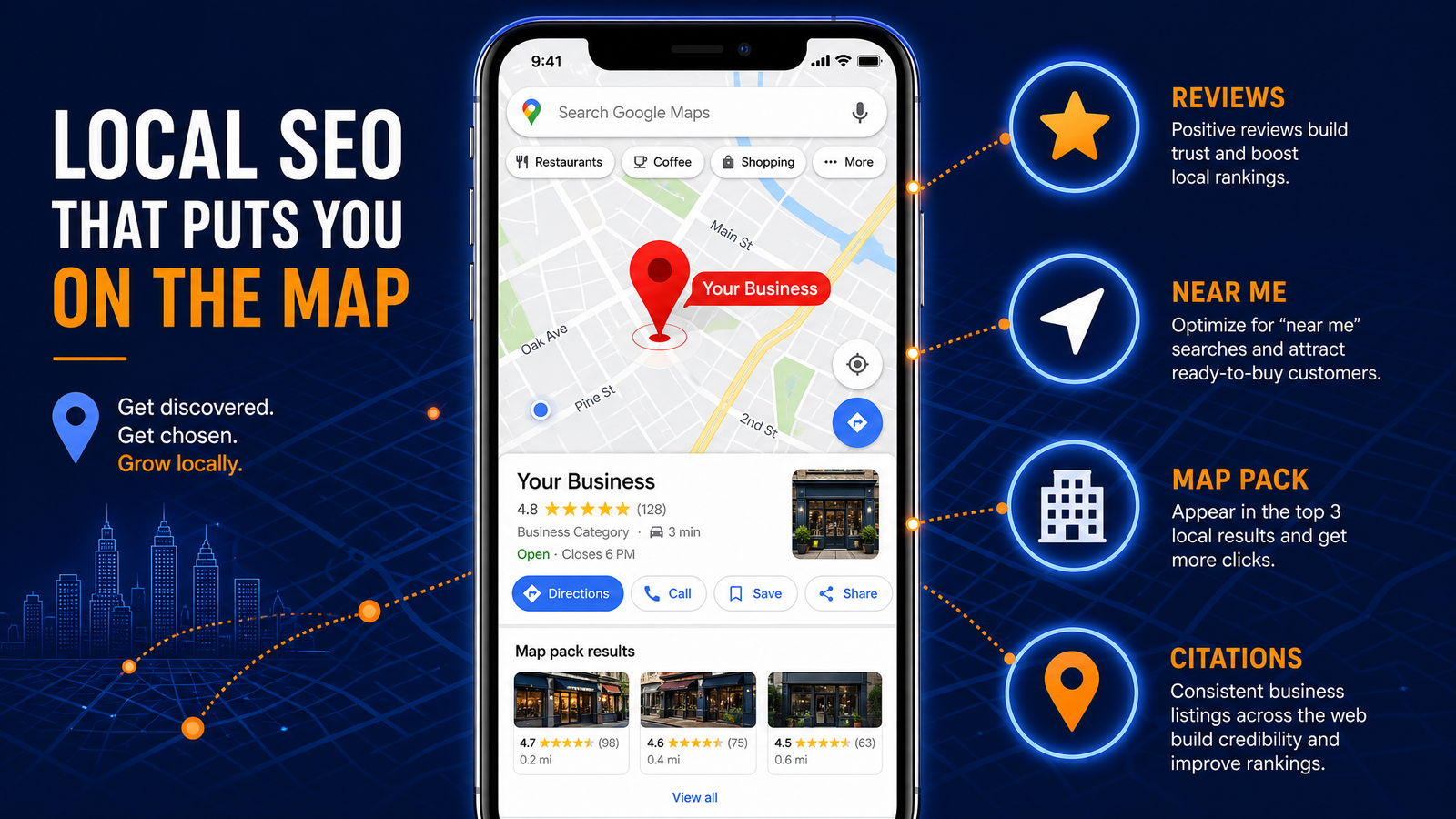
When they press search, Google shows two things: the local map pack (three businesses with pins on a map), and organic search results. The goal of local SEO is to get into that map pack and the organic top five.
Why is this such a big deal for Indian small businesses?
First, because Indian consumers trust local search results. If your business shows up in the map pack with good ratings and a complete profile, you're instantly credible. If you're buried on page three, many consumers assume you don't exist or aren't relevant. For a deeper dive, see seo for service-based businesses: how plumbers, electri.
Second, because local SEO levels the playing field. You don't need a massive marketing budget to rank in local search. A well-optimized Google Business Profile, good reviews, and consistent business information across the web can put a small shop ahead of a big chain.
Third, because search intent is highest at the local level. Someone searching for "dentist near me" is likely looking to book an appointment soon. They're not browsing. They're buying. Local SEO captures these high-intent customers.
Google Business Profile: Your Most Important Local SEO Asset
If you only do one thing for local SEO, make it this: claim and optimize your Google Business Profile (GBP).
GBP — previously called Google My Business — is the free listing Google shows for businesses. It includes your business name, address, phone number, hours, photos, reviews, and more. A fully optimized GBP is the difference between showing up in the map pack and being invisible.
Claiming Your Profile
Start by going to google.com/business and claiming your business. Google will send a verification code to your business address by postcard, or in some cases, by phone or email. The pin verification process typically takes 5-10 days for Indian businesses, so start early.
Filling Every Field Completely
Most Indian businesses stop at the basics — name, address, phone — and call it done. That's a mistake. Google rewards completeness. Every field you fill increases the chances of ranking.
You need to fill in:
- Business name: Exactly as it appears in real life. Don't add keywords (e.g., "Best Dental Clinic Indore — Root Canals & Braces" is a violation). Keep it clean.
- Category: Choose the most specific category. "Dentist" is better than "Doctor." "North Indian Restaurant" is better than "Restaurant."
- Address: Precise. If your business has multiple outlets, create separate profiles for each.
- Service area: If you travel to customers (electrician, plumber, photographer), set your service area rather than showing a specific address.
- Hours: Accurate and updated for holidays.
- Phone: A local Indian number. Google distinguishes mobile vs landline.
- Website: Your business website.
- Attributes: Does your clinic have wheelchair access? Free parking? Gender-neutral washrooms? These small details add up.
- Services: List specific services. A salon listing "haircut, coloring, bridal makeup, facial" will rank for more search terms than one that says "salon services."
- Description: 750 characters to explain your business. Write naturally, include relevant local keywords, but don't stuff them.
Photos and Videos
Businesses with photos get 42% more requests for directions and 35% more click-throughs to their websites, according to Google's own data.
At minimum, upload:
- 10+ high-quality photos of your business exterior, interior, and team
- 5+ photos of your products or services
- 1-2 short videos (30-60 seconds) showing your location or explaining what you do
Posts on Google Business Profile
Google Business Profile lets you create posts — updates, offers, events, and products — that appear in search results and on your listing. Businesses that post regularly see higher engagement.
Post at least once a week. Share offers ("10% off on first visit this month"), events ("Free dental checkup camp on Sunday"), or helpful content ("5 signs your AC needs servicing before summer").
NAP Consistency: The Silent Ranking Factor
NAP stands for Name, Address, Phone number. And consistency across the web is the single most overlooked local SEO factor.
Here's what happens. A business owner sets up:
- Google Business Profile: "Mohit's Kitchen, 23, MG Road, Indore — 0731-423..."
- Justdial listing: "Mohit Kitchen, 23, M.G. Road, Indore — 0731432..."
- Website footer: "MOHIT'S KITCHEN, M G Road, Indore — 97542..."
- Facebook page: "Mohits Kitchen, M G Rd, Indore"
Google sees these as slightly different businesses. The trust signal weakens. Your rankings suffer.
Fix: Standardize your NAP across every platform. Use exactly the same name, exactly the same address format (with or without commas, with or without "Street" vs "St"), and exactly the same phone number format.
For Indian businesses, this means deciding on:
- Do you use "Road" or "Rd"? (Pick one and stick to it)
- Do you include the city name or rely on the platform to show it?
- Do you use STD code with the phone number or without?
Write your NAP as a single, standardized string. Put it everywhere.
Local Citations for Indian Businesses
A citation is any mention of your business name, address, and phone number on another website. Unlike backlinks, citations don't need to be clickable links. They simply need to exist.
In India, citations matter differently than in the West. While Western businesses focus on Yelp, Yellow Pages, and Angie's List, Indian businesses need to focus on:
Tier 1: Must-Have Indian Citation Platforms
- Google Business Profile: Non-negotiable.
- Justdial: India's largest local search platform. Extremely high traffic. Claim your listing, complete every field, respond to reviews.
- IndiaMART: Critical for businesses selling products. Over 80 million visitors per month.
- Sulekha: Strong for local service-based businesses across metros and Tier 2 cities.
- Bing Places for Business: Less traffic than Google in India, but still relevant.
Tier 2: Industry-Specific Platforms
- Practo (for healthcare — doctors, clinics, dentists, diagnostic centers)
- UrbanClap / Urban Company (for service professionals)
- Zomato / Swiggy (for restaurants and food businesses)
- MagicBricks / 99Acres / Housing.com (for real estate)
- BookMyShow (for entertainment venues)
Tier 3: General Directories
- IndiaMart (general business)
- TradeIndia (for B2B and manufacturing)
- AskLaila (popular in Tier 2 cities)
- Yellow Pages India (still relevant for older demographics)
- MeraGrocer (for grocery and retail)
The rule: list on the most relevant platforms for your industry, not every directory you can find. Low-quality, spammy directories can hurt more than help. Focus on authoritative Indian platforms.
How to Build Citations
- Start with the top 5 platforms for your industry
- Use your standardised NAP string on every single one
- Keep a spreadsheet tracking where you've listed
- Check quarterly for inconsistencies
- Fix any incorrect listings immediately
Reviews: The Social Proof That Drives Local Rankings
Reviews do two things for local SEO. First, they directly influence Google's local ranking algorithm. Businesses with more positive reviews and higher ratings tend to rank better. Second, they influence human behavior. A business with 4.8 stars and 200 reviews will get more clicks than one with 3.5 stars and 12 reviews.
In India, where word-of-mouth is a centuries-old business tradition, online reviews are the digital version of that same trust mechanism.
Getting More Reviews
Most Indian businesses wait for customers to leave reviews. That's passive and slow. You need to be active.
- Ask at the right moment: Right after a positive interaction — when a customer just had a good meal, a successful treatment, a satisfied purchase.
- Make it easy: Send a direct link to your Google review page via WhatsApp. Don't make customers search.
- Train your staff: Your receptionist, cashier, or service person should know to ask for a review.
- Incentivize ethically: You cannot pay for reviews, but you can offer a small discount or loyalty point for any feedback. The reviews have to be honest.
Responding to Reviews
Every review — positive or negative — deserves a response.
Positive reviews: Thank the customer genuinely. Personalize. "Thank you, Mr. Sharma — we're glad you enjoyed the paneer butter masala. Hope to serve you again!" not "Thank you for your positive feedback."
Negative reviews: Respond professionally and promptly. Don't argue publicly. Acknowledge the issue, apologize sincerely, and offer to make it right. "We're sorry your experience wasn't up to the mark, Mrs. Verma. The food temperature was below our standard, and we've spoken to the kitchen team. Please give us a chance to serve you better — call us on [number] for a complimentary meal on your next visit."
Google sees responsive business owners as more trustworthy. And future customers see your response as a sign of professionalism.
Managing Fake Reviews
Fake reviews happen in India — competitors or disgruntled ex-employees sometimes leave false negative reviews. Flag them through Google's support system. Gather evidence (purchase records, CCTV footage, communication logs) and submit a removal request. It's not a quick process, but it works.
Local Link Building Strategies
Backlinks remain important for local SEO, but the strategy differs from national or global link building.
Sponsor local events: Sponsor a school event, a local marathon, or a community festival. Most sponsors get listed on the event website with a link.
Partner with local businesses: A wedding photographer linking to a makeup artist, a gym linking to a nutritionist, a café linking to a nearby bookstore. Mutual cross-linking between complementary businesses benefits both.
Get listed in local business associations: Bhopal Chamber of Commerce, Indore Industrial Association, Confederation of Indian Industry — if there's a local trade body with a member directory, get listed.
Press mentions: Did you open a new branch? Launch a new service? Hire a notable person? Send a press release to local newspapers and news websites. A single mention on a credible local news site is worth dozens of directory links.
Guest posts on local blogs: Many Indian cities have local blogs covering food, lifestyle, events, and business. Contribute quality content about your industry, mention your business naturally, and earn a link back.
The "Near Me" Search: How to Optimize for It
"Near me" searches have exploded in India. Google Trends data shows "near me" searches have grown over 300% since 2020 in Indian cities.
But here's the thing — Google doesn't just look for the phrase "near me." It detects that the user wants a local result and triggers the local search algorithm.
To optimize:
- Include your locality, neighborhood, and city name naturally in your content
- Create location-specific pages if you serve multiple areas (but don't create thin pages)
- Ensure your GBP is set up with the correct service area
- Get reviews mentioning specific services and locations
- Use location-based schema markup on your website
For example, if you're a plumber serving South Delhi, don't just say "plumber." Create content around "plumber in Saket," "plumber in Malviya Nagar," "AC installation in Hauz Khas."
How Local SEO Differs from Regular SEO
If you understand general SEO, you'll find local SEO familiar but different in important ways.
| Element | Regular SEO | Local SEO | |---------|------------|-----------| | Primary focus | Global or national search results | Geographic-specific results | | Key ranking factor | Content + backlinks | GBP + reviews + citations | | Search result type | Organic blue links | Map pack + local organic | | User intent | Information, research, purchase | Visit, call, buy locally | | Competition | Everyone in your niche | Businesses in your area | | Speed of results | 3-12 months | 1-3 months (much faster) |
Local SEO is generally faster because there's less competition at the zip-code-and-category level. You're competing with a dozen or two dozen businesses in your area, not thousands nationally.
Local SEO Mistakes Indian Businesses Make
Over the years working with Indian businesses at VidyaSaaS, I've seen the same mistakes repeated.
Mistake 1: Keyword-stuffed GBP name. "Best Silk Saree Shop in Lajpat Nagar | South Ex | Karol Bagh | Delhi" — Google will suspend this listing. Your business name must be your actual business name.
Mistake 2: Using a residential address when serving clients at their location. If you're a home-based service business (photographer, consultant, freelance designer), do not display your home address. Set your GBP as a service-area business.
Mistake 3: Ignoring WhatsApp. WhatsApp is the primary communication channel for millions of Indian consumers. Put your WhatsApp number on your GBP and website. Respond quickly.
Mistake 4: Duplicate listings. If your clinic moved from one location to another and someone created a new listing instead of updating the old one, you have duplicate listings. Google penalizes this. Find and merge duplicates through GBP support.
Mistake 5: Creating pages for every neighborhood. A few location pages are useful. 50 thin pages with barely different content is a spam signal that gets you penalized.
Measuring Local SEO Success
How do you know your local SEO is working?
Track these metrics monthly:
- GBP insights: How many people find your listing through search? Map views? Direction requests? Phone calls? Website clicks? All available in your GBP dashboard.
- Map pack rankings: Are you in the top 3 for your primary keywords? Use a tool or manual check (incognito search from your location).
- Phone call volume: Are you getting more calls from first-time customers? Ask them how they found you.
- Website local traffic: Google Analytics > Audience > Geo > Location. See if local traffic is increasing.
- Review growth and rating: Are reviews increasing month over month? Is your average rating stable or improving?
- Direction requests: More people asking for directions = more local visibility.
A realistic local SEO target: top 3 in the map pack for your top 5-10 keywords within 3-6 months, assuming moderate competition.
📚 Related Articles You Might Like:
Conclusion
Rajesh's dental clinic in Indore? After we optimized his Google Business Profile, cleaned up his citations, built a review collection system, and created location-specific content, his phone started ringing. Within four months, he was in the map pack for "dentist in Indore" and "dental clinic in Vijay Nagar." His consultation bookings doubled.
Local SEO isn't rocket science. It's systematic work. Claim your listings, standardize your information, build your reviews, and create content that signals to Google exactly where you are and who you serve.
At VidyaSaaS, we've helped hundreds of Indian small businesses — from clinics and restaurants to law firms and salons — dominate their local search results. It's what we do best.
Stop losing customers to competitors who show up first. Contact VidyaSaaS for a free local SEO audit. We'll review your current online presence and tell you exactly what needs to change. Call +91 97542 70102 or email info@vidyasaas.com.
Want Results Like This?
Get a free digital marketing audit and custom growth plan for your business.
Get Free AuditVidyaSaaS Team
Super AdministratorPart of the VidyaSaaS team — a group of digital marketing strategists, content specialists, and growth experts helping businesses across India achieve measurable results through data-driven marketing.
More about our teamRelated Articles
Handpicked content to help you grow your business

Amravati Cotton City Connected: SEO Strategies for Maharashtra Agricultural and Education Hub
Amravati cotton economy feeds Maharashtra textile industry. Its university produces thousands of gra...

Tirupati Beyond Balaji: SEO for Andhra Pilgrimage and Manufacturing Economy
Tirupati is India most visited pilgrimage city with 30 million annual visitors. Its manufacturing se...

Nellore Aqua Digital: SEO Strategies for Andhra Shrimp, Rice, and Renewable Energy Economy
Nellore produces more shrimp than any Indian district and is home to one of the world largest solar...
Ready to Grow Your Business?
Let's discuss how we can create a data-driven digital marketing strategy tailored to your goals.