
Blog Writing for SEO: How to Create Content That Ranks and Engages Readers
Blog writing for SEO — keyword research, content structure, headlines, meta descriptions, internal linking, E-E-A-T signals, and how to create content Google loves and readers trust.
VidyaSaaS Team
Super Administrator
Introduction
There's a myth floating around in Indian business circles that SEO content and engaging content are opposite things. That writing for Google means writing robotic, keyword-stuffed articles that nobody actually enjoys reading. And writing for humans means ignoring SEO and hoping people find you through sheer luck.
I'm here to tell you that's nonsense.
Google's algorithm in 2026 is smarter than most people give it credit for. It can tell when content is written for algorithms versus written for humans. And the content that ranks best? It's the content that serves human readers first. Google is just really good at figuring out which content does that. For a deeper dive, see our complete SEO guide.
The trick is understanding how to structure your content so Google can understand it, while writing it in a way that keeps humans reading. They're not opposing goals. They're two sides of the same coin.
This guide walks you through exactly how to write blog posts that rank on Google and keep readers engaged. I'm going to skip the theory and give you practical, step-by-step advice based on what actually works for Indian businesses in 2026.
Keyword Research for Blog Topics
Keyword research is where good SEO starts. But most people get it wrong. They target keywords that are too competitive, too broad, or not aligned with search intent. For a deeper dive, see content marketing strategy.
The Right Way to Research Keywords
Start with your customer's problems. What questions does your customer ask you in real conversations? What problems do they come to you with? These are your goldmine topics. An SEO consultant doesn't need to sit around wondering what to write about — just ask your sales team what prospects ask most often.
Use keyword tools for validation. Tools like Google Keyword Planner, Ahrefs, SEMrush, or even free options like Ubersuggest can tell you:
- Monthly search volume (how many people search for this)
- Keyword difficulty (how hard it is to rank)
- Related keywords (other topics to cover)
- Search trends (is interest growing or declining)
Target long-tail keywords. This is the biggest shortcut for Indian businesses. Instead of targeting "SEO services" (which has massive competition from every agency in India), target "SEO for dental clinics in Pune" or "digital marketing for salons in Bhopal." Long-tail keywords have less competition and higher conversion rates because the searcher knows exactly what they want.
Understand search intent. Every keyword has an intent behind it:
- Informational: "How to write SEO blog posts" — user wants to learn
- Commercial: "Best SEO tools for bloggers" — user is researching options
- Transactional: "Hire SEO content writer" — user wants to buy
Match your content to the intent. If someone searches "how to do SEO," don't give them a sales page. Give them a guide. Build trust first.
Keyword Mapping
Create a spreadsheet with target keywords, search volume, difficulty score, and content format (blog, video, guide, listicle). Prioritise keywords where you can realistically rank — a new blog shouldn't target terms that established publications dominate.
Content Structure That Google Loves
Google has gotten very good at understanding content structure. It uses heading tags, paragraph structure, and content depth to determine what your page is about and how valuable it is.
The H1, H2, H3 Structure
Your content should follow a clear hierarchy:
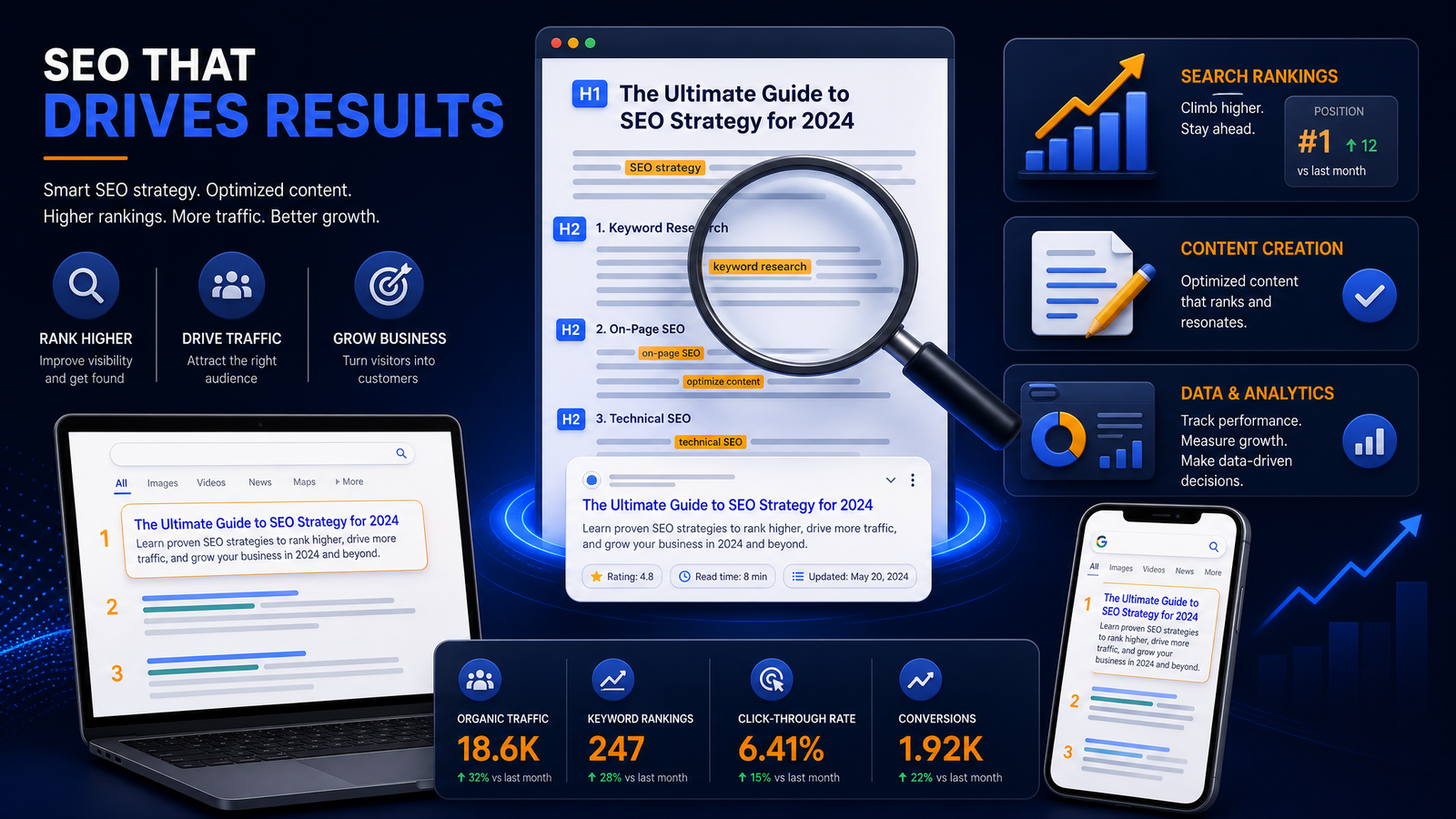
H1 (Page Title): One per page. Contains your primary keyword. Tells Google and readers what this page is about.
H2 (Main Sections): Break your content into 5-8 main sections. Each H2 should cover a distinct subtopic. Include related keywords where natural.
H3 (Sub-Sections): Within each H2, use H3s to break down complex topics. This creates a scannable structure that readers love and Google understands.
Why Structure Matters
Google's algorithm looks at heading tags to understand page structure. A page with a clear hierarchy signals quality and relevance. A wall of text with no headings signals the opposite.
For readers, headings are signposts. Most people don't read blog posts — they scan them. Clear headings help them find what they're looking for. If they find value in one section, they'll read more.
Paragraph Length
Keep paragraphs short. 2-3 sentences max on digital screens. Long paragraphs get skipped. Short paragraphs keep people moving through your content.
Writing Compelling Headlines
Your headline is the most important sentence you'll write for any blog post. It determines whether someone clicks on your result in Google search, and it influences your click-through rate, which is a ranking factor.
Headline Formulas That Work
How-to headlines: "How to Write SEO Blog Posts That Rank in 2026" — clear, specific, promise of value.
List headlines: "7 SEO Mistakes That Are Killing Your Blog Traffic" — numbered lists promise digestible content.
Question headlines: "Why Isn't Your Blog Getting Traffic?" — directly addresses a pain point.
Benefit headlines: "Double Your Blog Traffic With These SEO Techniques" — promises a result.
Curiosity headlines: "The SEO Strategy Most Indian Businesses Ignore" — makes people want to know what they're missing.
What to Avoid
Clickbait that doesn't deliver. Vague headlines that don't tell the reader what to expect. Headlines that are too long (keep under 60 characters for search results).
Meta Descriptions That Get Clicks
Meta descriptions don't directly affect rankings, but they do affect click-through rates. And higher click-through rates can lead to better rankings.
Writing Effective Meta Descriptions
- Keep it 150-160 characters. That's what Google typically displays.
- Include your primary keyword. It gets bolded in search results when it matches the query.
- Include a call to action. "Learn how," "Read more," "Get started."
- Summarise the value. What will the reader get from clicking?
- Make it compelling. Stand out from the other 10 search results.
Example: "Learn how to write SEO blog posts that rank on Google and actually engage readers. Practical tips on keywords, structure, headlines, and E-E-A-T for Indian businesses."
Internal Linking Strategy
Internal linking is one of the most underutilised SEO tactics. Most businesses write blog posts in isolation, never linking to other posts on their site. This misses a massive opportunity.
Why Internal Links Matter
Internal links help Google understand your site structure and the relationship between pages. They distribute authority throughout your site. And they keep readers on your site longer, increasing pages per session.
Best Practices
Link to relevant content. Every blog post should link to at least 2-3 other relevant posts. If you mention a concept you've covered in another post, link to it.
Use descriptive anchor text. "Learn more about our SEO services at VidyaSaaS" is better than "Click here."
Create topic clusters. Group related content together with interlinking. A pillar page linking to cluster pages and cluster pages linking back.
Link deep. Don't just link to your homepage or contact page. Link to specific, relevant content. This helps both users and search engines.
Audit old content. When you publish a new post, go back to older posts and add links to the new one. This keeps your older content fresh and connected.
Content Length — How Long Should Blogs Be?
The short answer: as long as it needs to be to answer the query completely. No longer, no shorter.
By the Numbers
For most topics, 1500-2500 words is the sweet spot for ranking. Google's top 10 results for most keywords average around 1500-2000 words. But longer content (3000+ words) tends to rank better for competitive, high-intent keywords.
Quality Over Length
Here's what matters more than word count:
- Does your content fully answer the search query?
- Does it cover related subtopics the reader might want?
- Is it well-structured and scannable?
- Does it provide unique value that other pages don't?
A 1000-word post that thoroughly answers a specific question can outrank a 3000-word post that rambles. Don't add fluff to hit a word count. Google can tell.
E-E-A-T Signals in Content
E-E-A-T stands for Experience, Expertise, Authoritativeness, and Trustworthiness. It's Google's framework for evaluating content quality.
How to Build E-E-A-T
Demonstrate experience. First-hand knowledge matters. "We've run over 500 Google Ads campaigns for Indian businesses" is more credible than generic advice.
Showcase expertise. Write about what you know. Author bios with credentials, experience, and specialisation help. For YMYL (Your Money or Your Life) topics like health and finance, demonstrated expertise is critical.
Build authority. Get mentioned on other reputable sites. Guest posts, interviews, podcast appearances, and citations build authority signals. Internal linking to authoritative sources helps too.
Build trust. Accurate information, proper citations, transparent about affiliations, clear author information, and a professional website design all contribute to trust.
Practical E-E-A-T for Indian Businesses
Include author bios with real credentials. Add testimonials and case studies. Link to reputable sources. Keep content updated. Have a clear About page and contact information. These signals matter more than most people think.
Updating Old Content vs Creating New
Most content marketers face this dilemma. Is it better to update old content or create new posts?
When to Update
Ranking on page 2-3. Content that's close to the top 10 positions deserves updating. A refresh — new data, updated examples, improved structure — can push it to page 1.
Outdated information. Statistics, examples, and best practices change. If your content references "in 2023" and it's now 2026, update it.
Low engagement but good relevance. If a post gets traffic but low time-on-page, it needs restructuring. Improve readability, add visuals, tighten the writing.
When to Create New
New keyword opportunities. If you're not targeting a keyword that your audience searches for, create new content.
New products or services. New offerings need new content explaining them.
Gaps in topic coverage. If your topic cluster is missing key subtopics, fill the gaps with new content.
The 80-20 Approach
Spend 80% of your content effort on creating new content. Spend 20% on updating and refreshing old content. For high-performing old content that's starting to slip, prioritise updates.
Why Consistency Matters More Than Volume
Here's a truth that took me years to fully appreciate.
A blog with 50 consistently great posts will outperform a blog with 200 inconsistent posts. Google rewards freshness (regular updates) and depth (comprehensive coverage). But the biggest factor is sustained effort.
One high-quality blog post per week, every week, for a year = 52 posts. That's enough to establish topical authority in most niches. It's enough to build an audience. It's enough to generate consistent traffic.
Five blog posts in one week, then nothing for two months = dead blog with no momentum.
Setting a Realistic Schedule
Be honest about your bandwidth. Can you commit to one post per week? Start there. Can you do two? Great. But don't overcommit and burn out.
For most Indian businesses, one post per week is realistic and sufficient. If you can sustain that for 6-12 months, you'll see meaningful SEO results. Consistency beats intensity every single time.
Common SEO Blog Writing Mistakes
Ignoring search intent. Writing content that doesn't match what the searcher wants. A "how-to" query needs a guide, not a definition.
Keyword stuffing. Using the same keyword repeatedly in an unnatural way. Google penalises this and readers hate it.
Thin content. Short, shallow posts that don't fully answer the query. These rarely rank for competitive terms.
No unique value. Paraphrasing what other blogs have said adds nothing. Your content needs a unique angle, better examples, deeper research, or a fresh perspective.
Ignoring formatting. Walls of text get skipped. Use short paragraphs, bullet points, bold text for emphasis, and plenty of white space.
No CTA. Someone reads your entire post and then what? Tell them what to do next — subscribe, download, contact, read related content.
📚 Related Articles You Might Like:
Conclusion
SEO blog writing isn't a mystery. It's a craft that combines understanding search intent, structure, keywords, and reader psychology. Write for humans first, but structure for search engines so they can find and understand your content.
The formula is simple: target the right keywords, write comprehensive content that truly helps your reader, structure it clearly, link it intelligently, and be consistent. Do that for six months, and you'll see results.
Need help with your blog content? At VidyaSaaS, we write SEO-optimised blog content for Indian businesses across industries. Our Content Writing services help you create content that ranks, engages, and converts. Get in touch to discuss your content needs.
Want Results Like This?
Get a free digital marketing audit and custom growth plan for your business.
Get Free AuditVidyaSaaS Team
Super AdministratorPart of the VidyaSaaS team — a group of digital marketing strategists, content specialists, and growth experts helping businesses across India achieve measurable results through data-driven marketing.
More about our teamRelated Articles
Handpicked content to help you grow your business

Sangli Turmeric City Digital: Content Marketing for Maharashtra Agriculture and Education Hub
Sangli produces India finest turmeric and exports grapes to Europe. Its sugar cooperatives shaped In...

Nanded Sachkhand to Startups: Digital Marketing Strategy for Maharashtra Pilgrimage and Industrial City
Nanded hosts one of Sikhism holiest shrines and a growing industrial belt. But its digital strategy...

Sagar MP Heartland Goes Digital: Marketing Strategy for Bundelkhand Education and Agriculture Hub
Sagar hosts Dr Harisingh Gour University — central India oldest — and anchors Bundelkhand agricultur...
Ready to Grow Your Business?
Let's discuss how we can create a data-driven digital marketing strategy tailored to your goals.