
Copywriting vs Content Writing: What's the Difference and Why Your Business Needs Both
Copywriting vs content writing — what's the difference, why both matter for Indian businesses, and when to hire which specialist for your marketing.
VidyaSaaS Team
Super Administrator
Introduction
I've met dozens of business owners who say things like "I need someone to write content for my website" and end up hiring a writer who's great at blog posts but terrible at sales pages. Or they hire a copywriter who writes punchy ad copy but can't produce a 2000-word educational article to save their life.
They're both writers. They both work with words. But they're not interchangeable. And understanding the difference can save you time, money, and a lot of frustration.
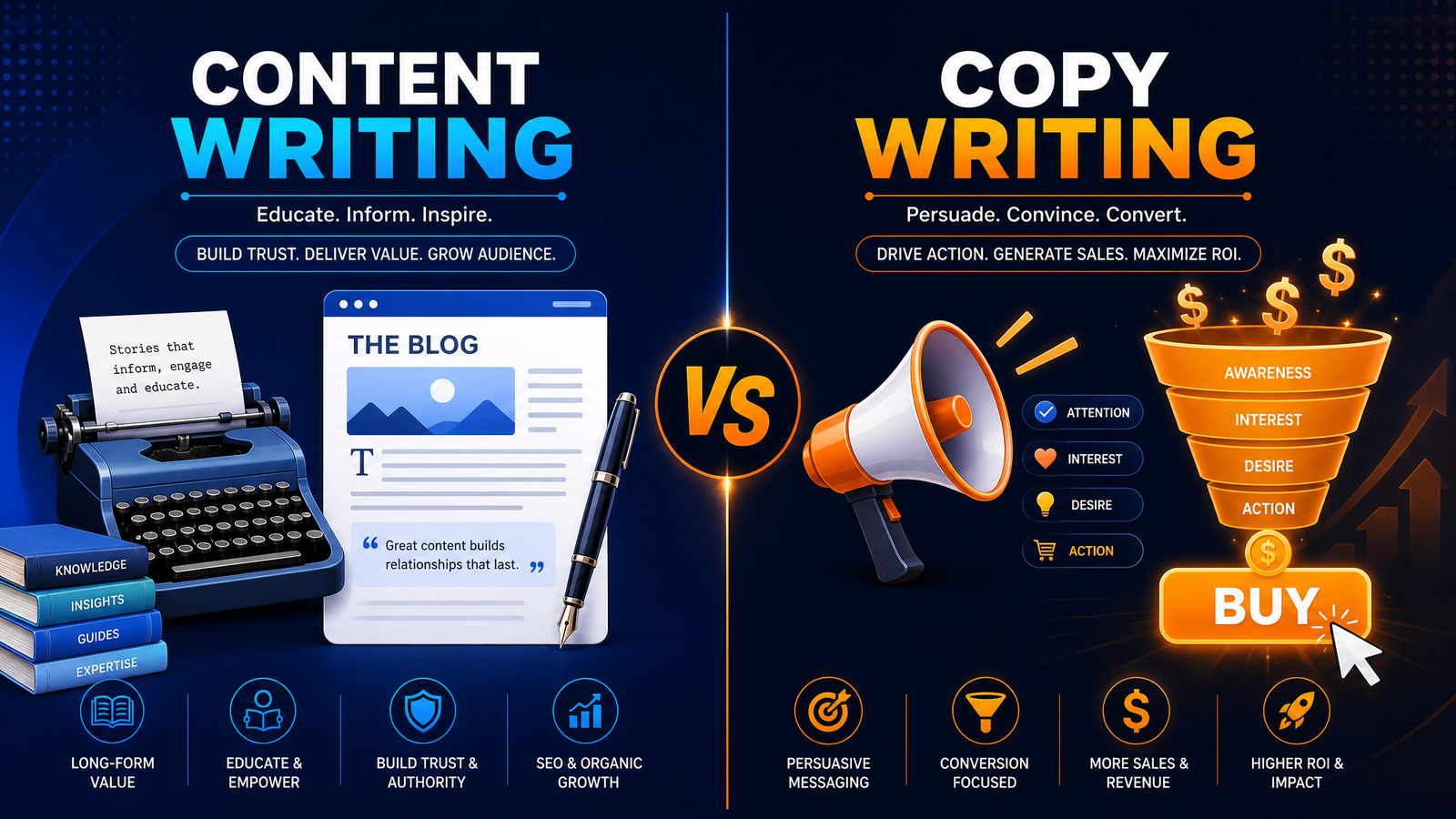
Content writing and copywriting serve different purposes. Content writing builds relationships, educates audiences, and establishes authority. Copywriting drives action — it makes people click, buy, sign up, or call. One is about connection. The other is about conversion. For a deeper dive, see brand identity guide.
A business that understands both will outperform a business that only invests in one. Here's the complete breakdown of what each discipline is, how they differ, and why you need both to grow your business.
Content Writing: Building Relationships Through Information
Content writing is the art of creating valuable, informative content that attracts and retains an audience. Its primary goal isn't to sell — it's to help. By helping, you build trust. By building trust, you eventually earn the right to sell.
Types of Content Writing
Blog Posts: Long-form articles that educate, inform, or entertain. They establish authority on specific topics and bring organic traffic through search engines. For a deeper dive, see content marketing strategy.
E-books and Guides: In-depth resources that provide comprehensive information on a topic. Often used as lead magnets to grow email lists.
Social Media Posts: Platform-specific content that builds community and engagement. Educational carousels, thought-leadership posts, tips and tricks.
Newsletters: Email content sent to subscribers. Builds ongoing relationships and keeps your audience engaged between purchases. For a deeper dive, see graphic design for social media: 10 design principles t.
Case Studies: Detailed examinations of how you solved a client's problem. Social proof combined with educational content.
Whitepapers: Deep, research-backed reports on industry topics. Heavy on data and analysis.
Website Content: About pages, service descriptions, FAQ sections. The foundational content that tells people who you are and what you do.
The Goal of Content Writing
The goal is to be useful. To answer questions your audience is asking. To solve problems they're facing. To make them smarter about your industry. The sale is secondary — a natural outcome of the relationship built through helpful content.
Skills Content Writers Need
Research ability: Finding and synthesising information from multiple sources.
SEO knowledge: Understanding keywords, content structure, and search intent.
Storytelling: Making complex topics engaging and relatable.
Long-form structure: Organising large amounts of information coherently.
Audience empathy: Understanding what readers need and how they want to receive it.
Consistency: Producing quality work on a regular schedule.
Copywriting: Driving Action Through Persuasion
Copywriting is the art of using words to persuade someone to take a specific action. Buy now. Sign up. Call today. Schedule a consultation. Download this guide. Every word is chosen to move the reader closer to that action.
Types of Copywriting
Ad Copy: Google Ads, Facebook Ads, Instagram Ads, LinkedIn Ads. Every word costs money, so efficiency matters.
Landing Pages: Standalone pages designed for conversion. The copy needs to guide the visitor from arrival to action without distraction.
Sales Pages: Long-form pages that build a case for purchase. Used for high-ticket products and services.
Email Marketing: Promotional emails, product launches, cart abandonment sequences. Copy that drives opens, clicks, and conversions.
Product Descriptions: E-commerce copy that makes people want to buy. Features and benefits, pain points and solutions.
Call-to-Action (CTA) Buttons: Small words that make a big difference. "Get Started" vs "Learn More" vs "Book Now" — the right words can boost conversion rates.
Direct Mail and Print: Brochures, flyers, catalogues. Traditional but still effective.
Video Scripts: For TV ads, YouTube pre-rolls, social media video ads. Every second counts.
The Goal of Copywriting
The goal is to convert. To turn a visitor into a lead. A lead into a customer. A customer into a repeat buyer. Every sentence serves that purpose. Fluff gets cut. Value propositions get sharpened. Emotional triggers get activated.
Skills Copywriters Need
Persuasion psychology: Understanding what makes people say yes (urgency, scarcity, social proof, reciprocity).
Conciseness: Saying more with fewer words. In copywriting, every extra word reduces impact.
A/B testing mindset: Writing multiple versions, testing, and iterating based on data.
Brand voice adaptation: Writing in different voices for different brands and audiences.
Emotional intelligence: Knowing which emotions to trigger for specific products and audiences.
Direct response expertise: Understanding sales funnels, customer journeys, and conversion mechanics.
The Key Differences
| Aspect | Content Writing | Copywriting | |--------|----------------|-------------| | Primary goal | Educate and inform | Persuade and convert | | Timeframe | Long-term relationship building | Immediate action | | Typical formats | Blogs, guides, newsletters | Ads, landing pages, sales emails | | Length | Usually longer | Usually shorter | | Emotional tone | Informative, helpful | Urgent, persuasive | | Success metric | Traffic, engagement, shares | Conversion rate, sales, leads | | SEO focus | Important | Less important | | Sales approach | Soft sell, earned sale | Direct call to action |
This isn't a value judgment. One isn't better than the other. They serve different roles in your marketing funnel. Content writing fills the top of the funnel — attracting people and building trust. Copywriting handles the bottom — converting that trust into action.
How They Complement Each Other
The magic happens when you use both together.
Scenario: A New Customer Journey
-
A business owner in Pune searches "how to run Google Ads for my clinic" (content writing opportunity — a blog post)
-
They find your blog post, which thoroughly explains Google Ads setup for clinics. They read the whole thing. They trust you because the content is genuinely helpful.
-
At the bottom of the blog, there's a CTA: "Want us to set up your Google Ads campaign? Get a free audit." (copywriting opportunity — the CTA)
-
They click. They land on a landing page that persuades them to fill out a form. (copywriting — the landing page)
-
They fill the form. Your sales team follows up. But before the call, they receive an email sequence that nurtures them. (copywriting — email sequence)
-
Between calls, they receive a case study PDF showing similar clinics you've helped. (content writing — case study)
-
They become a client.
The blog post built the trust. The landing page closed the deal. The email sequence nurtured. The case study sealed it. Content writing and copywriting working together at every stage.
Without the blog post, nobody finds you. Without the landing page, nobody converts. You need both.
Bad Copy vs Good Copy: Real Examples
Let me show you what this looks like in practice.
Example 1: Google Ad Headlines
Bad: "Digital Marketing Services Available — Visit Our Website"
- Generic, boring, no hook. Why should anyone click?
Good: "Stop Wasting Ad Budget — VidyaSaaS Delivers 3x ROI for Indian Brands"
- Specific. Targets pain point. Promises a result. Includes social proof.
Example 2: Email Subject Lines
Bad: "February Newsletter"
- Nobody opens this. Zero curiosity.
Good: "The SEO mistake costing your business ₹50,000/month"
- Creates curiosity. Specific about the cost. Targets a pain point.
Example 3: Website Hero Section
Bad: "We are a full-service digital marketing agency providing comprehensive solutions for businesses of all sizes."
- Corporate jargon salad. Says nothing memorable.
Good: "Grow Your Indian Business with Performance-Driven Digital Marketing. No Lock-In Contracts. Results Guaranteed."
- Clear value proposition. Audience-specific. Removes friction ("no lock-in contracts").
Example 4: Blog Introduction
Bad: "In today's digital landscape, having a strong online presence is crucial for businesses."
- AI-sounding. Generic. Nobody reads past this.
Good: "You're spending ₹50,000 a month on ads and getting leads that don't convert. I know the feeling because I've been there."
- Specific. Relatable. Addresses a real pain point. Human voice.
The Psychology of Persuasive Writing
Good copywriting isn't about fancy words. It's about understanding how people think and what makes them act.
Key Psychological Principles
Loss aversion: People fear losing something more than they want to gain something. "Don't miss out" works better than "Get this deal."
Social proof: People follow what others do. "Join 2,000+ Indian businesses" is more persuasive than claims without evidence.
Scarcity: Limited availability drives action. "Only 5 spots left" or "Offer ends Friday."
Reciprocity: When you give value first, people feel obliged to give back. Free guides, checklists, and consultations work on this principle.
Commitment and consistency: Once someone takes a small step (like downloading a guide), they're more likely to take a larger step (like booking a consultation).
Authority: People trust experts. Highlight credentials, years of experience, notable clients.
Writing for Emotion
People make buying decisions emotionally and justify them logically. Your copy needs to address both.
Pain Points: "Frustrated with low sales?" "Tired of wasted ad spend?" "Worried your competitors are ahead?"
Aspirations: "Imagine doubling your revenue in 6 months." "Picture your phone ringing with qualified leads."
Fear vs Greed: Most purchases are motivated by either fear (of missing out, of being left behind, of a problem getting worse) or desire (for success, recognition, freedom). Know which one your customer responds to.
When to Hire Which Specialist
Hire a Content Writer When You Need:
- Regular blog posts for your website
- Long-form guides and e-books
- SEO-optimised articles
- Educational social media content
- Case studies and whitepapers
- Newsletter content
Hire a Copywriter When You Need:
- Ad copy (Google, Facebook, LinkedIn)
- Landing pages designed for conversion
- Sales pages and product descriptions
- Email sequences for launches and promotions
- CTA buttons and headlines
- Direct mail and brochure copy
The Ideal Scenario
Hire both. Either as freelancers, as part of a content agency like VidyaSaaS, or as in-house resources. Content writers build the audience; copywriters convert them. Together, they create a complete content-to-conversion system.
Common Mistakes Indian Businesses Make
Using Copywriters for SEO Content. A great copywriter can write persuasive ads, but may not understand SEO, keyword research, or long-form content structure. Don't expect your copywriter to produce 2000-word blog posts unless that's their specific skill set.
Using Content Writers for Ads. A content writer who writes beautiful blog posts may struggle with the conciseness and persuasion required for ad copy. Ad copy is a different muscle.
Hiring One Person for Both Roles. Some people can do both, but they're rare. If you find one, pay them well. If not, invest in two specialists.
Not Investing in Either. The most common mistake. Businesses who don't invest in content or copywriting struggle to attract and convert customers.
Short-Term Thinking. Content writing takes time to deliver ROI. Copywriting can deliver faster results. Both need sustained investment.
📚 Related Articles You Might Like:
Conclusion
Content writing and copywriting aren't competitors. They're partners. Content writing builds the trust and authority that makes copywriting work. Copywriting converts the audience that content writing attracts.
Indian businesses that understand this distinction invest in both. They create educational blog posts, guides, and videos that attract their ideal customers. And they write compelling ads, landing pages, and emails that turn those visitors into paying clients.
If you're not doing either, start with content writing — build your audience first. If you're only doing content writing, add copywriting — start converting that audience. If you're lucky enough to be doing both well, you're ahead of 90% of your competitors.
Need help with content writing, copywriting, or both? At VidyaSaaS, we offer complete Content Marketing services that include everything from SEO blog writing to high-converting ad copy. Get in touch and let's build a content strategy that attracts AND converts.
Want Results Like This?
Get a free digital marketing audit and custom growth plan for your business.
Get Free AuditVidyaSaaS Team
Super AdministratorPart of the VidyaSaaS team — a group of digital marketing strategists, content specialists, and growth experts helping businesses across India achieve measurable results through data-driven marketing.
More about our teamRelated Articles
Handpicked content to help you grow your business

Sangli Turmeric City Digital: Content Marketing for Maharashtra Agriculture and Education Hub
Sangli produces India finest turmeric and exports grapes to Europe. Its sugar cooperatives shaped In...

Nanded Sachkhand to Startups: Digital Marketing Strategy for Maharashtra Pilgrimage and Industrial City
Nanded hosts one of Sikhism holiest shrines and a growing industrial belt. But its digital strategy...

Sagar MP Heartland Goes Digital: Marketing Strategy for Bundelkhand Education and Agriculture Hub
Sagar hosts Dr Harisingh Gour University — central India oldest — and anchors Bundelkhand agricultur...
Ready to Grow Your Business?
Let's discuss how we can create a data-driven digital marketing strategy tailored to your goals.