
Content Marketing Strategy 2026: Blog, Video, and Social Media Working Together
Content marketing strategy for 2026 — how blog content feeds social media, fuels video, generates emails, and builds a complete content ecosystem for your business.
VidyaSaaS Team
Super Administrator
Introduction
Here's a story I see play out every week with Indian businesses.
Company A has a blog. They post once a month. Each post is decent but takes days to write. They share it on LinkedIn and Instagram once, get a handful of views, and move on. Total traffic from blog: negligible. They're thinking of giving up on content marketing altogether.
Company B is in the same industry. They also write a blog once a week. But each blog post becomes a LinkedIn post, a Twitter thread, a video summary, an email newsletter, and three Instagram slides. Their content is everywhere. Leads come in consistently from channels they didn't even actively build. For a deeper dive, see blog writing for seo: how to create content that ranks .
Same effort. Completely different results. The difference? Company B understands the content ecosystem.
Content marketing in 2026 isn't about creating more content. It's about creating once and distributing everywhere. It's about building a system where every piece of content feeds another, where your blog supports your social media, your social media drives people to your video, and your video generates email subscribers.
This is the content ecosystem approach. And it's how you get 5x the results from the same amount of effort.
The Content Ecosystem: How Everything Connects
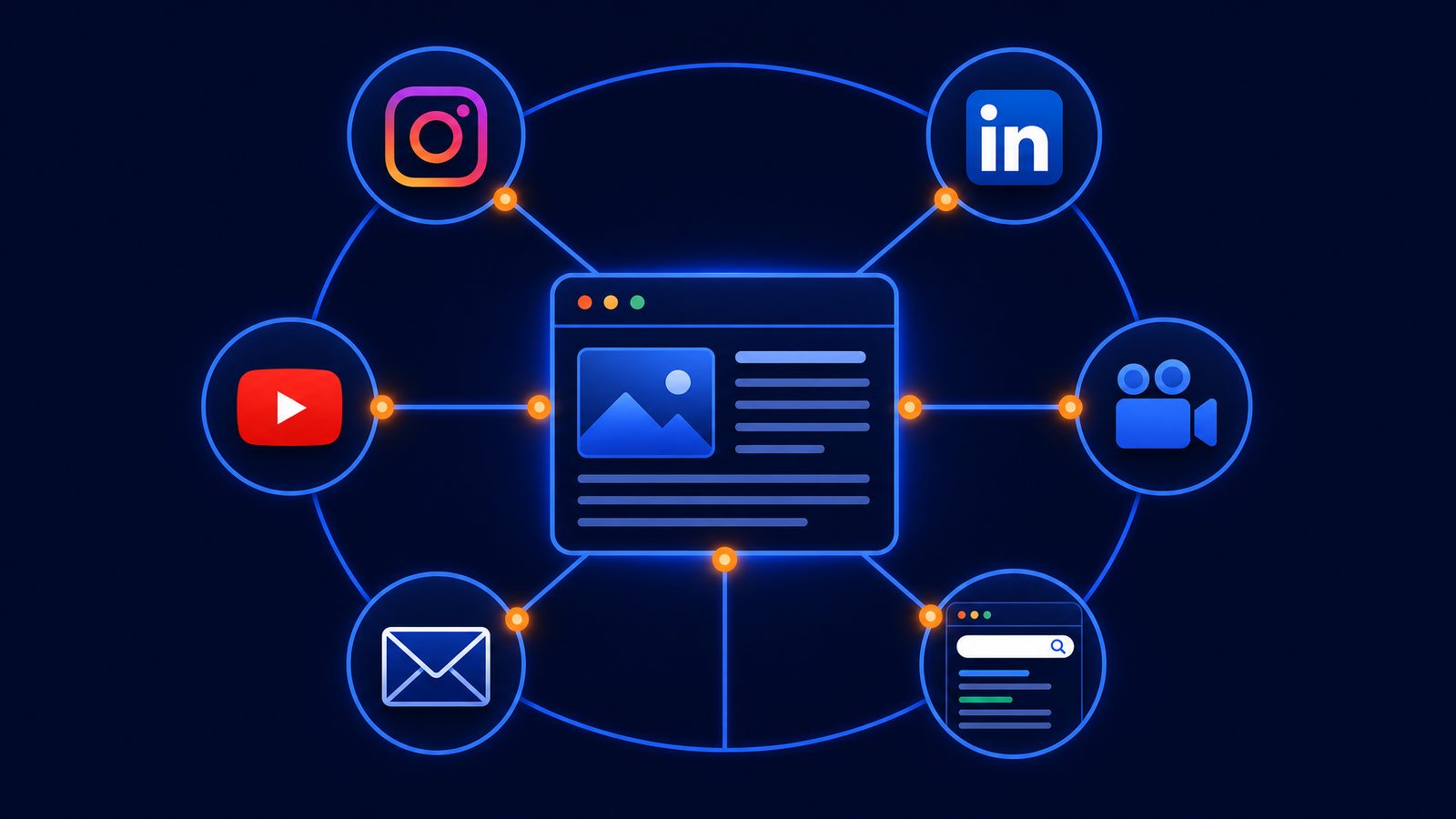
Think of your content not as individual pieces, but as an interconnected system. Each piece of content has a job, and each platform feeds into another.
The Core: Your Blog or Website
Your blog is the centre of your content universe. It's the one piece of content you own completely. Social media platforms can change their algorithms, shut down, or deprecate. Your blog stays yours.
Everything starts with your blog. A well-researched, SEO-optimised blog post is the most durable content asset you can create. It ranks in Google search, it can be updated and refreshed, and it serves as source material for every other content format. For a deeper dive, see copywriting vs content writing: what's the difference a.
Distribution Layer: Social Media
Social platforms are where your blog content gets distributed, repackaged, and amplified. A single blog post should generate:
- 2-3 LinkedIn posts (key points, quotes, your take)
- 1-2 Twitter threads (condensed version of the post)
- 3-5 Instagram slides or Reels (visual takeaways)
- A Facebook post (link + summary)
Each platform gets a version of the content optimised for that format and audience. Not a link drop. An actual piece of content that adds value on its own.
Amplification Layer: Video
Your blog content becomes video content. A 1500-word blog post easily becomes a 5-10 minute YouTube video. The outline, the points, the structure — it's all there. You just need to present it verbally.
The video goes on YouTube (long-term search traffic), gets clipped into Shorts (virality and reach), and the audio file becomes a podcast episode.
Retention Layer: Email
Your email list is your most valuable marketing asset. Every piece of content you create should have a reason for people to subscribe. Your blog can have a lead magnet. Your videos can have a "download the checklist" CTA. Your social posts can point to a newsletter signup.
Email is where you build relationships that survive algorithm changes. It's the only channel you fully control.
Topic Clusters and Pillar Pages
Gone are the days of writing random blog posts about whatever comes to mind. Modern content marketing uses topic clusters — a strategic approach that signals authority to Google and provides a clear learning path for your audience.
What Are Topic Clusters?
A topic cluster consists of a pillar page (a comprehensive guide on a broad topic) and cluster content (individual blog posts targeting specific subtopics within that broad topic).
Example for a digital marketing agency:
Pillar Page: "Complete Guide to Digital Marketing for Indian Businesses" Cluster Content:
- "How to Run Google Ads for Your Small Business"
- "SEO Checklist for Indian Websites"
- "Social Media Marketing for Salons and Spas"
- "Email Marketing Best Practices for E-commerce"
- "Content Marketing Strategy for B2B Companies"
Each cluster post links back to the pillar page, and the pillar page links out to each cluster post. This creates a web of internal links that Google recognises as topical authority.
Why It Works
When you write 10-15 blog posts all connected around one topic, Google sees you as an authority on that topic. Your pillar page ranks higher for competitive keywords. Your cluster posts rank for long-tail keywords. And every post in the cluster boosts the others through internal linking.
For Indian businesses, this means you can compete with larger companies on specific topics by demonstrating deep expertise through interconnected content.
Content Repurposing: The Efficiency Hack
This is the single biggest lever in content marketing. Most businesses create content once and never touch it again. Repurposing extends the life of your content by presenting it in different formats for different platforms.
The Repurposing Workflow
1. Create the core asset. Write a comprehensive blog post (1500-2500 words). This is your source material.
2. Extract social posts. Pull 3-5 key ideas from the blog. Each becomes a standalone social media post. Don't just quote yourself — add context, ask questions, make it conversational.
3. Create visual assets. Turn statistics, lists, and comparisons into graphics. Use Canva to create quote cards, infographics, and carousel posts.
4. Record video. Read through your blog's key points. Record a 5-10 minute video covering the main ideas. You don't need a script — your blog is your script.
5. Edit short-form clips. Cut your video into 30-60 second clips. These become Reels, Shorts, and TikTok posts. Each clip should stand alone as valuable content.
6. Write email newsletter. Summarise your blog in 200-300 words. Link to the full post. Send to your email list.
7. Update internal links. Link to your new content from older relevant posts. This boosts SEO and keeps old content fresh.
Repurposing Example
That one blog post just gave you:
- 1 blog post (evergreen SEO asset)
- 3-5 social media posts (drive engagement)
- 1 carousel post (save-worthy content)
- 1 YouTube video (searchable traffic)
- 3-5 Shorts/Reels (discovery reach)
- 1 podcast episode (if audio is extracted)
- 1 email newsletter (retention)
- Multiple internal links (SEO boost)
That's 15+ pieces of content from one core asset. The time to create the core asset is the same. But the distribution multiplies your effort by 15x.
Distribution Over Creation
Most content marketers spend 80% of their time creating and 20% distributing. The smart ones reverse that ratio.
Here's the uncomfortable truth. Your best piece of content is useless if nobody sees it. The quality of your content determines whether people stay when they find you. But distribution determines whether they find you at all.
Distribution Channels
Organic Search (SEO): This is the gift that keeps giving. A well-optimised blog post can rank for years. Invest in keyword research, on-page SEO, and internal linking.
Social Media: Share your content across LinkedIn, Twitter/X, Instagram, Facebook, and relevant groups. Tailor the format to each platform.
Email List: Your most engaged audience. Send new content to your list with a compelling subject line. Open rates of 20-40% are typical.
Community and Groups: Share in relevant LinkedIn groups, Facebook groups, Reddit communities, and WhatsApp groups. Don't spam — share genuinely useful content and be part of the conversation.
Influencer and Guest Content: Ask industry peers to share your content. Write guest posts for other publications. Appear on podcasts. Each appearance distributes your content to a new audience.
Paid Distribution: For high-value content, consider a small paid boost on LinkedIn or Facebook. ₹2000-5000 can get your content in front of thousands of relevant people.
The 80-20 Rule for Distribution
Spend 20% of your content time creating. Spend 80% distributing. Write once, promote everywhere.
Measuring Content ROI
Content marketing is a long game. But you need to know if it's working.
Leading Indicators (Early Signals)
- Traffic to blog posts (page views and unique visitors)
- Time on page (are people actually reading?)
- Social shares and saves (are people finding it valuable?)
- Email signups (is it generating subscribers?)
- Comments and replies (is it starting conversations?)
Lagging Indicators (Business Results)
- Leads attributed to content (via UTM parameters or CRM tracking)
- Conversion rate from content readers to customers
- Customer lifetime value of content-attributed leads
- SEO rankings for target keywords (track improvement over 3-6 months)
What to Track Monthly
- New blog posts published
- Total blog traffic
- Top 5 performing posts
- New email subscribers from content
- Content-attributed leads
- Keyword ranking changes
Building a Content Team or Outsourcing
At some point, you can't do it all yourself. Here's how to scale.
The Minimal Team
- Content strategist (you, or a senior hire): Topic selection, keyword research, editorial calendar, quality control.
- Content writer: Writes blog posts, social captions, email newsletters. Can be full-time or freelance.
- Video creator: Shoots and edits video content. Can be part-time or freelance.
Freelance vs Agency
Freelancers work well when you need specific skills (writing, video, design) and can manage them directly. Agencies like VidyaSaaS work well when you need a complete content marketing system — strategy, execution, and distribution.
The Hybrid Model
Many successful Indian businesses use a hybrid: in-house strategist who knows the brand deeply, supported by freelance writers and a design/video agency. This gives you depth and flexibility.
Common Content Mistakes
Creating Without a Distribution Plan. If you don't know how you'll distribute a piece of content before you create it, don't create it. Plan distribution in advance.
Ignoring Search Intent. Writing content nobody is searching for. Do keyword research. Understand what questions your audience is asking. Create content that answers those questions.
Inconsistent Publishing. A blog that's updated once in a blue moon signals to both Google and your audience that you're not serious about content. Set a realistic schedule and stick to it.
No Internal Linking. Every post should link to at least 2-3 other relevant posts on your site. This isn't just SEO — it keeps readers on your site longer.
Treating All Platforms the Same. What works on LinkedIn won't work on Instagram. What works on YouTube won't work in an email. Adapt your content to each platform's strengths.
Not Promoting Older Content. Your best content from last year is still valuable. Re-share it. Update it. Link to it from new content.
The Content Marketing Flywheel
Think of content marketing as a flywheel, not a funnel. Each piece of content feeds the next.
A blog post gets traffic → some readers subscribe to your email → you send them more content → they become customers → you feature them in a case study → the case study becomes a blog post → that post gets traffic → and the cycle continues.
The flywheel gets easier to turn the more you use it. Every piece of content you've ever created becomes fuel for future content. A library of 100 posts, 50 videos, and a growing email list is a machine that generates leads on autopilot.
📚 Related Articles You Might Like:
Conclusion
Content marketing in 2026 isn't about creating more. It's about connecting what you already create into an ecosystem where every piece reinforces every other piece. Your blog feeds your social media. Your social media drives traffic to your blog. Your video content repurposes both. Email captures and retains the audience.
The businesses that win are the ones that build this system. Not the ones with the most content, but the ones with the most connected content.
Start with one pillar topic. Write a comprehensive blog post. Then spend a week distributing it across every channel. Turn it into a video. Extract social clips. Send it to your email list. Internal link it to older content. Watch it compound over time.
At VidyaSaaS, we build complete content marketing systems for Indian businesses. From strategy to creation to distribution, we help you create a content engine that generates leads consistently. Check out our Content Marketing services or get in touch for a free consultation.
Want Results Like This?
Get a free digital marketing audit and custom growth plan for your business.
Get Free AuditVidyaSaaS Team
Super AdministratorPart of the VidyaSaaS team — a group of digital marketing strategists, content specialists, and growth experts helping businesses across India achieve measurable results through data-driven marketing.
More about our teamRelated Articles
Handpicked content to help you grow your business
Sangli Turmeric City Digital: Content Marketing for Maharashtra Agriculture and Education Hub
Sangli produces India finest turmeric and exports grapes to Europe. Its sugar cooperatives shaped In...
Nanded Sachkhand to Startups: Digital Marketing Strategy for Maharashtra Pilgrimage and Industrial City
Nanded hosts one of Sikhism holiest shrines and a growing industrial belt. But its digital strategy...

Sagar MP Heartland Goes Digital: Marketing Strategy for Bundelkhand Education and Agriculture Hub
Sagar hosts Dr Harisingh Gour University — central India oldest — and anchors Bundelkhand agricultur...
Ready to Grow Your Business?
Let's discuss how we can create a data-driven digital marketing strategy tailored to your goals.