Branding for Indian Startups: How to Build a Brand From Zero
Starting a brand from nothing? Learn how Indian startups can build a strong brand identity on a budget — name selection, logo design, brand voice, and launch strategy.
VidyaSaaS Team
Super Administrator
Meta Description: Starting a brand from nothing? Learn how Indian startups can build a strong brand identity on a budget — name selection, logo design, brand voice, and launch strategy.
Introduction
You've got a startup idea. Maybe it's a food delivery service for tier-2 cities. Maybe it's a SaaS tool for Indian small businesses. Maybe it's a D2C brand selling something your grandmother used to make at home.
You're excited. You're motivated. You're also broke. For a deeper dive, see brand identity guide.
And now someone tells you that you need "branding." But you've got 50 things to do — product development, hiring, fundraising, building your first prototype. How is branding supposed to be a priority when you don't even have a proper office?
Here's the thing: branding isn't a luxury for startups. It's survival.
In the early days, nobody knows who you are. You have no reputation, no reviews, no word-of-mouth. The only thing you have is the impression you make. And that impression — for better or worse — is your brand.
The good news? You don't need a branding agency with a ₹50 lakh budget. You need clarity, consistency, and a few smart decisions that will serve you for years.
This guide is for Indian startup founders who need to build a brand from zero — with limited money, limited time, but unlimited ambition.
Why Startups Can't Afford to Skip Branding
Most founders think branding is something you do after you've achieved product-market fit. "First, build the product. Then worry about how it looks. For a deeper dive, see brand identity guide."
That's backwards.
Branding Before Product-Market Fit
Your brand is how early adopters decide whether to take a chance on you. When you're unknown, every interaction is a test. Does your website look professional? Is your messaging clear? Do you seem trustworthy?
A weak brand makes people hesitate. A strong brand makes them click "buy now" or "sign up" even though they've never heard of you.
Branding Helps Fundraising
Investors invest in brands, not just products. A startup with a clear brand identity, a compelling story, and a consistent visual presentation stands out in a sea of pitch decks. VCs see hundreds of decks. Which ones get remembered? The ones that feel like a real brand, not just an idea.
Branding Powers Organic Growth
A strong brand gets shared. People talk about brands they love. They post about them. They recommend them to friends. For a startup with no marketing budget, this organic word-of-mouth is gold.
Branding Lets You Charge More
When your brand is strong, you compete on value, not price. A no-name chai brand sells at commodity prices. A brand with a story, a personality, and a consistent identity can charge a premium. This difference is often the margin that keeps a startup alive in the early years.
Step 1: Name Selection
Your startup name is one of the most important decisions you'll make. Get it wrong, and you're fighting uphill forever.
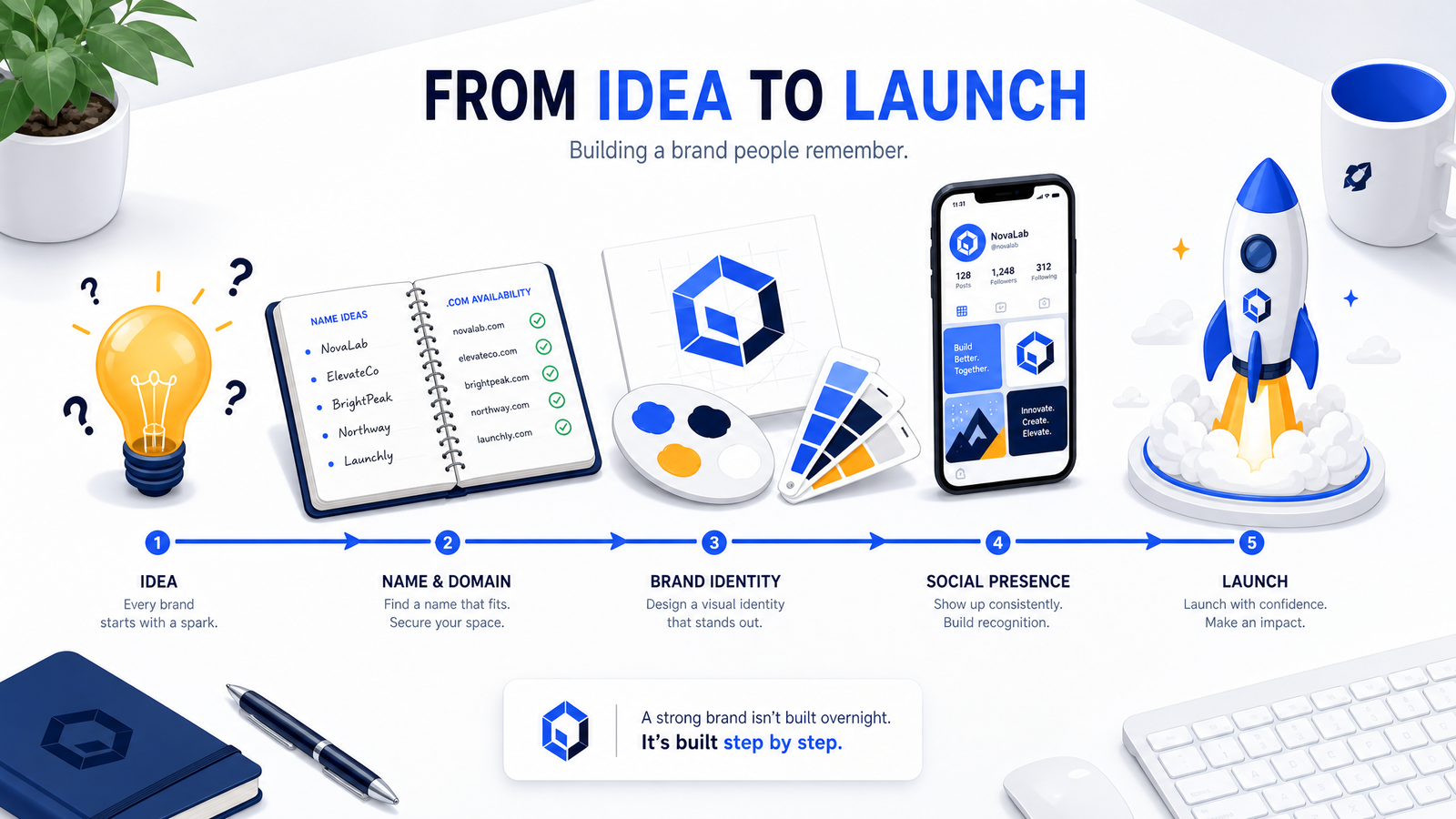
What Makes a Good Startup Name
- Easy to say and spell. If you have to explain how to spell your name over the phone, it's too complicated.
- Easy to remember. Short names work best (think CRED, Zomato, Ola, Swiggy).
- Meaningful (or memorably meaningless). A name can describe what you do (like "FreshMenu") or be a completely made-up word (like "CRED").
- Domain availability. Before you fall in love with a name, check if the .com, .in, and social media handles are available.
The Domain Check
Available .com domains for good names are rare in 2026. Alternatives:
- Get both .com and .in
- Use .co, .io, .app (works if your audience is tech-savvy)
- Use "get[yourbrand].com" or "try[yourbrand].com"
- Pick a unique name that has a free domain
Tools: Namecheap, GoDaddy, InstantDomainSearch for domains. Namechk or KnowEm for social handles.
Common Naming Mistakes
Inside jokes. A name only your co-founders find clever confuses everyone else.
Too generic. "Indian Food Express" or "Delhi Services Hub" — these get lost in search and don't differentiate you.
Hard to spell. "Xyztq Solutions" — nobody can find you or refer you.
Limiting future growth. "Bangalore Pizza" works only if you stay in Bangalore selling pizza. What if you expand?
Cultural issues. Check your name's meaning in Hindi, Tamil, Bengali, and other languages. Something innocent in English might mean something else.
Real Indian Startup Names and Why They Work
- CRED — Short, memorable, aspirational. Easy to type. Implies credibility.
- Zomato — Made-up word. Unique. Globally pronounceable.
- Razorpay — Descriptive but distinctive. Evokes precision and speed.
- Groww — Action word with personality. Positive connotation.
Step 2: Logo Design Principles
Your logo isn't everything, but it's often the first visual people see.
DIY First (Know Your Limits)
For early-stage startups, start with:
- Canva — Free logo templates. Upgrades cost ₹2,500/year.
- Looka or Hatchful — AI-generated logos. ₹3,000-₹5,000 for ownership.
- Fiverr or Freelancer — Indian freelancers charge ₹3,000-₹10,000. Quality varies.
When to Invest in Professional Design
Move to a pro when:
- You've raised a seed round
- Customers say your branding looks amateur
- Your logo fails at small sizes or in black and white
- You need your logo on packaging, signage, or merchandise
Professional logo design in India: ₹15,000-₹50,000.
What Makes a Good Startup Logo
Scalable. Looks good at 16px (favicon) and 16 feet (billboard).
Works in one color. Recognizable in all black. If it needs color to work, it's weak.
Timeless, not trendy. Avoid 2010s glossy skeuomorphism. Clean and simple serves you longer.
Original. Don't look like your competitor. Check trademark databases to avoid legal issues.
Logo Variations You Need
- Primary logo (full color)
- Icon/symbol only (favicon, app icon)
- Reversed (white on dark)
- Monochrome (black only)
- Minimum size (simplified for small spaces)
Step 3: Brand Voice and Messaging
Your brand voice is how you sound. Your messaging is what you say.
Finding Your Startup Voice
- If your brand was a person, would they be formal or casual?
- Would they use technical jargon or plain language?
- Serious and authoritative or playful and warm?
- Short and punchy or thoughtful and detailed?
Examples:
- CRED sounds like a cool friend who knows about finance
- Zerodha sounds like a patient teacher explaining investing
- Zomato sounds like an excited foodie friend
Core Messages Every Startup Needs
Elevator pitch (one sentence): "We help [target audience] achieve [outcome] by [your approach]."
Tagline (3-7 words): Short, memorable, distinct.
- CRED: "For the creditworthy"
- Zerodha: "Investing made simple"
- Amul: "The Taste of India"
Brand story (three paragraphs):
- The problem you saw
- What you built
- The world you're creating
Value proposition: Why choose you over every alternative?
Common Messaging Mistakes
- Trying to appeal to everyone. Be specific or be invisible.
- Features before benefits. "AI-powered" means nothing. "Make decisions faster" means everything.
- Copying competitors. If you sound like everyone else, you'll be forgotten.
- Buzzwords. "Synergistic, best-in-class, next-generation" add nothing.
Step 4: Visual Identity on a Startup Budget
You don't need a full brand system on day one.
Minimum Viable Brand Kit
- Logo
- Color palette — 2-3 colors (use Coolors.co)
- Typography — One heading font, one body font (Google Fonts is free)
- Social media templates — Canva templates for Instagram, LinkedIn, Facebook
- Basic brand guidelines — One page showing how to use everything
That's it. Enough to launch.
Free Tools
- Colors: Coolors.co, Adobe Color
- Fonts: Google Fonts
- Templates: Canva (free version)
- Icons: Font Awesome, Feather Icons, Lucide
- Stock photos: Unsplash, Pexels, Pixabay
What to Spend On
- Custom logo: ₹5,000-₹15,000
- Team photoshoot: ₹5,000-₹10,000
- Website: ₹20,000-₹50,000
Step 5: Brand Launch Strategy
You have a name, logo, and basic identity. Now launch.
Pre-Launch
- Landing page with "Coming Soon" and email signup
- LinkedIn or Twitter presence sharing your journey
- Waitlist building
- Reach out to 10 potential customers for feedback
Launch Day
- Announce on personal networks
- Publish "Why we started this" story (Medium, LinkedIn, or your blog)
- Email your waitlist with a launch offer
- Ask early users to share their experience
Post-Launch
- Publish consistently
- Respond to every comment and review
- Collect and showcase testimonials
- Refine messaging based on what resonates
Building Credibility Without Budgets
Content Marketing
Publish valuable content. Fintech startup? Write about personal finance. SaaS tool? Write about productivity. Food brand? Share recipes and nutrition. This positions you as an expert.
Social Proof
- Customer testimonials on every page
- Case studies with numbers
- User-generated content
- Media mentions (even small niche publications)
Partnerships
Partner with complementary businesses. Cross-promotion gives you access to their audience.
Awards
Apply for startup awards and certifications. Many are free. Even being a finalist adds credibility.
How Brand Helps Fundraising
When VCs evaluate your startup, they check:
- Does your pitch deck look professional? (Visual brand)
- Can they explain your product in one sentence? (Messaging clarity)
- Does your founder story feel authentic? (Brand narrative)
- Is your market positioning clear? (Brand strategy)
A well-branded startup signals attention to detail. If founders care about brand details, they probably care about product, service, and operations too.
Indian Startup Brand Case Studies
CRED
Launched in 2018 with a counterintuitive idea: make paying credit card bills aspirational.
Strategy: Exclusivity. "For the creditworthy." Membership by credit score.
Visual identity: Typography-first. Minimalist. The Hanken Grotesk font became synonymous with the brand.
Result: Unicorn in 3 years. Cult following. Brand value over ₹6,000 crores.
Lesson: Your brand can redefine an industry. CRED made a boring chore feel exclusive.
Zerodha
Disrupted Indian stockbroking by making investing simple and affordable.
Strategy: "Investing made simple." No jargon. No hidden fees. Transparent pricing.
Visual identity: Clean, green, educational. Feels like an expert teacher, not a flashy broker.
Result: India's largest stockbroker. Bootstrapped. Profitable.
Lesson: You don't need flashy branding. Authenticity and clarity win.
Bombay Shaving Company
Built a men's grooming brand from scratch against Gillette.
Strategy: Premium but accessible. "Better grooming for the modern Indian man."
Visual identity: Bold typography, dark premium look, high-quality photography.
Result: Multi-crore brand with D2C and retail presence.
Lesson: A strong brand lets you compete with giants. Gillette owns shelf space. BSC owns a feeling.
Common Branding Mistakes by Founders
1. Branding as an Afterthought
"Branding later" is the most expensive mistake. Branding built reactively is always worse and costs more.
2. Copying Competitors
"Make it look like [competitor]" — you look like a cheap copy. Differentiate, don't imitate.
3. Inconsistent Execution
Different logo on website vs Instagram vs pitch deck. Consistency is free. Use it.
4. Branding for Investors, Not Customers
Designing to impress VCs instead of connecting with customers is backwards.
5. Changing Everything Too Often
Rebranding every six months destroys recognition. Stick with your brand for at least 2-3 years.
📚 Related Articles You Might Like:
Conclusion
Building a brand from zero as an Indian startup isn't about spending lakhs on agencies. It's about smart, intentional choices — a good name, a simple logo, a clear voice, and consistent execution.
Start with the minimum viable brand kit. Launch. Get feedback. Iterate. As you grow, invest more. But never treat branding as optional.
Your brand is how people remember you, trust you, and choose you. In a market of thousands of startups, it's the difference between being noticed and being forgotten.
Building your startup brand? VidyaSaaS helps Indian startups build complete brand identities from the ground up. From name selection and logo design to brand guidelines and launch strategy, we've helped over 2,000 businesses find their voice. Schedule a free brand consultation.
Want Results Like This?
Get a free digital marketing audit and custom growth plan for your business.
Get Free AuditVidyaSaaS Team
Super AdministratorPart of the VidyaSaaS team — a group of digital marketing strategists, content specialists, and growth experts helping businesses across India achieve measurable results through data-driven marketing.
More about our teamRelated Articles
Handpicked content to help you grow your business
Kalaburagi Heritage to High-Tech: Branding Karnataka Emerging Business Hub Through Digital Marketing
Kalaburagi produces 30% of Karnataka tur dal and hosts major cement plants. But its brand identity i...
Ujjain Mahakal to Modern: Branding MP Spiritual and Industrial City for the Digital Age
Ujjain Mahakal Temple draws millions. Its industrial areas employ thousands. But its brand identity...
Sambalpur Digital Loom: Branding Odisha Handloom Heritage for the Ecommerce Era
Sambalpuri sarees take 3 weeks to weave by hand. But they sell online in 3 minutes when the branding...
Ready to Grow Your Business?
Let's discuss how we can create a data-driven digital marketing strategy tailored to your goals.