D2C Brand Growth in India: The Digital Marketing Plan to Scale From Zero to ₹1 Crore
Complete digital marketing roadmap for Indian D2C brands to scale from zero to ₹1 crore. Stage-by-stage strategy covering launch, growth, and scaling phases.
VidyaSaaS Team
Super Administrator
Introduction
The Indian D2C (Direct-to-Consumer) revolution isn't coming — it's already here. From beauty and personal care to food and fashion, Indian consumers are skipping middlemen and buying directly from brands they discover on Instagram, YouTube, and Google. Brands like Mamaearth, The Whole Truth, and Boat have shown what's possible. But what about the thousands of D2C brands launching every month in India?
Here's the reality: most D2C brands in India don't survive the first year. Not because their product is bad, but because their marketing strategy is. They either burn cash on ads without a plan or rely entirely on organic reach that dries up when Instagram changes its algorithm.
The difference between a D2C brand that hits ₹1 crore in revenue and one that shuts down at ₹10 lakh is not the product. It's the marketing strategy, stage by stage. For more on this, see our complete SEO guide.
In this blog, we'll break down exactly how to go from zero to ₹1 crore — the channels, budgets, tactics, and timelines that work for Indian D2C brands. We've helped brands based in Bhopal, Mumbai, and Delhi navigate this journey, and the principles are universal.
Let's build your D2C growth engine.
The Indian D2C Landscape in 2025-26
Before we dive into strategy, let's understand where the Indian D2C market stands right now. For more on this, see brand building guide.
India has over 200,000 D2C brands in various stages of growth. The market is projected to reach $100 billion by 2030. What's driving this? Three things: affordable smartphones and data, UPI making payments frictionless, and a generation of consumers who trust Instagram reviews over billboard ads.
But here's what most people miss — the Indian D2C customer is different from their Western counterpart. They expect COD (Cash on Delivery) options. They're more price-sensitive. They switch brands faster. And they're heavily influenced by what their WhatsApp groups recommend.
This means your marketing strategy can't just copy what worked in the US or Europe. For more on this, see influencer marketing insights. You need a India-specific playbook that accounts for:
- COD return rates that can hit 30-40% in some categories
- WhatsApp as a primary retention channel (not just email)
- Regional language preferences
- Festival season spikes (Diwali alone can do 30% of annual sales for many brands)
- Price comparison behaviour across platforms
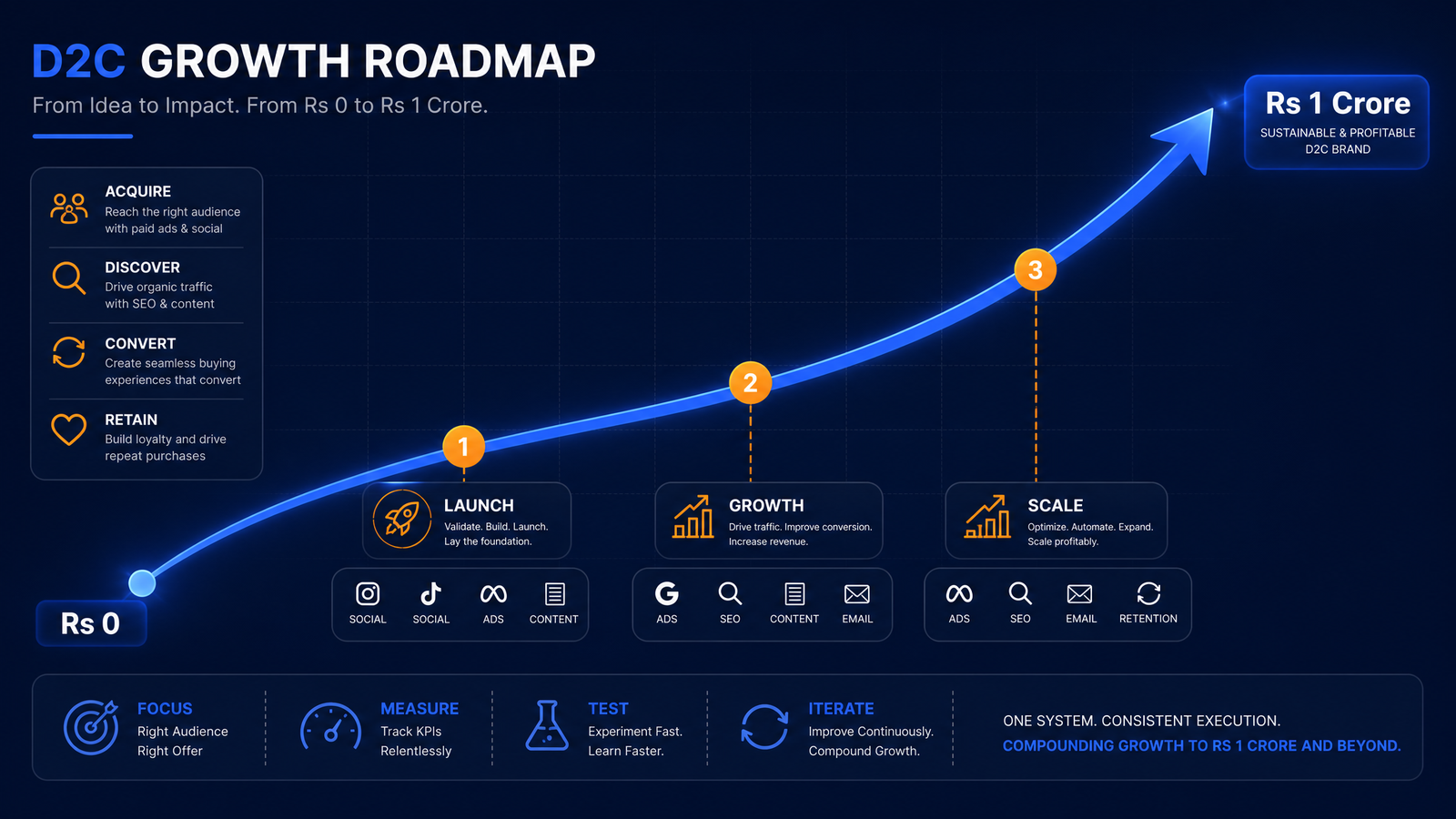
Stage 1: Launch (Months 1-3) — Building Brand Identity and First Customers
You have a product. You have a website. Now what?
The launch phase is not about profit. It's about validation — proving that people want your product enough to pay for it. Your goals in this phase: achieve 100+ orders, gather 50+ reviews, and build an engaged social following.
Branding and Positioning
Before you spend a rupee on ads, your brand foundation needs to be solid. This means:
- A clear problem statement: "We exist because X problem exists for Indian consumers"
- Differentiated positioning: What makes you different from existing options?
- Consistent visual identity: Colours, fonts, photography style
- Brand story that connects emotionally
Indian consumers are bombarded with options. Your brand story is what makes someone choose you over a competitor selling the exact same thing for ₹50 less.
Building Your First Website
Your website is your store. For D2C brands, speed and mobile optimisation are non-negotiable. 70%+ of Indian D2C traffic comes from mobile. If your site takes more than 3 seconds to load on a Jio 4G connection, you're losing customers.
Essential elements for your launch website:
- Clear value proposition above the fold
- High-quality product images (not stock photos)
- Mobile-first design
- Simple checkout (3 steps max)
- COD clearly available and explained
- Trust signals: payment icons, secure checkout badge, return policy
- Social proof: even if you have no reviews yet, feature media mentions or founder story
Social Media: Instagram First
For most Indian D2C brands, Instagram is the launch channel. Why? Because it's where your early adopters hang out, and it's the cheapest way to build awareness when you have zero budget.
Launch Instagram strategy:
- 30 posts before you launch (product shots, behind-the-scenes, founder story)
- Reels, Reels, Reels — Reels get 10x the reach of static posts
- User-generated content from beta testers
- Stories with polls and Q&A to build engagement
- Consistent posting (at least once daily)
- Hashtag strategy: mix of broad (#d2cindia, #madeinindia) and niche (#[yourcategory]india)
Early Influencer Marketing
You don't need a celebrity. You need 10 micro-influencers with 5,000-50,000 followers who have high engagement rates. In India, micro-influencers often outperform macro-influencers for D2C brands because their audience trusts them personally.
Launch influencer strategy:
- Give product in exchange for content (barter, no cash)
- Ask for honest reviews, not scripted promotions
- Repurpose influencer content across your channels
- Track with unique discount codes per influencer
Launch Budget Allocation
In the launch phase, your total marketing budget should not exceed ₹50,000-1,00,000 per month. Here's how to split it:
- 40%: Influencer and content (barter + small payments)
- 30%: Meta Ads (Instagram + Facebook)
- 20%: Google Ads (brand search when brand awareness is low)
- 10%: Experimentation (new channels, collaborations)
Stage 2: Growth (Months 4-8) — Paid Ads, Influencer Scaling, and Repeat Orders
You've validated the product. You have some orders and reviews. Now it's time to pour fuel on the fire.
In the growth phase, your goal is to hit ₹10-20 lakh per month in revenue. This requires moving from "let's see what works" to "let's double down on what's working."
Scaling Performance Marketing
This is where most D2C brands go wrong. They take what worked in the launch phase and just increase the budget. That's not scaling — that's burning money.
Meta Ads at scale:
- Build a proper funnel: awareness → consideration → conversion
- Retarget everyone who visited your site but didn't buy
- Create catalog ads for your full product line
- Use dynamic creative optimisation
- Test 10+ ad creatives per week (different hooks, formats, offers)
Google Ads for D2C:
- Shopping Ads are non-negotiable — they show product images + price directly in search
- Brand search: bid on your brand name (competitors will)
- Non-brand search: target "buy [product] in India" type keywords
- Performance Max campaigns for Google's full network
- Remarketing for cart abandoners
The ₹1 crore ad math: Most Indian D2C brands need a 2-3x ROAS (Return on Ad Spend) to be profitable after returns, COD charges, and product costs. If you're spending ₹5 lakh on ads, you need ₹12-15 lakh in attributed revenue. Track this obsessively.
Influencer Marketing at Scale
Move from barter to paid collaborations. Budget for 5-10 influencers per month with 50,000-500,000 followers each.
What changes in growth phase:
- Trackable affiliate links for every influencer
- Performance-based bonuses for influencers who drive sales
- Long-term ambassador programs (monthly retainers)
- Category expansion: partner with influencers in adjacent niches
Website Optimisation for Conversion
Your website should be converting at least 2-3% of visitors. If it's lower, fix these things before scaling ads:
- Page speed (target under 2 seconds on mobile)
- Checkout friction (offer guest checkout, reduce form fields)
- Trust badges prominently displayed
- Social proof widgets showing recent purchases
- Exit-intent popups with offers
- Product page structure: clear benefits > features, multiple angles, video
Cash on Delivery Optimisation
COD is both a blessing and a curse for Indian D2C. It unlocks customers who don't use cards or UPI, but return rates on COD orders can hit 40%.
COD best practices:
- Send WhatsApp confirmation within 1 minute of order
- SMS reminder 2 hours before delivery
- Call centre confirmation for orders above a certain value
- "Request OTP" delivery confirmation (reduces fake orders)
- Partial prepayment (₹50-100) for COD orders to confirm intent
- Follow-up sequence for RTO (Return To Origin) to salvage orders
Stage 3: Scale (Months 9-18) — SEO, Retention, and Market Domination
You're doing ₹20-50 lakh per month. Your brand has a following. Now it's time to build a moat that competitors can't easily cross.
The scaling phase is about efficiency and retention. Customer acquisition cost (CAC) naturally rises as you grow. Your job is to build channels that bring customers without increasing ad spend proportionally.
Search Engine Optimisation for D2C
Most D2C brands ignore SEO in the first year. That's a mistake. SEO is the gift that keeps giving — every article you write and every product page you optimise is an asset that compounds over time.
D2C SEO priorities:
- Category pages optimised for high-intent keywords ("buy organic face wash online")
- Product pages with unique descriptions (not manufacturer copy-paste)
- Blog content answering "best [product] for [problem] in India"
- How-to guides and comparison articles
- Video content on YouTube driving to your site
- Technical SEO: site structure, sitemaps, page speed
SEO timeline for D2C: You won't see results for 3-6 months. Start in month 6, and by month 12, it will be your highest-ROI channel.
Retention Marketing
Acquiring a customer costs 5-7x more than retaining one. In D2C, retention is where you build your moat.
Email marketing for D2C:
- Welcome sequence (5-7 emails over 2 weeks)
- Abandoned cart sequence (3 emails over 48 hours)
- Post-purchase sequence (order confirmation, shipping update, delivery confirmation, review request)
- Replenishment reminders (for consumable products)
- Win-back sequence for inactive customers
- Birthday and anniversary offers
Open rates in India average 15-20% for well-segmented email lists. Not great but important for a full retention strategy.
WhatsApp marketing (this is the Indian secret weapon):
- Opt-in only (DND compliance)
- Order updates and delivery tracking
- Personalised product recommendations
- Festive offers and exclusive previews
- Loyalty program updates
WhatsApp has 80%+ open rates in India. A well-executed WhatsApp strategy can be your highest-impact retention channel.
Loyalty programs:
- Points for purchases, reviews, referrals
- Tiered membership (Silver, Gold, Platinum) with increasing benefits
- Early access to new products
- Birthday gifts
- Referral rewards (give ₹100, get ₹100)
Marketplace vs D2C Website Strategy
Many Indian D2C brands wonder: should I sell on Amazon/Flipkart or only on my own website?
The answer is both. But the strategy is different:
Amazon/Flipkart advantages:
- Built-in traffic and trust
- Prime delivery network
- Easy customer acquisition
- Category visibility
Amazon/Flipkart disadvantages:
- High commissions (15-30%)
- No customer data
- Hard to differentiate
- Price competition
D2C website advantages:
- Full customer data ownership
- Higher margins (no marketplace commission)
- Brand experience control
- Direct relationship with customers
D2C website disadvantages:
- Zero built-in traffic
- Higher marketing cost per acquisition
- Logistics setup required
The winning strategy: Use marketplaces for discovery and your website for retention. Capture marketplace customers through inserts with your website URL, and redirect repeat buyers to your own store where margins are higher.
Real D2C Success Metrics to Track
In the launch phase, track: orders, cost per order, customer acquisition cost, and repeat purchase rate.
In the growth phase, add: ROAS by channel, average order value, customer lifetime value (LTV), and return rate.
In the scale phase, track: LTV:CAC ratio (should be 3:1 or higher), organic revenue percentage, retention rate at 30/60/90 days, and net promoter score.
Real numbers from Indian D2C brands we've worked with:
A personal care brand from Bhopal went from ₹0 to ₹12 lakh per month in 6 months by focusing on Instagram Reels + micro-influencers. Their launch month? 47 orders. Month 6? 2,100 orders. Their secret? They invested 60% of their early budget in content, not ads.
A snack brand from Indore hit ₹85 lakh per month in 14 months. Their turning point? Fixing their website speed (from 5.8 seconds to 1.9 seconds) — conversion rate went from 0.8% to 2.7% overnight.
A home decor brand from Delhi scaled from ₹3 lakh to ₹45 lakh per month by shifting 40% of their ad budget to Google Shopping Ads. Meta Ads had plateaued, but Shopping Ads opened a new acquisition channel that tripled their revenue.
Common D2C Marketing Mistakes
Scaling too fast: Increasing ad budget by 5x in one month leads to ad fatigue, higher costs, and lower returns. Scale by 20-30% per week at most.
Ignoring unit economics: If your cost per order is ₹800 and your average order value is ₹600, every sale is a loss. Fix the math before scaling.
No retention strategy: Getting a first order is exciting. But if you never email or WhatsApp that customer again, you've wasted the hardest acquisition you'll ever make.
Bad messaging: "Premium quality" means nothing. "Made with Kashmiri saffron and cold-pressed" tells me exactly why it's different.
Copying competitors: Your competitor might be crushing it on LinkedIn Ads. That doesn't mean you should be. Run your own tests.
When to Hire a Marketing Agency
You can DIY the launch phase. But by the time you hit ₹20 lakh per month, you need specialists. Here's when to bring in help:
- Meta Ads specialist when you're spending ₹1+ lakh per month on Meta
- SEO expert when you have 50+ products on your site
- Retention marketer when you have 5,000+ customers
- Full-service agency at ₹50+ lakh per month
VidyaSaaS offers comprehensive D2C marketing services — from performance marketing and SEO to retention strategies and creative production. Our team has scaled multiple D2C brands from launch to ₹1 crore and beyond.
📚 Related Articles You Might Like:
Conclusion
Going from zero to ₹1 crore as an Indian D2C brand is not about luck. It's about having the right strategy for each stage of growth. Launch with great product and brand. Grow with performance marketing and influencers. Scale with SEO and retention.
The brands that win are the ones that understand each stage requires a different playbook. Most D2C brands fail because they treat month 3 the same as month 12. Don't be that brand.
Ready to scale your D2C brand? Get in touch with VidyaSaaS for a free marketing audit. Our team of 50+ digital marketing professionals can help you build a growth engine that takes you from zero to ₹1 crore and beyond. Call +91 97542 70102 or email info@vidyasaas.com.
Want Results Like This?
Get a free digital marketing audit and custom growth plan for your business.
Get Free AuditVidyaSaaS Team
Super AdministratorPart of the VidyaSaaS team — a group of digital marketing strategists, content specialists, and growth experts helping businesses across India achieve measurable results through data-driven marketing.
More about our teamRelated Articles
Handpicked content to help you grow your business

Digital Marketing for Noida Startups: From Zero to Visible in 90 Days
A practical 90-day digital marketing roadmap for Noida startups to build online visibility, attract...

Jaipur Business Guide: Traditional Markets Meet Digital Growth
How Jaipur businesses from gems to hospitality can blend traditional strengths with modern digital m...

Digital Marketing in Chandigarh: The Tricity Growth Playbook
A comprehensive digital marketing playbook for Chandigarh businesses targeting the Tricity area — Pa...
Ready to Grow Your Business?
Let's discuss how we can create a data-driven digital marketing strategy tailored to your goals.