
How to Handle Negative Google Reviews: An ORM Action Plan for Indian Brands
Learn how Indian businesses can handle negative Google reviews effectively. Step-by-step response framework, legal guidelines, and review management strategies.
VidyaSaaS Team
Super Administrator
Introduction
Let's be honest — getting a negative Google review hurts. You pour your heart into your business, and then one afternoon, you open Google Maps and see a 1-star review about "rude staff" or "bad service." Your heart sinks. Your first instinct? Fire back with a defensive response, or maybe just ignore it and hope it goes away.
Here's the thing — both reactions will cost you customers.
In India, where word-of-mouth travels faster than ever through WhatsApp forwards and social media shares, your Google Business Profile is often the first thing a potential customer sees. A single badly-handled negative review can turn away dozens of prospective buyers. But handled well? That same review becomes proof of your professionalism. For more on this, see reputation management guide.
This isn't about making all bad reviews disappear. It's about building an Online Reputation Management (ORM) system that turns criticism into credibility. At VidyaSaaS, we've managed ORM for over 500 Indian businesses across cities like Bhopal, Indore, Mumbai, Delhi, and Bangalore. We've seen what works and what backfires spectacularly.
Let's build your ORM action plan from the ground up.
Why Negative Reviews Matter More in India
The Indian consumer is unique. We're price-sensitive but quality-conscious. Before booking a salon appointment, ordering food, or hiring a plumber, most of us check Google reviews. And here's the stat that should make you sit up — studies show that 94% of Indian consumers read online reviews before making a purchase decision. More importantly, 84% trust online reviews as much as personal recommendations. For more on this, see our local SEO guide.
But here's the kicker — it's not the star rating alone that matters. It's how you respond.
When a potential customer in Pune sees that a restaurant owner responded politely to a 1-star review about cold food, they think: "This place cares." When they see a 2-star review with no response at all, they think: "This place doesn't care about feedback."
And when they see a business owner arguing angrily with a reviewer? That's a delete-and-never-visit moment. For more on this, see our complete SEO guide.
The good news is that negative reviews, when handled correctly, can actually boost your credibility. Research indicates that consumers trust businesses with a mix of positive and negative reviews more than those with perfect 5-star ratings. A perfect record looks fake. A business that handles criticism gracefully looks human.
The Psychology of the Negative Reviewer
Before you write a single word of your response, take a moment to understand where the reviewer is coming from. This isn't about excusing bad behaviour — it's about responding strategically.
Most negative reviews fall into one of these categories:
The Genuinely Wronged Customer — Something actually went wrong. Food was late, product was defective, service was unprofessional. This person wants acknowledgment and, ideally, a fix. If you handle this well, they'll often update their review.
The Unreasonable Expectation Setter — They expected something you never promised. Maybe they walked into a budget salon expecting luxury spa treatment. Their frustration is real, but the fault isn't entirely yours.
The Competitor or Troll — Yes, this happens in India. A competitor's employee posts a fake 1-star review. Or someone who had a bad day decides to vent. These are harder to spot but do happen.
The Serial Complainer — Some people are never happy. They leave 1-star reviews at every place they visit. Their complaint might be minor, but their response to your response will be aggressive.
Your response strategy needs to account for which type you're dealing with. The framework below works for all of them, but the tone and approach will vary.
The VidyaSaaS ORM Response Framework
After managing thousands of reviews across industries, we've developed a five-step framework that works for Indian businesses. Use this for every negative review.
Step 1: Pause and Process
Never respond to a negative review within the first hour. I know you want to. Don't.
Your emotional brain wants to defend, explain, or attack. Your strategic brain needs time to assess. Give yourself at least 2-4 hours — overnight if the review came late in the evening.
During this time, do three things:
- Research the customer — check if they're in your CRM, what their visit was, what happened
- Talk to your team — find out what actually occurred from your staff's perspective
- Decide the category — genuine issue, unreasonable expectation, troll, or serial complainer
Step 2: Acknowledge and Apologize Specifically
This is where most Indian businesses mess up. They write generic apologies like "Sorry for the inconvenience." That's meaningless.
A good apology is specific: "We're sorry that your biryani arrived cold. That's not our standard, and we understand how disappointing that must have been after waiting 40 minutes for delivery."
Notice what this does: names the specific issue, takes ownership, and shows empathy. It acknowledges the customer's time and feelings.
Never say "sorry you felt that way" — that's a non-apology that blames the customer. Never blame "the delivery partner" or "the Zomato boy" — take ownership.
Step 3: Explain Without Excusing
You can explain what went wrong without making excuses. The difference:
Excuse: "We were very busy that night and the kitchen was overwhelmed." Better: "We had an unexpectedly busy evening, and our kitchen fell behind on quality checks. We've added an extra chef to prevent this."
The first sounds like you're making excuses. The second acknowledges the problem AND shows what you're doing to fix it. Customers care more about the fix than the reason.
Step 4: Take the Conversation Offline
For serious complaints, offer a way to connect privately. Give an email, phone number, or ask them to DM you on Instagram.
"Please reach out to us at manager@yourbusiness.com — we'd love to make this right personally. We've noted your order details and want to ensure you have a completely different experience next time."
This serves two purposes: it shows public accountability while moving the detailed conversation to a private channel where issues can be resolved without a public back-and-forth.
Step 5: Close with Invitation
End your response by inviting them to give you another chance:
"We'd love the opportunity to serve you better. Please give us a chance to show you the experience we're known for."
What to Never, Ever Say
Some responses are worse than no response at all. Here's your absolute never-list:
"This review is fake." — Even if it is, calling it fake publicly invites more scrutiny. Handle fake reviews through Google's reporting process, not in a public response.
"You're lying." — Never directly call a customer a liar. It makes you look defensive even when you're right.
"Actually, according to our records..." — Starting with "actually" is confrontational. Frame corrections neutrally.
"Our other customers love us." — Irrelevant. You're dismissing one person's experience.
"We've been in business for 20 years." — Also irrelevant. Longevity doesn't excuse a single bad experience.
Personal attacks or sarcasm. — This should go without saying, but in the heat of the moment, businesses slip. Don't.
Legal Considerations for Indian Businesses
India doesn't have a specific law for online reviews, but several legal frameworks apply:
Consumer Protection Act, 2019 — This is the big one. Fake reviews that mislead consumers are a violation. If a competitor posts a fake review about you, you can file a complaint. Equally, if you're posting fake positive reviews about yourself, that's also actionable.
IT Act, 2000 (Section 66A, 67) — Defamatory content, including false reviews that harm your business reputation, can be challenged. Though Section 66A was struck down, other provisions still protect against cyber defamation.
Google's Defamation Policy — You can flag reviews that contain hate speech, threats, fake content, or competitor spam. Reviews that are clearly about a different business can also be reported.
Practical steps for legal action:
- Document everything — take screenshots of reviews, save timestamps
- If it's a genuine customer who's being unreasonable, try resolving privately first
- For fake reviews, report through Google Business Profile dashboard
- For serious defamation, consult a lawyer who understands cyber law
- In most cases, a well-crafted public response is more effective than legal action
Getting Negative Reviews Removed: Google's Actual Policy
Here's the truth — Google doesn't remove reviews just because they're negative. They remove reviews that violate their policies:
Policy violations that can get a review removed:
- Spam and fake content (AI-generated reviews, reviews from non-customers)
- Offensive content (hate speech, threats, sexual content)
- Conflict of interest (competitors or employees reviewing their own business)
- Off-topic (reviewing something that isn't about your business)
- Impersonation (someone pretending to be your business)
How to report a review:
- Log into your Google Business Profile
- Find the review you want to report
- Click the three dots next to the review
- Select "Flag as inappropriate"
- Fill in the reason
- Wait — Google can take days or weeks to act
The hard truth: Most flags don't result in removal unless there's a clear policy violation. A negative review that accurately describes a bad experience is staying. Your best bet is handling the response well and getting more positive reviews to dilute the impact.
Turning Negative Reviews Into Positive Outcomes
Every negative review is a free consulting session from your market. Here's what to do with the data:
Pattern recognition: If you're getting multiple reviews about "slow service," that's not a review problem — that's an operations problem. Fix the underlying issue.
Training material: Share negative reviews (anonymized) with your team. "See what happened when Mr. Sharma had to wait 30 minutes? How do we ensure this doesn't happen again?"
Process improvement: A restaurant in Indore noticed three reviews about AC not working. They fixed their AC and mentioned it in responses to those reviews. New customers started commenting on how well-maintained their AC was.
Trust building: When a business in Mumbai handled a complaint about a wrong delivery with grace and offered a free replacement, the customer not only updated their review to 4 stars but became a regular. The public response to that negative review brought in more customers than any ad campaign.
Encouraging Positive Reviews Ethically
The best antidote to negative reviews is a steady stream of positive ones. But you need to do this right:
What works:
- Ask happy customers directly — "If you enjoyed your experience, would you mind leaving us a Google review?"
- Add a review link to your email receipts and WhatsApp messages
- Put a Google review card at your checkout counter
- Send a follow-up message after service: "Thank you for visiting! If everything was great, here's our Google review link."
- Make it easy — share a direct link to your review page
What doesn't work (and can get you penalised):
- Offering discounts or freebies in exchange for reviews — violates Google's policy
- Writing fake reviews — Google can detect and remove them
- Review gating — only asking happy customers to review while hiding the link from unhappy ones
- Review clubs — asking friends and family to post 5-star reviews without actually visiting your business
Review Response Templates
These are starting points. Customise them for your specific situation.
Template 1: Genuine Service Failure
"Thank you for your honest feedback, [Name]. We're genuinely sorry that [specific issue]. That's absolutely not the experience we want our customers to have. We've spoken with our team about [specific fix], and we'd love the opportunity to make this right. Please reach out to [email/phone] so we can personally ensure your next experience is exactly what it should be."
Template 2: Unreasonable Expectation
"Thank you for your feedback, [Name]. We understand your frustration and appreciate you sharing your perspective. While we strive to provide [your standard offering], we recognise that expectations can vary. We'd love to understand more about what you were hoping for — please connect with us at [email] so we can discuss this further."
Template 3: Competitor Troll or Fake Review
"Thank you for your feedback. We take all reviews seriously and have reviewed our records. We don't have any record of [specific complaint] occurring at our business. If you are a genuine customer, please contact us at [email] so we can investigate and make things right."
Template 4: You Genuinely Fixed the Issue
"Thank you for giving us a chance to make things right, [Name]. We're glad we could resolve [specific issue] and appreciate you updating your review. We've implemented [permanent fix] to ensure this doesn't happen again. Looking forward to serving you again."
Real Examples: Good vs Bad Responses
The Good: Hair Salon in Indore
Review: "Booked for a haircut at 5 PM. Was made to wait 45 minutes. No one even told me about the delay."
Bad Response: "Sorry for the wait. We get very busy in the evenings."
Good Response: "Rajesh, thank you for your feedback. Waiting 45 minutes without communication is unacceptable, and we're truly sorry. We've reviewed our booking system and realised we were overbooking peak slots. We've now added a 15-minute buffer between appointments and trained our reception team to proactively communicate any delays. Please visit us again — your next haircut is on us. Call us at 9876543210 to book, and our manager will personally ensure you're seen on time."
What made this good? Specific apology, concrete fix, actionable offer, personal touch.
The Bad: Restaurant in Bhopal
Review: "Food was bland and the service was slow."
Bad Response: "Actually most of our customers love our food. Maybe you ordered the wrong dish. And we were very busy that night."
This response argues with the customer, dismisses the feedback, makes excuses, and shows zero willingness to improve. It tells every potential customer reading: "We don't care about your feedback."
When to Escalate Offline
Some situations are too complex or sensitive for a public response. Escalate offline when:
- Legal threats are involved — Never discuss legal action in public responses
- The customer has a history of issues — A pattern requires a personal conversation
- The issue involves money — Refunds, replacements, or billing disputes are private matters
- The review contains personal information — Google will remove reviews with personal data
- The customer is clearly emotional and escalating — Sometimes a phone call resolves what 10 public responses can't
Building Your ORM System
A single response isn't a strategy. An ORM system is:
Weekly: Check all new reviews. Respond within 48 hours. Track sentiment trends.
Monthly: Review complaint patterns. Are there recurring issues? Fix them at the source.
Quarterly: Audit your Google Business Profile. Update photos, services, and response templates.
Continuous: Encourage positive reviews. Monitor mentions across Google, Justdial, Zomato, Swiggy, and social media.
Tools for ORM: Services like Repute, ReviewTrackers, or even a simple Google Sheets tracker can help you stay organised. At VidyaSaaS, we offer comprehensive ORM services that include review monitoring, response drafting, and monthly reputation reports.
📚 Related Articles You Might Like:
Conclusion
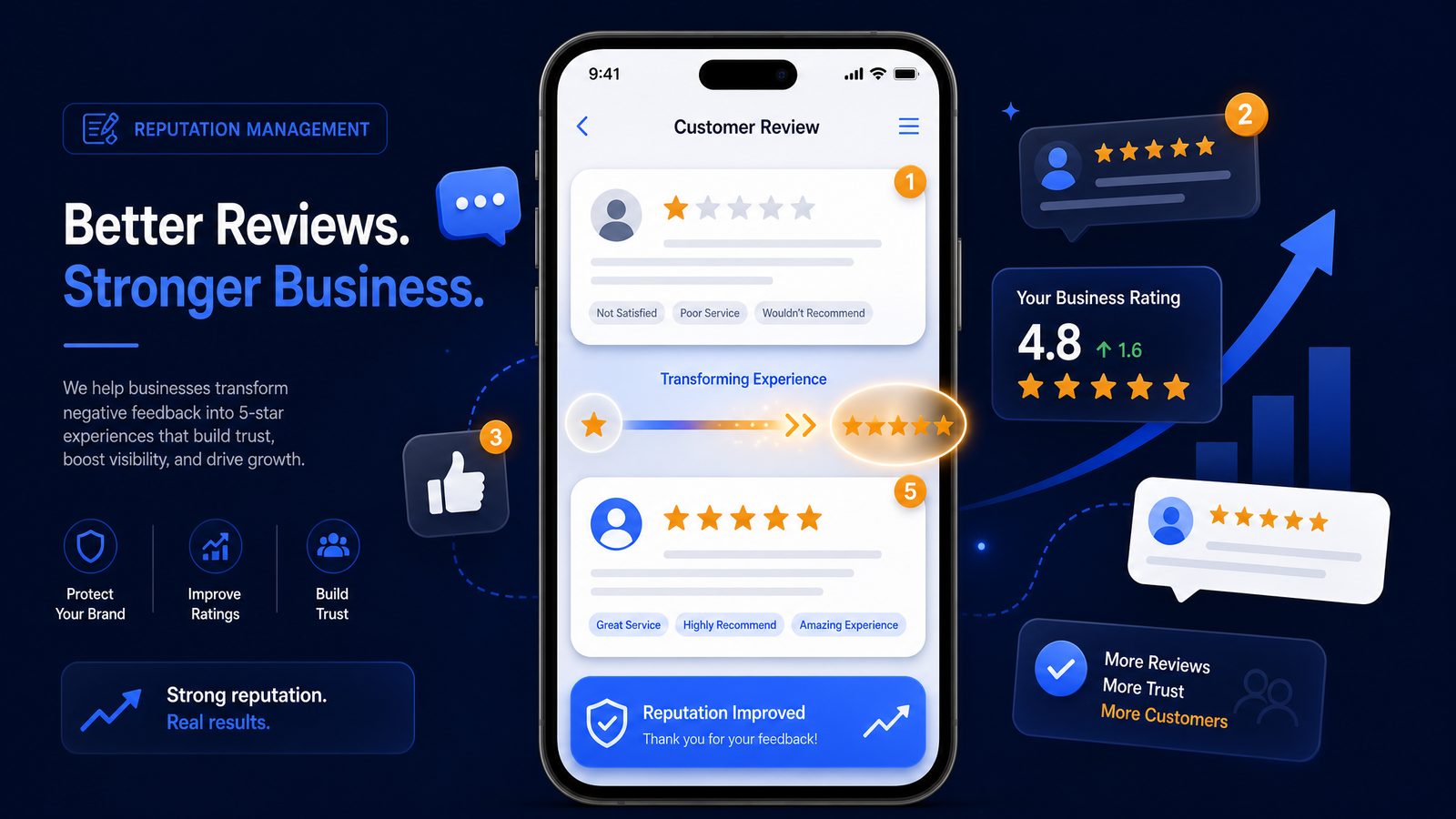
Negative Google reviews aren't a crisis — they're a conversation. When you handle them professionally, specifically, and promptly, you turn a critic into a customer and a complaint into a case study.
The businesses that win in India today aren't the ones with perfect 5-star ratings. They're the ones that respond to every review — good and bad — with professionalism and care. A well-handled complaint tells potential customers more about your character than a hundred 5-star reviews ever could.
At VidyaSaaS, we've helped hundreds of Indian businesses build reputation systems that actually work. From review response templates to full ORM strategies, our team knows what moves the needle.
Ready to take control of your online reputation? Contact VidyaSaaS for ORM services — get a free review audit and personalised response strategy for your business. Call us at +91 97542 70102 or email info@vidyasaas.com.
Want Results Like This?
Get a free digital marketing audit and custom growth plan for your business.
Get Free AuditVidyaSaaS Team
Super AdministratorPart of the VidyaSaaS team — a group of digital marketing strategists, content specialists, and growth experts helping businesses across India achieve measurable results through data-driven marketing.
More about our teamRelated Articles
Handpicked content to help you grow your business

Ready to Grow Your Business?
Let's discuss how we can create a data-driven digital marketing strategy tailored to your goals.