
Online Reputation Management (ORM): What It Is and Why Indian Businesses Need It
Online Reputation Management (ORM) explained for Indian businesses. Learn how to manage reviews, handle negative feedback, build a positive brand image, and protect your reputation online.
VidyaSaaS Team
Super Administrator

Introduction
Here's a story that should scare every business owner.
A restaurant in Pune had been running successfully for eight years. Consistently 4.3 stars on Google. Solid reviews. Stellar word of mouth.
One Saturday night, a customer had a bad experience. The food took too long. The service was slow. They posted a one-star Google review with a photo of their cold food. Not just one review — they also posted on Twitter tagging food bloggers. They made a 30-second video and put it on Instagram Reels.
Within 48 hours, that single review had been seen by over 2 lakh people. The restaurant's bookings dropped 40% over the next two weeks. It took them six months and a dedicated reputation management campaign to recover.
This is not an unusual story. In 2026, a single negative review can cost a business lakhs of rupees. One bad experience, amplified by social media, can undo years of goodwill.
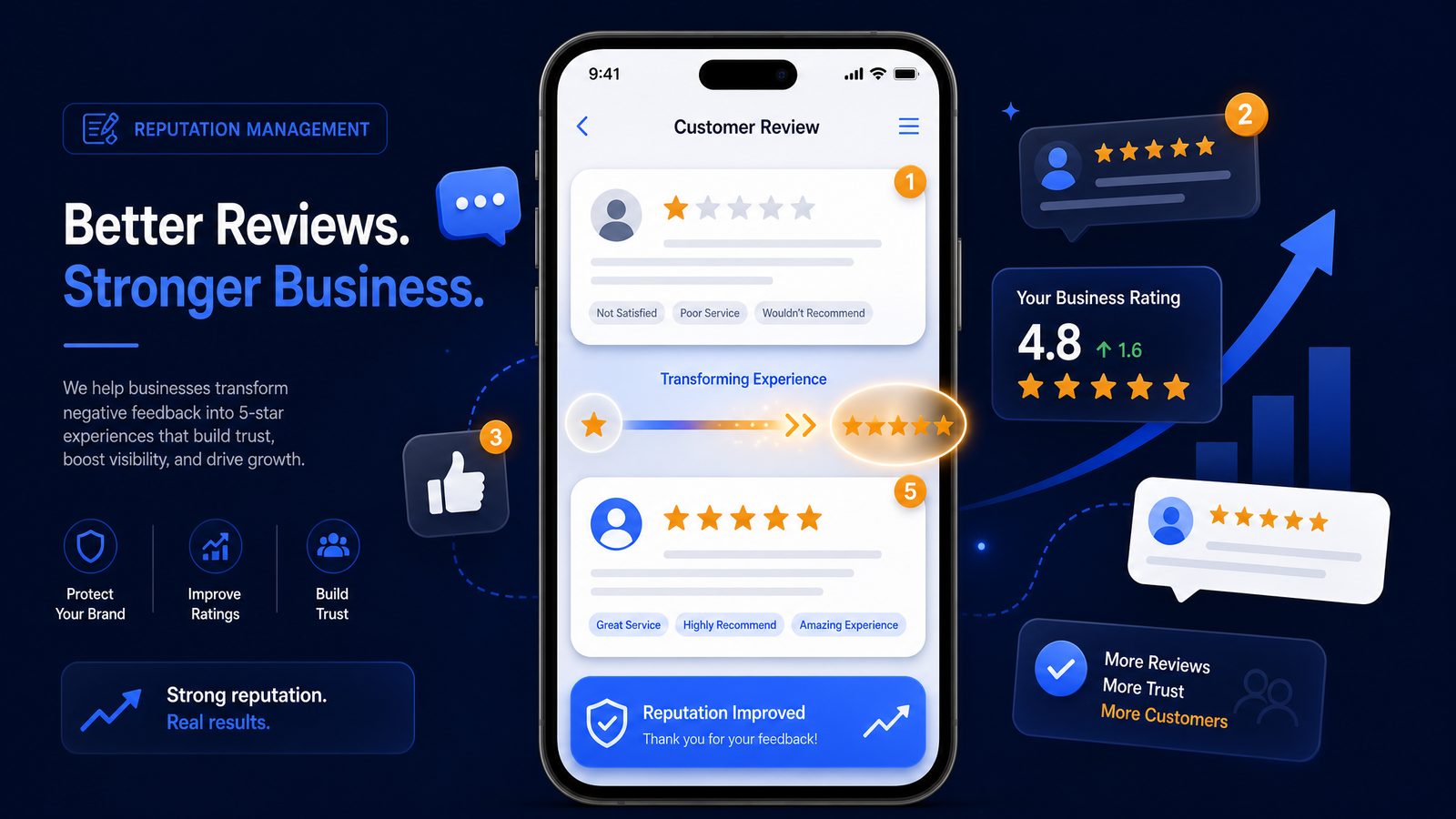
That's why Online Reputation Management (ORM) has become one of the most critical areas of digital marketing. It's not just about responding to reviews. It's about actively monitoring, managing, and shaping what people see when they search for your business online. For a deeper dive, see local SEO strategies.
This guide covers everything Indian business owners need to know about ORM — what it covers, why it matters, how to handle negative reviews, and how to build a positive online reputation that protects your business.
What ORM Actually Covers
Online Reputation Management is the practice of monitoring, managing, and influencing how your business is perceived online. Think of it as digital PR — but more systematic and data-driven.
The Five Pillars of ORM
1. For a deeper dive, see digital marketing framework. Review Management
This is what most people think of when they hear ORM. Monitoring and responding to reviews on platforms like Google Maps, Justdial, Zomato, UrbanClap, and industry-specific review sites.
Review management includes:
- Monitoring new reviews as they come in
- Responding to positive reviews (thanking reviewers)
- Responding to negative reviews (addressing concerns professionally)
- Encouraging satisfied customers to leave reviews
- Flagging fake or malicious reviews for removal
2. Social Listening
Social listening is monitoring what people are saying about your brand across social media platforms — Twitter, Instagram, Facebook, YouTube, Reddit, and forums like Quora.
Social listening catches:
- Mentions of your brand name (tagged or untagged)
- Discussions about your products or services
- Trends in customer sentiment
- Early warning signs of potential crises
3. Content Suppression
Content suppression is the strategy of pushing negative search results down by creating positive content. You can't delete bad reviews or negative articles. But you can push them to page 2 of Google search results where 95% of people never look.
Content suppression tactics:
- Publishing positive blog posts and articles
- Creating and optimizing your website pages
- Building strong social media profiles
- Getting positive press coverage
- Encouraging user-generated content
4. Crisis Management
When something goes wrong — a product recall, a customer complaint gone viral, a PR disaster — crisis management kicks in. This is the most high-pressure part of ORM.
Crisis management involves:
- Rapid response protocols
- Internal communication strategy
- External messaging (public statements, apologies, action plans)
- Media handling
- Long-term recovery planning
5. Proactive Reputation Building
The best ORM is the kind you do before anything goes wrong. Proactive reputation building creates a reservoir of goodwill that protects you when things get tough.
Proactive tactics:
- Publishing thought leadership content
- Building an active, engaged social media presence
- Participating in industry events and communities
- Creating valuable resources for your audience
- Building relationships with journalists and influencers
Impact of Online Reputation on Sales
Let's look at the numbers. The data on how online reputation affects business is clear.
The Statistics That Matter
93% of consumers read online reviews before making a purchase decision. This number has been rising steadily and is now nearly universal.
87% of consumers trust online reviews as much as personal recommendations. A good review carries almost the same weight as a friend's suggestion.
A one-star increase in your Google rating can increase revenue by 5-9%. For a restaurant doing ₹50 lakhs annually, that's ₹2.5-4.5 lakhs in additional revenue — from just better reviews.
72% of consumers will not consider a business with an average rating below 4 stars. If your rating drops from 4.2 to 3.9, you lose nearly three-quarters of potential customers.
A single negative review at the top of your Google listing can reduce conversion rates by 22%. That's one bad review costing you nearly a quarter of your potential sales.
It takes 40 positive reviews to offset the damage of one negative review. This isn't a rule set by Google — it's consumer psychology. People weigh negative information more heavily than positive information.
The Indian Context
These statistics apply globally, but the Indian market has some specific characteristics:
- Indian consumers are more likely to check Google Reviews and Justdial before purchasing
- WhatsApp-forwarded negative reviews and news spread rapidly in Indian social circles
- Indian consumers are more forgiving of service issues (if the response is good) but less forgiving of quality issues
- Price-sensitive Indian buyers use reviews to reduce the risk of wasting money
- In tier-2 and tier-3 cities, word-of-mouth is amplified by community groups on WhatsApp and Facebook
Google Reviews, Justdial, IndiaMART, Glassdoor: The Key Platforms
Different platforms matter for different types of businesses. Here's what you need to know about the major players.
Google Business Profile (formerly Google My Business)
Why it matters: Google Reviews are the most visible and most trusted reviews. They appear directly in Google search results and Google Maps. For local businesses, Google Reviews are the single most important reputation factor.
What to do:
- Claim and verify your Google Business Profile
- Complete every field (hours, photos, services, attributes)
- Respond to every review — positive and negative
- Post regular updates (offers, events, new products)
- Monitor your overall rating weekly
Response strategy:
- Positive reviews: Thank them. Personalize. "Thanks for the kind words, Rohan! We're glad you enjoyed the biryani."
- Negative reviews: Apologize, address the issue, take it offline. "We're sorry about your experience. Please DM us so we can make it right."
Justdial
Why it matters: Still widely used by Indian consumers, especially for local services. Older demographics rely heavily on Justdial.
What to do:
- Verify and complete your listing
- Respond to reviews
- Encourage satisfied customers to leave reviews here too
- Keep your contact info and service details updated
Zomato / Swiggy (for restaurants and food businesses)
Why it matters: Reviews on these platforms directly impact ordering decisions. A drop in rating can cause a measurable drop in orders.
What to do:
- Respond to every review (Zomato allows owner responses)
- Address complaints about specific dishes
- Acknowledge delivery issues (even if the restaurant wasn't at fault)
- Use the "thank you" feature for positive reviews
IndiaMART / TradeIndia (for B2B and manufacturing)
Why it matters: B2B buyers use these platforms to vet suppliers. Negative reviews here can cost you significant contracts.
What to do:
- Keep your product catalog up-to-date and accurate
- Respond to inquiries promptly
- Encourage satisfied B2B clients to leave reviews
- Address quality or delivery complaints transparently
Glassdoor / AmbitionBox (for employer branding)
Why it matters: Your company's reputation as an employer affects your ability to hire good talent. Employees leaving negative reviews can also become a PR problem.
What to do:
- Claim your company profile
- Respond professionally to negative reviews
- Encourage satisfied employees to share their experience
- Address the issues raised (if valid — and be transparent about changes you're making)
Naukri.com / LinkedIn (for professional reputation)
Why it matters: For B2B companies and consultancies, professional reviews on these platforms affect client trust.
What to do:
- Maintain an active, professional presence
- Respond to feedback on company pages
- Share client testimonials and case studies
How to Respond to Negative Reviews
The way you respond to a negative review matters as much as the review itself. A good response can turn a complaining customer into a loyal advocate. A bad response can turn a one-star review into a viral PR disaster.
The ORR Framework (Own, Respond, Resolve)
Own: Acknowledge the problem. Don't make excuses. Don't blame the customer. Don't blame your staff publicly.
Good: "We're sorry you had a disappointing experience."
Bad: "Our staff says your food was served correctly. Are you sure you ordered the right thing?"
Respond: Respond publicly. Show other customers that you care. Then take the conversation private for detailed resolution.
Good: "We'd like to learn more about what went wrong. Please DM us your contact details so our manager can personally follow up."
Bad: "Please email us at support@company.com." (This looks impersonal and dismissive.)
Resolve: Actually fix the problem. If the food was cold, offer a replacement meal or refund. If the product was damaged, send a replacement. And then follow up to make sure the customer is satisfied.
Sample Response Templates
For a reasonable complaint (service issue, one-time mistake): "Hi [name], thank you for your honest feedback. We apologize that your experience didn't meet our standards. This isn't the kind of service we aim to provide. Could you please DM us your contact information so our manager can look into this personally? We'd like to make it right."
For a review that's unfair or inaccurate: "Hi [name], we take all feedback seriously. While we believe there may have been a misunderstanding regarding [specific point], we apologize for any inconvenience caused. We'd appreciate the opportunity to discuss this further. Please reach out to us at [phone/email]."
For a review that includes valid, repeated concerns: "Hi [name], thank you for bringing this to our attention. You're right that [issue] is not acceptable, and we're taking steps to address it. We've spoken with our team about [specific change being made]. We hope you'll give us another chance to serve you better."
What NOT to Do
- Never argue with the reviewer publicly
- Never reveal private information (order details, the customer's full name, payment info)
- Never blame the customer for your mistake
- Never respond with standard copy-paste — it looks insincere
- Never ignore a negative review
Proactive Reputation Building
The best defense is a good offense. Building a strong online reputation before problems arise protects your business when they do.
Encourage Positive Reviews
Most satisfied customers never leave reviews. You need to ask.
How to ask for reviews:
- After a successful purchase, send a follow-up email or WhatsApp message: "We're glad you enjoyed your experience. If you have a moment, please leave us a Google review."
- Put a QR code at your checkout counter that links directly to your Google review page
- Add a review request to your post-service email or receipt
- Run a "Review Contest" — enter customers who leave reviews into a monthly draw (make sure platform guidelines allow this)
Important: Don't incentivize positive reviews specifically. Don't say "Leave a 5-star review and get 10% off." This violates platform policies and feels dishonest. Say "We'd love your honest feedback" instead.
Create Quality Content
A strong content strategy builds your reputation across multiple dimensions:
- Blog posts that demonstrate your expertise (thought leadership establishes authority)
- Customer success stories and case studies (social proof at its best)
- Behind-the-scenes content (humanizes your brand)
- Community involvement coverage (shows you're a good corporate citizen)
Build a Strong Social Media Presence
An active, engaged social media presence creates a buffer against negative content. When something bad happens, your followers see your side of the story, not just the negative posts.
What "active" means:
- Post consistently (3-5 times per week minimum)
- Respond to comments and DMs
- Share user-generated content
- Show your human side (team photos, celebrations, behind-the-scenes)
Monitor Your Brand
You can't manage what you don't know about. Set up monitoring to catch mentions early.
Free monitoring tools:
- Google Alerts: Get emails when your brand is mentioned online
- Social media search: Use platform-native search for your brand name
- Mention (basic plan): Start at ₹5,000/month for more comprehensive monitoring
Paid monitoring tools (for growing businesses):
- Brand24: ₹15,000-₹50,000/month
- Awario: ₹13,000-₹40,000/month
- Sprout Social: ₹15,000+/month
ORM Tools for Indian Businesses
You don't need expensive enterprise tools to start managing your reputation. Here are options for every budget.
Free / Minimum Budget
Google Alerts: Monitor brand mentions across the web. Free. Google Business Profile dashboard: Monitor and respond to Google reviews. Free. Social media platform notifications: In-app notifications for tags, mentions, and reviews. Free. Spreadsheet: Track your review counts, ratings, and responses manually. Free.
Budget: Up to ₹10,000/month
ReviewTrackers: ₹5,000-₹10,000/month. Centralized review monitoring and response across multiple platforms. Reputology: ₹6,000-₹12,000/month. Review monitoring and sentiment analysis. Mention (basic): ₹5,000/month. Social listening across platforms.
Budget: ₹10,000-₹30,000/month
Brand24: ₹15,000-₹30,000/month. Social listening, sentiment analysis, influencer identification. Sprout Social (Standard): ₹20,000-₹35,000/month. Full social media management with listening and engagement tracking. Determ: Reputation management platform specifically good for multi-location businesses.
Enterprise / Multi-Location Brands
Reputation.com: ₹50,000+/month. Enterprise-grade reputation management. Best for chains, franchises, and multi-location businesses.
When to Hire an ORM Agency
Not every business needs a full-time ORM agency. But here are signs that you should consider hiring one.
Signs You Need Professional ORM Help
1. You have more than 50-100 reviews per month. If you're getting more reviews than your team can respond to personally, you're missing opportunities and risking unaddressed negative reviews.
2. You're dealing with a reputation crisis. A viral negative post, a social media backlash, or a media firestorm needs professional handling. This is not the time to manage it yourself.
3. Your rating has dropped and you can't recover it. Sometimes your own efforts aren't enough. An agency can systematically rebuild your rating through proper review management.
4. Negative content ranks on the first page of Google. If a negative review, article, or social media post appears on page 1 when people search for your brand, professional content suppression is needed.
5. You manage multiple locations. A restaurant chain, a clinic network, or a real estate developer with multiple projects — multi-location reputation management is complex and benefits from professional tools and processes.
What to Look for in an ORM Agency
- Experience with your industry (different industries have different reputation dynamics)
- Transparent reporting and metrics
- Ethical practices (no fake reviews, no black-hat techniques)
- Experience with Indian platforms (Justdial, IndiaMART, etc.)
- Crisis management experience
Crisis Management: When Things Go Wrong
Every business faces a crisis eventually. The question is not if, but when. Here's how to handle it.
The First Hour
The first hour is critical. Social media spreads news faster than any PR team can react. Your response in the first 60 minutes sets the tone.
Your first-hour checklist:
- Verify the facts. Don't respond to rumors — but confirm confirmed issues immediately.
- Pause all scheduled social media posts. Ad campaigns might need to be paused too.
- Issue an initial statement. Acknowledge the situation. Express concern. Promise an update.
- Notify your team (internal). Everyone should know the official stance and not speak out of turn.
- Monitor relentlessly. Track how the story is evolving.
The First 24 Hours
- Gather all facts. What exactly happened? Who was involved? What's the impact?
- Create a response plan. Public statement, internal communication, customer communication.
- Address the issue. Apologize if warranted. Explain what went wrong. Outline the actions you're taking.
- Compensate affected parties. Go beyond what's minimally required.
- Communicate consistently across all channels.
The Recovery Phase
- Continue monitoring for weeks after the initial crisis
- Publish positive content to counterbalance negative search results
- Rebuild trust through transparency and consistent quality
- Implement changes that prevent the crisis from recurring
- Share what you've learned (when appropriate)
Real Indian Example
A consumer electronics brand faced a crisis when a video of a phone battery swelling went viral. The video got 2 million views in three days.
Their response:
- First 2 hours: Acknowledged the issue on Twitter, announced investigation
- 12 hours: Released preliminary findings (confirmed it was an isolated manufacturing defect)
- 24 hours: Announced free replacement program for all affected units, extended warranty
- 48 hours: CEO recorded a personal apology video, posted on social media
- 1 week: Published detailed investigation report and corrective measures
Outcome: The brand's trust score actually improved after the crisis. Their transparent handling turned a potential disaster into a demonstration of accountability.
📚 Related Articles You Might Like:
Conclusion
Online Reputation Management is not optional for Indian businesses in 2026. A single negative review can cost you lakhs of rupees in lost business. A neglected reputation can destroy years of hard work building customer trust.
But ORM isn't just about damage control. It's about building a positive, authentic online presence that attracts customers, builds trust, and protects your business when things go wrong. The businesses that invest in ORM proactively — monitoring their mentions, responding to reviews, creating positive content, and building relationships — are the ones that thrive even when challenges arise.
Start today. Claim your profiles. Set up monitoring. Create a review response system. Build positive content. And if you're facing a reputation challenge you can't handle alone, get professional help before it escalates.
VidyaSaaS offers comprehensive ORM services for Indian businesses — from review management and social listening to crisis handling and reputation building. If you'd like to learn more about how we can help protect and grow your online reputation, reach out to us. Call +91 97542 70102 or email info@vidyasaas.com.
Want Results Like This?
Get a free digital marketing audit and custom growth plan for your business.
Get Free AuditVidyaSaaS Team
Super AdministratorPart of the VidyaSaaS team — a group of digital marketing strategists, content specialists, and growth experts helping businesses across India achieve measurable results through data-driven marketing.
More about our teamRelated Articles
Handpicked content to help you grow your business
Ready to Grow Your Business?
Let's discuss how we can create a data-driven digital marketing strategy tailored to your goals.