On-Page SEO vs Off-Page SEO vs Technical SEO: What's the Difference?
On-page, off-page, and technical SEO — what do each mean and how do they work together? A clear breakdown with examples. Learn what to prioritize first.
VidyaSaaS Team
Super Administrator
Introduction
A business owner in Bhopal called me a few months ago. He had heard about SEO from a friend and hired an agency. Six months later, his traffic had barely budged. "They said they were doing SEO," he told me, frustrated. "But I don't even know what they're supposed to be doing."
When I dug into what the agency had actually delivered, the picture became clear. They had written a few blog posts (on-page work) and done nothing else. No technical fixes. No link building. No citation cleanup. Just content.
The problem wasn't that they were doing bad work. The problem was they were only doing one-third of the work. For a deeper dive, see our complete SEO guide.
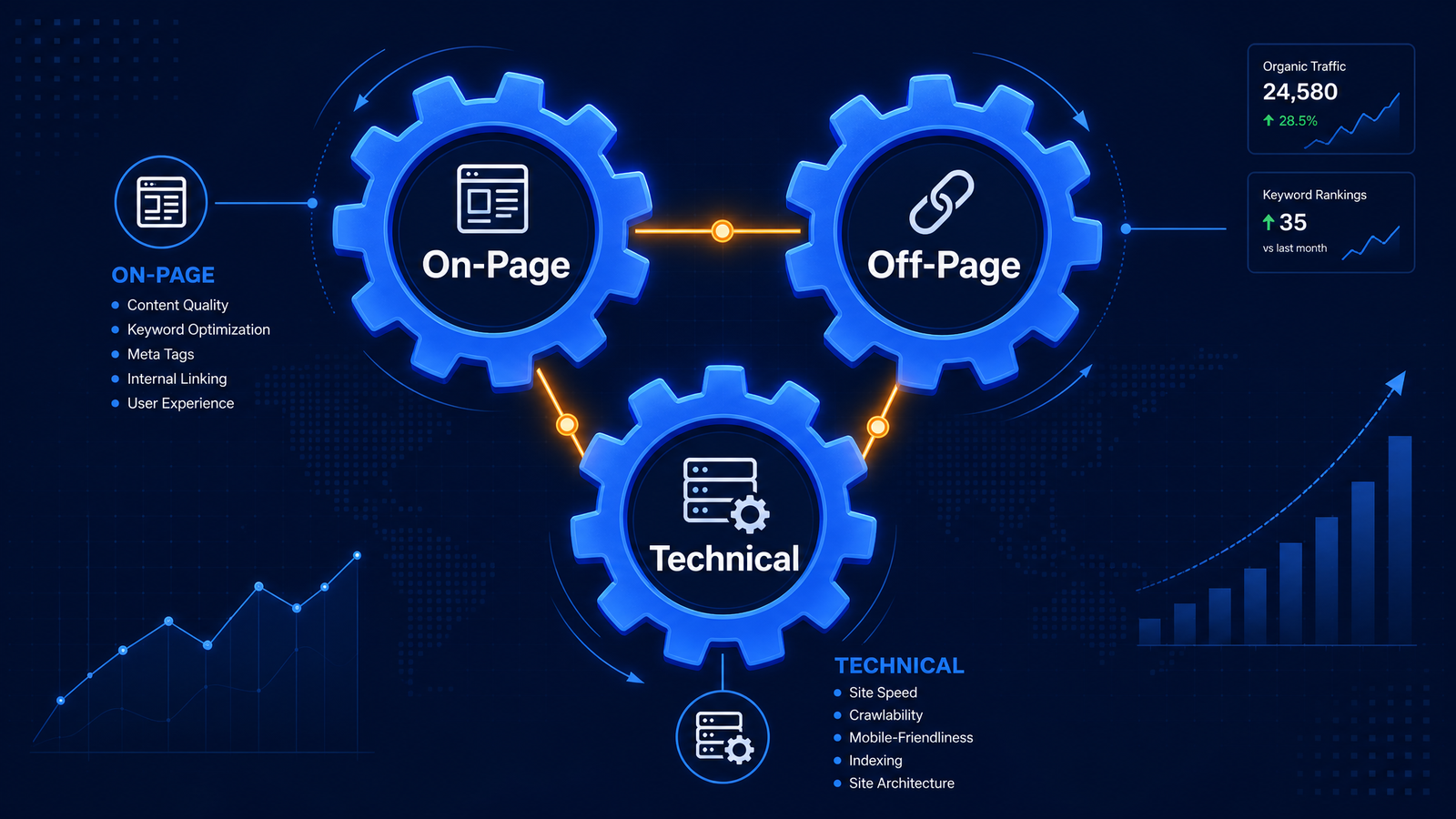
SEO is not a single activity. It's a system of three interconnected disciplines — on-page SEO, off-page SEO, and technical SEO. Ignoring any of them is like trying to run a business with only one department. The sales team can sell all day, but if operations doesn't deliver and finance doesn't manage cash flow, the business fails.
This guide breaks down each type of SEO, how they differ, how they work together, and crucially — what you should prioritize first.
The Three Pillars of SEO: A Quick Overview
Before we dive deep, here's the simplest way to think about each one:
On-page SEO is what you do on your website to make it relevant and useful. This is your content, your keywords, your headers, your images, your internal links. For a deeper dive, see link building in 2026: safe strategies that actually wo.
Off-page SEO is what happens outside your website that signals to Google you're trustworthy and authoritative. This is mostly backlinks, but also brand mentions, reviews, and social signals.
Technical SEO is the infrastructure. How fast your site loads, how well it works on mobile, how easy it is for Google to crawl, how secure it is, how your data is structured. For a deeper dive, see technical SEO checklist.
Think of it as a three-legged stool. Every leg has to be in place for the stool to stand.
On-Page SEO: What You Control on Your Website
On-page SEO is the most straightforward of the three because you have complete control over it. Every change you make happens on your own website.
Title Tags
The title tag is the clickable headline that appears in search results. It's the first thing a searcher sees when deciding whether to click your link or a competitor's.
A good title tag:
- Includes your target keyword near the front
- Is 50-60 characters long (Google cuts off longer titles)
- Is unique for every page (no duplicate title tags anywhere on your site)
- Is compelling enough to earn clicks
Examples:
- Bad: "Home | Bhopal Marketing Agency" — generic, no value
- Good: "Digital Marketing Agency in Bhopal | SEO & PPC Services | VidyaSaaS"
- Better: "SEO Services in Bhopal: Rank Higher, Grow Faster | VidyaSaaS"
Meta Descriptions
The meta description is the 150-160 character summary under the title in search results. It doesn't directly impact rankings, but it dramatically affects click-through rate. And more clicks mean more traffic.
A good meta description:
- Summarizes what the page is about
- Includes the target keyword naturally
- Has a clear value proposition
- Ends with a subtle call-to-action
Example: "We help Indian businesses rank higher on Google. Unlike agencies that hide behind jargon, we deliver transparent, data-driven SEO with no lock-in contracts. Free consultation."
Header Tags (H1, H2, H3)
Headers structure your content for both readers and search engines.
Your H1 is the main title of the page. You should have exactly one H1 per page, and it should include your primary keyword.
Your H2s break down the main sections of your content. Think of them as chapter titles. H3s break down subsections within each H2.
This structure helps Google understand the hierarchy and relevance of your content. Pages with clear header structures are more likely to appear in featured snippets and AI Overviews.
Content
Content is the heart of on-page SEO. Google evaluates whether your content is truly helpful for users searching a particular query.
Key factors:
- Relevance: Does your content actually answer the search query?
- Comprehensiveness: Does it cover the topic thoroughly?
- Originality: Is this your unique perspective or rehashed content from other sites?
- Readability: Is it easy to scan and understand?
- Freshness: Is the information current?
In 2026, Google's AI can evaluate content quality with surprising accuracy. Generic, thin content simply does not rank. Content that genuinely helps users — that teaches, informs, or solves a problem — does.
Keyword Optimization
Keywords are the words and phrases people type into search engines. On-page SEO involves naturally incorporating relevant keywords into your content.
But here's what most people get wrong: keyword stuffing — repeating the same phrase over and over in the hope of ranking higher — hasn't worked for over a decade. Google penalizes it.
Instead, think about:
- Using your primary keyword in the title, H1, and first 100 words
- Using related terms (LSI keywords) naturally throughout
- Writing for humans first, search engines second
Image Optimization
Images affect both user experience and SEO. On every image on your site:
- Use descriptive, keyword-rich filenames (blue-ceramic-vase-jaipur.webp not IMG_4928.jpg)
- Add alt text that describes what the image shows (helps Google understand the image and helps accessibility)
- Compress images to under 200KB (affects page speed, which is also an SEO factor)
Internal Linking
Internal links connect one page of your website to another. They help Google understand your site's structure and distribute link equity (authority) across your pages.
Good internal linking:
- Links from high-authority pages to pages that need more visibility
- Uses descriptive anchor text ("learn about our SEO services" not "click here")
- Creates a logical flow between related content
- Ensures no important page is an orphan (no internal links pointing to it)
A blog post about local SEO should naturally link to your Google Business Profile optimization guide and your local SEO services page.
Off-Page SEO: What Others Say About You
Off-page SEO is everything that happens outside your website that affects your search rankings. The most important factor is backlinks — links from other websites to yours.
Why Backlinks Matter
Google treats each backlink as a vote of confidence. When a reputable website links to yours, it's essentially saying, "This content is worth reading." The more high-quality votes you have, the more authoritative you appear, and the higher you rank.
But not all backlinks are equal. One link from a respected industry publication like Economic Times or YourStory is worth more than 50 links from low-quality directories.
What Makes a Good Backlink
- Authority: From a website with high domain authority (DA)
- Relevance: From a site in your industry or related field
- Natural placement: Embedded naturally in content, not in a footer or sidebar
- Followed: "Dofollow" links pass link equity, "nofollow" links don't (though nofollow links can still drive traffic and brand awareness)
White Hat Link Building Strategies
Guest posting: Writing articles for other websites in your industry in exchange for a backlink to your site. Quality matters enormously. A well-written guest post on a reputable site can drive both traffic and SEO value.
Digital PR: Getting mentioned in news articles, podcasts, or interviews. HARO (Help A Reporter Out) connects you with journalists looking for expert sources. In India, platforms like PressRajat and Indian PR distribution services can help.
Broken link building: Finding broken links on other websites in your industry and suggesting your content as a replacement. Time-intensive but effective.
Resource page linking: Many websites curate lists of useful resources in specific fields. If your business qualifies, ask to be included.
Skyscraper technique: Finding existing content on a topic, creating something significantly better, and reaching out to everyone who linked to the original.
Local partnerships: Local business associations, industry bodies, sponsor event pages, supplier websites — all potential sources of relevant backlinks.
What Google Penalizes
- Buying links: Paying for links from spammy networks
- Private Blog Networks (PBNs): Networks of sites created solely to link to each other
- Excessive link exchanges: "You link to me, I link to you" done at scale
- Automated link building: Using software to create links
- Low-quality directory links: Hundreds of links from directories that exist only to sell links
Google's Penguin algorithm specifically targets manipulative link practices. If you get hit by Penguin, recovery takes months of cleanup work.
Beyond Backlinks: Other Off-Page Factors
Brand mentions: Even unlinked mentions of your brand across the web signal importance to Google. Set up Google Alerts for your brand name and monitor where you're mentioned.
Reviews: Google Business Profile reviews directly impact local rankings. More positive reviews = better local visibility.
Social signals: While Google says social media doesn't directly impact rankings, content shared widely on social platforms tends to attract more backlinks. And brand searches — people searching for your name after seeing social content — signal relevance.
Influencer mentions: In India, mentions from industry influencers on LinkedIn, Twitter, or YouTube can drive both traffic and SEO value.
Technical SEO: The Infrastructure That Makes Everything Work
Technical SEO is the behind-the-scenes work that makes your website crawlable, indexable, fast, and secure. It's the least visible of the three types but arguably the most important because broken technical SEO breaks everything else.
Site Speed
Page speed directly impacts both rankings and user experience. Google confirmed it as a ranking factor for both desktop and mobile.
Key metrics (Core Web Vitals):
- LCP (Largest Contentful Paint) — under 2.5 seconds
- INP (Interaction to Next Paint) — under 100ms
- CLS (Cumulative Layout Shift) — under 0.1
In India, where mobile data speeds vary, optimizing for speed is especially critical. A site that loads in 5 seconds on 4G will lose half its visitors before the page finishes.
Mobile-Friendliness
With over 70% of Indian searches on mobile, responsive design isn't optional. Google uses mobile-first indexing — it primarily looks at the mobile version of your page for ranking.
Crawlability
Google needs to be able to find your pages. Issues that block crawling:
- Incorrect robots.txt configuration
- Orphan pages with no internal links
- JavaScript content that Google can't render
- Broken navigation links
Indexability
Even if Google can find your pages, it may not index them. Issues include:
- Noindex tags on important pages
- Duplicate content
- Thin or low-quality pages
- Server errors (5xx)
- Redirect chains
Structured Data (Schema Markup)
Adding schema markup helps Google understand your content in specific ways — and enables rich results in search. Product schema can show prices and reviews directly in search results. Local Business schema can show your address, phone, and hours. Article schema can show publish date and author.
HTTPS
Every site must load over HTTPS in 2026. Google flags non-HTTPS sites as "not secure" in the browser address bar, scaring away visitors.
XML Sitemaps and Robots.txt
These two files tell Google how to navigate your site. A well-maintained sitemap ensures Google discovers all your important pages. A clean robots.txt ensures you're not accidentally blocking important pages from crawling.
How the Three Types of SEO Work Together
Here's a concrete example showing how on-page, off-page, and technical SEO interact.
Let's say you own a bridal makeup studio in Pune.
Technical SEO: Your website loads in 1.8 seconds. It's fully responsive on mobile. Google can crawl every page easily. You have schema markup for your business. SSL is active. Your site is technically perfect.
On-page SEO: You have a page titled "Bridal Makeup Artist in Pune | Best Wedding Makeup Services." Your content covers different makeup styles, your portfolio, testimonials, pricing packages, and booking information. You've included phrases like "airbrush makeup Pune" and "engagement makeup artist near me" naturally. Your H2s organize the content clearly.
Off-page SEO: A popular wedding blog links to your site as "one of Pune's best bridal makeup artists." You're listed on WeddingWire and Shaadi.com vendor directories. A YouTuber featured your work in her wedding vlog. You have 230 Google reviews with a 4.7-star average.
Now imagine each one missing:
-
Without technical SEO: Your site takes 6 seconds to load. Google can't index most of your gallery photos. 40% of your pages return 404 errors. Your site barely appears in search, no matter how good your content is.
-
Without on-page SEO: Your technical setup is perfect and you have backlinks, but your page just says "Bridal Makeup Services" with a phone number and email. Google doesn't understand what you do, where you do it, or why a user should visit. You don't rank.
-
Without off-page SEO: Your site is technically sound and your content is excellent. But nobody has linked to you. Google sees no external validation. Your competitors, who have backlinks and reviews, consistently outrank you.
All three are necessary. None works fully without the others.
What to Prioritize First
If you're starting from zero, here's the order I recommend:
Step 1: Fix technical SEO basics. Before creating content or building links, make sure Google can actually find and crawl your site. Fix site speed, mobile issues, crawlability, and security. A technically broken site will never rank.
Step 2: Build on-page SEO foundation. Create quality pages for your most important services or products. Optimize title tags, meta descriptions, headers, and content. Get the basics right before scaling.
Step 3: Start off-page SEO. Begin building backlinks, collecting reviews, and earning brand mentions alongside your content efforts. This takes the longest to show results, so start early.
Step 4: Iterate and scale. SEO is not a one-time project. You need to continuously create content, build links, and monitor technical health. The businesses that treat SEO as ongoing investment outperform those that do it in sprints and then stop.
Common Confusion Points
"Is SEO just about content?"
No. Content is a major part of on-page SEO, but it's only one component. Without technical SEO (can Google find it?) and off-page SEO (does anyone trust it?), even the best content may not rank.
"I have backlinks, why am I not ranking?"
Backlinks alone won't compensate for poor on-page optimization or technical issues. Check your title tags (are they targeting the right keywords?), your meta descriptions, your content quality, and your page speed.
"I optimized my page, why no traffic?"
On-page optimization makes your page relevant for a keyword. But if the keyword is highly competitive and you have no backlinks or technical SEO foundation, you won't outrank established competitors. SEO is a cumulative effort.
"Can I do just one type of SEO?"
You can, but results will be limited. Technical SEO without content gives you a fast, well-structured website with nothing useful on it. Content without technical SEO is a great article nobody can find. Content and technical without off-page is a great, findable page that has no authority to compete.
Measuring Progress Across All Three
Each type of SEO has its own success metrics.
On-page SEO metrics:
- Keyword rankings for your target terms
- Organic click-through rate (CTR) from Search Console
- Pages indexed vs pages submitted
- Bounce rate and time on page from Analytics
Off-page SEO metrics:
- Referring domains count
- Total backlinks
- Domain Authority / Domain Rating (from tools like Ahrefs or Moz)
- Brand search volume
- Review count and average rating
Technical SEO metrics:
- Core Web Vitals scores (Search Console)
- Pages indexed vs not indexed
- Crawl errors count
- Mobile usability issues count
- Page speed scores (PageSpeed Insights)
Track all of them. If one metric stops moving, investigate that pillar.
📚 Related Articles You Might Like:
Conclusion
The Bhopal business owner I mentioned? After we explained the three pillars, he understood why his previous agency's "only content" approach wasn't working. We fixed the technical issues first — his website had 14 critical crawl errors. Then we consolidated his on-page SEO — his title tags were all defaulting to "Home" on every page. Then we started a targeted off-page campaign — local citations, Google reviews, and relevant backlinks from Bhopal business directories.
Month three was when things clicked. Traffic started growing. Rankings improved. The phone started ringing.
SEO is not a single thing. It's three things working together. On-page makes you relevant. Off-page makes you trusted. Technical makes you accessible. All three are required for consistent, long-term rankings.
At VidyaSaaS, we handle all three pillars for businesses across India. Our approach is balanced — we don't over-invest in one area at the expense of others.
Want a balanced SEO strategy tailored to your business? Talk to VidyaSaaS. We'll audit your current presence across all three pillars and build a roadmap that actually moves the needle. Call +91 97542 70102 or email info@vidyasaas.com.
Want Results Like This?
Get a free digital marketing audit and custom growth plan for your business.
Get Free AuditVidyaSaaS Team
Super AdministratorPart of the VidyaSaaS team — a group of digital marketing strategists, content specialists, and growth experts helping businesses across India achieve measurable results through data-driven marketing.
More about our teamRelated Articles
Handpicked content to help you grow your business

Amravati Cotton City Connected: SEO Strategies for Maharashtra Agricultural and Education Hub
Amravati cotton economy feeds Maharashtra textile industry. Its university produces thousands of gra...

Tirupati Beyond Balaji: SEO for Andhra Pilgrimage and Manufacturing Economy
Tirupati is India most visited pilgrimage city with 30 million annual visitors. Its manufacturing se...

Nellore Aqua Digital: SEO Strategies for Andhra Shrimp, Rice, and Renewable Energy Economy
Nellore produces more shrimp than any Indian district and is home to one of the world largest solar...
Ready to Grow Your Business?
Let's discuss how we can create a data-driven digital marketing strategy tailored to your goals.