
ROAS Explained: How to Calculate and Improve Your Return on Ad Spend
What is ROAS? How to calculate return on ad spend, what's a good ROAS for Indian businesses, and practical strategies to improve it. ROAS vs ROI explained.
VidyaSaaS Team
Super Administrator
Introduction
A Delhi-based ecommerce store owner called me last year, frustrated. "I'm spending ₹2 lakh per month on Google Ads," he said. "I'm getting sales. But I have no idea if I'm actually making money or just burning cash."
He had revenue numbers. He had ad spend numbers. But he didn't know his ROAS. And without ROAS, you're flying blind.
ROAS — Return on Ad Spend — is the single most important metric in digital advertising. It tells you whether your ad campaigns are profitable, which channels are working, and what needs to change. For a deeper dive, see Google Ads strategies.
Yet most Indian business owners either don't track it, calculate it wrong, or don't know what "good" looks like.
This guide covers everything: what ROAS is, how to calculate it, what's a healthy ROAS for different industries in India, and most importantly — how to improve it.
What Is ROAS?
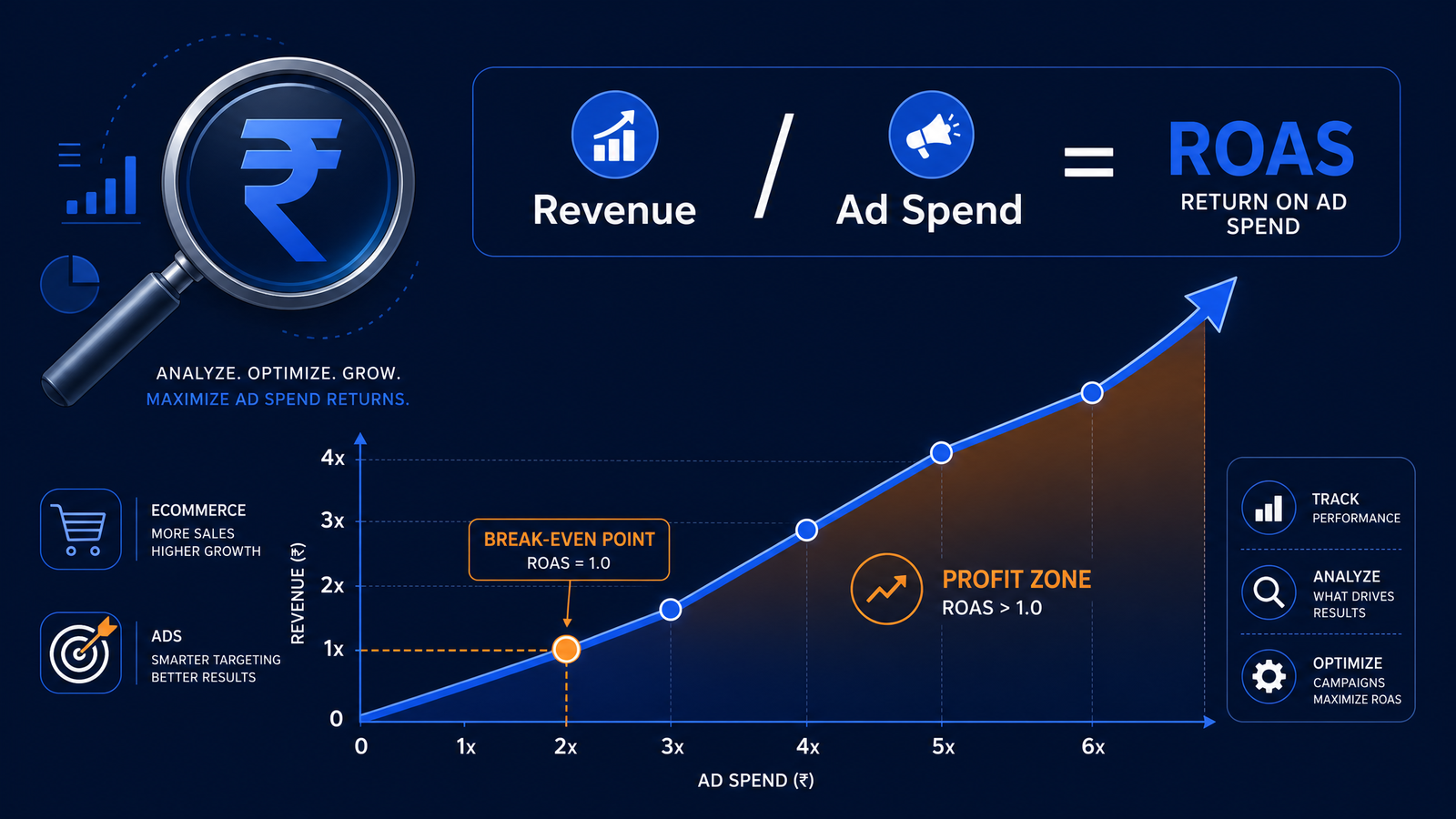
ROAS stands for Return on Ad Spend. It measures how much revenue you earn for every rupee you spend on advertising. For a deeper dive, see lead generation tactics.
The formula is simple:
ROAS = Revenue from Ads ÷ Cost of Ads
If you spend ₹10,000 on Google Ads and generate ₹50,000 in revenue from those ads, your ROAS is 5:1 (or 500%). For a deeper dive, see performance marketing mistakes that are burning your ad.
If you spend ₹10,000 and generate ₹10,000 in revenue, your ROAS is 1:1 — you broke even on ad spend (excluding other costs).
If you spend ₹10,000 and generate ₹5,000 in revenue, your ROAS is 0.5:1 — you're losing money.
ROAS vs ROI: What's the Difference?
These two metrics are often confused. They're related but measure different things.
ROAS (Return on Ad Spend) measures revenue against ad spend only. It's a narrow, campaign-level metric.
ROI (Return on Investment) measures profit against total investment, including all costs — ad spend, product cost, fulfillment, overhead, labor.
Example: You sell a product for ₹1,000. Your cost to produce it is ₹400. Your shipping and packaging cost is ₹100. You spent ₹200 on ads to sell it.
ROAS: Revenue (₹1,000) ÷ Ad Spend (₹200) = 5:1
ROI: Profit (₹1,000 - ₹400 - ₹100 - ₹200 = ₹300) ÷ Total Cost (₹400 + ₹100 + ₹200 = ₹700) = 42.8%
A 5:1 ROAS looks great. A 43% ROI is decent but not amazing. Neither metric is wrong — they measure different things.
Use ROAS for: Evaluating campaign performance, comparing channels, optimizing ad spend. Use ROI for: Evaluating overall business profitability from advertising.
What's a "Good" ROAS for Indian Businesses?
There's no universal number. "Good" ROAS depends on your profit margins, industry, and business model.
General Benchmarks
| Industry | Acceptable ROAS | Good ROAS | Great ROAS | |----------|----------------|-----------|------------| | Ecommerce (low margin) | 3:1 | 5:1 | 8:1+ | | Ecommerce (high margin) | 2:1 | 4:1 | 6:1+ | | Local Services | 5:1 | 10:1 | 20:1+ | | SaaS / B2B | 3:1 | 5:1 | 10:1+ | | Real Estate | 4:1 | 8:1 | 15:1+ | | Education / Courses | 3:1 | 6:1 | 12:1+ |
Why These Numbers Differ
Ecommerce: Low margins (30-50% gross) mean you need higher ROAS just to break even after product costs. A 5:1 ROAS on a 30% margin product means ₹5 revenue = ₹1.50 gross profit on ₹1 ad spend — 50% margin on ad spend, which is decent but not amazing.
Local Services: High margins (70-90% for most service businesses) mean you can afford a lower ROAS. A plumber spending ₹200 on ads to get a ₹2,000 service call has a 10:1 ROAS and excellent ROI because the service cost is mostly labor.
SaaS / High-ticket: High customer lifetime value (LTV) means you can accept a lower initial ROAS because customers who subscribe for 12+ months become highly profitable.
The one number that matters for your business: Your break-even ROAS = 1 ÷ (Profit Margin as a decimal)
If your product has a 40% profit margin: Break-even ROAS = 1 ÷ 0.40 = 2.5:1
You need to generate ₹2.50 in revenue for every ₹1 in ad spend just to break even on product costs. Anything above 2.5:1 is profit (before overhead).
How to Calculate ROAS Properly
Basic ROAS Calculation
Revenue from Ads: ₹1,50,000
Ad Spend: ₹30,000
ROAS = ₹1,50,000 ÷ ₹30,000 = 5.0 (or 5:1)
Tracked vs Attributed Revenue
The challenge: how do you know which revenue came from ads?
Last-click attribution: Credits the sale to the last channel the user clicked before purchasing. This under-values awareness campaigns and over-values bottom-of-funnel campaigns.
Multi-touch attribution: Credits multiple channels in the customer journey. More accurate but harder to set up.
Google Ads conversion tracking: Tracks conversions from Google Ads clicks. You'll see ROAS within Google's platform, but only for last-click Google Ads attribution.
UTM parameters: Add tracking codes to your ad URLs. Use Google Analytics to see full-journey attribution across all channels.
For most Indian small businesses: Google Ads conversion tracking for Google campaigns, Meta pixel for Meta campaigns, and UTM-tagged URLs for everything else. This setup covers 90% of what you need.
What Revenue to Include
When calculating ROAS at the campaign level, include:
- Direct sales revenue (from the ad click)
- Revenue from sales that happen within the attribution window (usually 30 days for Google, 7-28 days for Meta)
- Revenue from phone calls if you're tracking call conversions
Don't include:
- Revenue that can't be attributed to the ad
- Estimated lifetime value (use this for ROI, not ROAS)
- Offline revenue that you can't track back to specific campaigns
Factors That Affect Your ROAS
Industry Competition
More competition means higher CPCs, which means lower ROAS at the same conversion rate. Insurance and legal keywords in India can cost ₹100-300 per click, making it hard to achieve high ROAS.
Profit Margins
Higher margins give you more room. A ₹500 product with ₹350 cost (30% margin) needs higher ROAS than a ₹10,000 service call with ₹1,000 cost (90% margin).
Conversion Rate
Your website's conversion rate directly impacts ROAS. A site converting at 3% will have 3x the ROAS of a site converting at 1%, all else equal.
Average Order Value (AOV)
Higher AOV = better ROAS. If you can increase AOV through upsells, bundles, or minimum order thresholds, your ROAS improves without changing anything else.
Attribution Window
A 7-day attribution window gives lower ROAS than a 30-day window because fewer conversions are credited. Choose an attribution model that matches your sales cycle.
10 Strategies to Improve Your ROAS
1. Refine Keyword Targeting
Stop bidding on broad keywords that attract window-shoppers. Focus on high-intent keywords:
- "Buy" terms outperform "research" terms
- Long-tail keywords have lower CPC and higher conversion rates
- Negative keywords prevent wasted spend on irrelevant searches
Example: If you sell leather bags in Jaipur, add "cheap," "DIY," "repair," "second hand" as negative keywords to avoid irrelevant clicks.
2. Improve Ad Relevance
Google measures Quality Score — how relevant your ad is to the search query. Higher Quality Score = lower CPC = better ROAS.
Improve Quality Score by:
- Matching your ad copy to the search query
- Using the keyword in your headline
- Creating tightly themed ad groups (don't put "leather bags" and "leather belts" in the same group)
- Directing traffic to relevant landing pages (not your homepage)
3. Optimize Landing Pages
A user who clicks your ad needs to find exactly what they expected. If your ad promises "discount on men's formal shoes" and your landing page shows women's casual footwear, users bounce — and you paid for the click.
Landing page optimization:
- Match the ad promise to the page content
- Clear call-to-action above the fold
- Fast load time (under 2 seconds)
- Mobile-optimized layout
- Trust signals (reviews, guarantees, secure checkout)
- Minimal form fields (the more fields, the lower the conversion rate)
4. Use Ad Extensions (Google Ads)
Ad extensions improve CTR and Quality Score without extra cost:
- Sitelink extensions (link to specific pages)
- Call extensions (phone numbers for mobile users)
- Location extensions (show your address and map pin)
- Structured snippets (highlight specific product categories or services)
5. Implement Retargeting
Most users don't convert on their first visit. Retargeting shows ads to people who already visited your site but didn't buy. These users are warmer and convert at 2-5x the rate of cold traffic.
Set up:
- Google Display retargeting for site visitors
- Meta Pixel retargeting for Facebook/Instagram
- Dynamic retargeting for ecommerce (show users the exact products they viewed)
6. Optimize Bidding Strategy
Google Ads offers multiple bidding strategies:
- Manual CPC: Full control, but requires constant optimization
- Enhanced CPC: Google adjusts your bids based on conversion likelihood
- Target CPA: Google optimizes to get conversions at your target cost
- Target ROAS: Google optimizes to hit your target return (best for experienced advertisers)
- Maximize Conversions: Google spends your full budget to get the most conversions
Most Indian advertisers under-utilize automated bidding. Once you have 30+ conversions in 30 days, test Target CPA or Target ROAS.
7. Segment Campaigns by Performance
Stop lumping good and bad performers together. Create separate campaigns or ad groups for:
- High-intent vs low-intent keywords
- Top-performing products vs middle-of-the-road products
- Different locations (a campaign for Bhopal, one for Indore)
- Different devices (mobile campaigns if your mobile conversion rate is different from desktop)
Segment, test, allocate budget to winners, pause losers.
8. Improve Product Feed Quality (Ecommerce)
For Google Shopping and Meta catalog campaigns, your product feed quality directly impacts performance:
- Accurate titles with key attributes (brand, size, color, material)
- High-quality images on white backgrounds
- Competitive pricing
- Correct availability info (in stock vs out of stock)
- GTIN/MPN identifiers for better visibility
- Regular feed updates
9. Test Ad Creative Regularly (Meta)
Meta Ads are creative-driven. The same audience and targeting can perform completely differently with different creative.
Test systematically:
- Each ad set should have 3-5 different creative options
- Test different formats (image vs video vs carousel)
- Test different hooks (price, benefit, urgency, social proof)
- Test different CTAs (Shop Now, Learn More, Book Now)
- Kill underperformers after 500-1000 impressions, scale winners
10. Focus on Customer Lifetime Value
A customer who buys once at 2:1 ROAS isn't profitable. But if that customer comes back 5 times over a year, the real ROAS is 10:1.
Shift your perspective from "cost per acquisition" to "cost per customer" and track LTV.
- Invest more in acquiring customers with high repeat purchase potential
- Set up post-purchase email sequences to drive repeat sales (which cost nothing in ad spend)
- Build loyalty programs that keep customers coming back
Common ROAS Mistakes
Mistake 1: Not tracking offline conversions
If you run a service business and get calls from ads but don't track call conversions, your ROAS looks terrible — even though calls are your highest-value leads.
Fix: Set up call tracking. Google Ads offers call-only campaigns and call conversion tracking. Use a call tracking service if needed.
Mistake 2: Looking at ROAS in isolation
A 50:1 ROAS on ₹1,000 spend is ₹50,000 in revenue. That's great. A 5:1 ROAS on ₹1,00,000 spend is ₹5,00,000 in revenue. That's also great.
Don't compare them the same way. Scale matters. A lower ROAS at higher scale can still be highly profitable.
Mistake 3: Not considering customer lifetime value
Focusing only on first-purchase ROAS leads you to under-invest in customer acquisition. If your average customer buys three times, a break-even first purchase actually generates positive overall ROI.
Mistake 4: Pausing campaigns too early
New campaigns take 2-4 weeks to learn and optimize (Google's learning phase). Pausing after 3-7 days because ROAS isn't immediately amazing costs you in the long run.
Mistake 5: Ignoring seasonality
ROAS varies by season. A Diwali campaign might have higher costs but also higher revenue. Compare ROAS to the same period last year, not to a month where nobody was buying.
ROAS Tracking Tools
- Google Ads: Built-in conversion tracking, ROAS reporting
- Meta Ads Manager: Built-in purchase tracking with ROAS calculations
- Google Analytics: Full-journey attribution, multi-touch models
- Triple Whale / Northbeam (advanced): Attribution platforms for ecommerce brands
- Call tracking tools: Track phone call conversions
- Custom spreadsheets: Sometimes the simplest option for small businesses
📚 Related Articles You Might Like:
Conclusion
The Delhi ecommerce store owner who was spending ₹2 lakh per month without knowing his ROAS? After we set up proper tracking and analyzed his numbers, the picture was clearer than he expected. His Google Shopping campaigns were delivering 6:1 ROAS. His Display campaigns were at 1.5:1. And his search campaign for brand terms was doing 20:1.
We reallocated budget: reduced Display spend, increased Shopping, added retargeting. In two months, his overall ROAS went from 3:1 (unprofitable after product costs) to 5.5:1 (solidly profitable).
He's now spending ₹3.5 lakh per month, and he tracks his ROAS weekly.
ROAS isn't complicated. It's one number — revenue divided by spend. But that one number, tracked properly and acted upon, can transform your advertising from an expense into a profit center.
At VidyaSaaS, we help Indian businesses track, optimize, and scale their ad ROAS. Our performance marketing services are built around transparent measurement and continuous improvement.
Want to know your real ROAS and how to improve it? Contact VidyaSaaS for a free advertising audit. We'll analyze your current campaigns, calculate your true ROAS, and build an optimization roadmap. Call +91 97542 70102 or email info@vidyasaas.com.
Want Results Like This?
Get a free digital marketing audit and custom growth plan for your business.
Get Free AuditVidyaSaaS Team
Super AdministratorPart of the VidyaSaaS team — a group of digital marketing strategists, content specialists, and growth experts helping businesses across India achieve measurable results through data-driven marketing.
More about our teamRelated Articles
Handpicked content to help you grow your business

Hubli-Dharwad Twin Cities Digital: Performance Marketing for Karnataka Commercial Capital
Hubli-Dharwad is called Chota Mumbai for its commercial intensity. But its 5,000 MSMEs barely use Go...

Jamnagar Brass to Reliance: Performance Marketing for Gujarat Industrial and Marine Giant
Jamnagar hosts the world largest oil refinery and a 500-year-old brass industry. But its businesses...

Kakinada Port to Profit: Performance Marketing for Andhra Energy and Aquaculture Economy
Kakinada supplies 40% of India seafood exports and hosts the KG Basin gas operations. Yet most busin...
Ready to Grow Your Business?
Let's discuss how we can create a data-driven digital marketing strategy tailored to your goals.