
The Complete Digital Marketing Strategy Framework for Indian Businesses in 2026
Build a winning digital marketing strategy for your Indian business from scratch. Complete framework covering goals, audience, channels, budget, and execution.
VidyaSaaS Team
Super Administrator
Introduction
Most Indian businesses don't have a digital marketing strategy. They have a collection of tactics. A Facebook page here, a Google Ads account there, a blog that gets updated once every three months. There's no plan connecting these activities to a concrete business goal.
This is why ₹500 crore is wasted on ineffective digital marketing in India every year. Not because digital marketing doesn't work — but because businesses throw money at random tactics without a strategy behind them.
A strategy is different from a plan. A strategy asks: "Given our business goals, our customers, our competition, and our budget — what's the smartest way to allocate our resources?" A plan just lists activities. For more on this, see content marketing approach.
This blog gives you the complete framework to build your digital marketing strategy from scratch. Whether you're a bootstrapped startup in Bhopal or a growing business in Mumbai, the structure is the same. Only the details change.
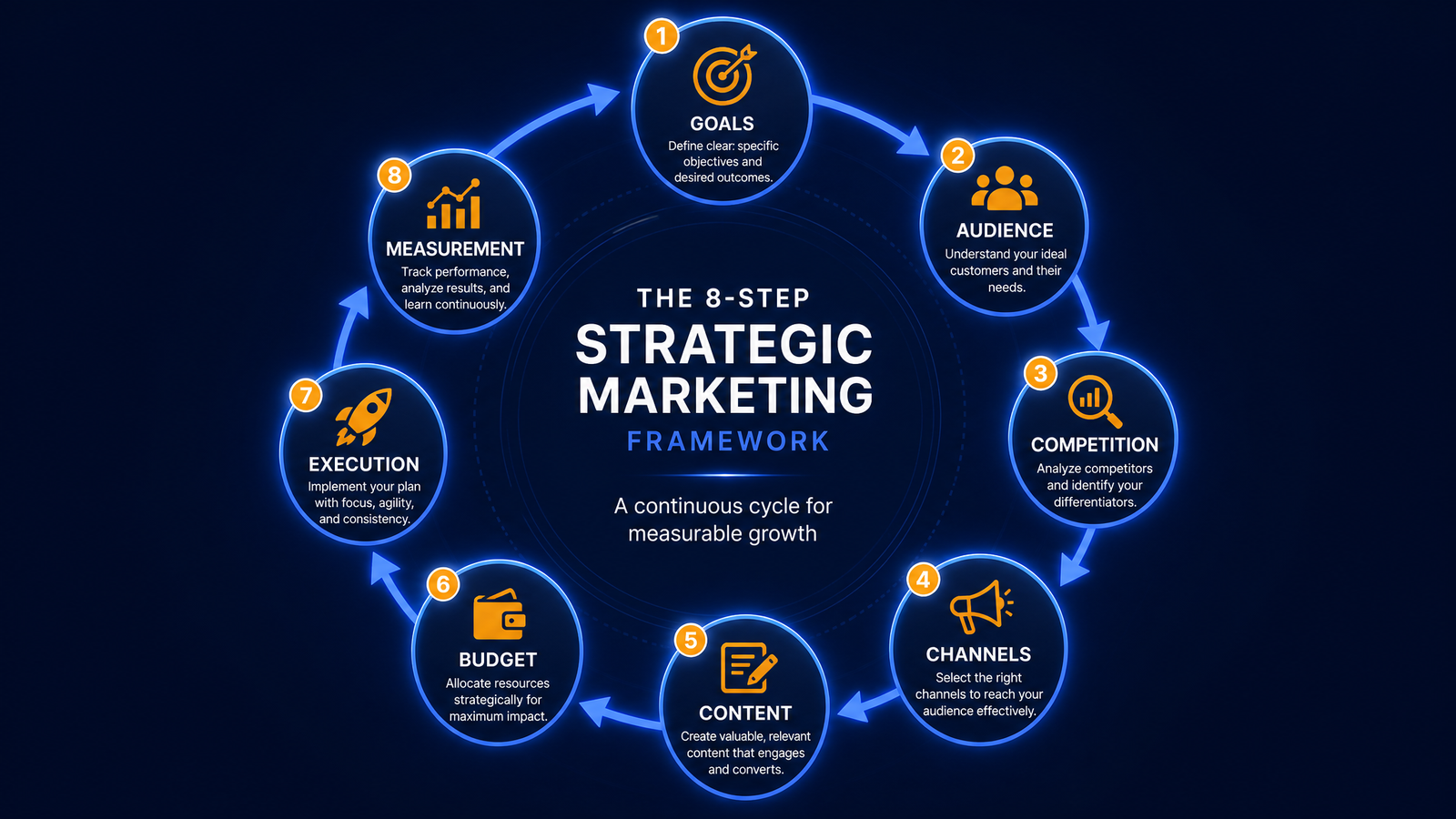
Step 1: Start With Business Goals, Not Marketing Goals
Here's the biggest mistake businesses make: they start with "We need more Instagram followers" or "Let's run Google Ads." That's starting with tactics. You need to start with what matters to your business.
Ask yourself (or your leadership team):
- What revenue do we want to achieve this year?
- How many new customers do we need to hit that revenue?
- What's our target profit margin?
- Which products or services are our priority?
- What's our timeline for each goal?
Bad marketing goal: "Increase website traffic by 50%." Good marketing goal informed by business goal: "Generate 200 qualified leads per month to hit ₹2 crore in annual revenue, at a cost per lead under ₹500. For more on this, see digital marketing framework."
The second goal is specific, measurable, and tied to a business outcome. Every tactic you choose should directly contribute to this goal.
Breaking Down Revenue Goals Into Marketing Metrics
If your goal is ₹2 crore in annual revenue:
- Average deal size: ₹50,000
- Customers needed: 400 per year (33 per month)
- If your lead-to-customer conversion rate is 20%, you need 165 leads per month
- If your website-to-lead conversion rate is 3%, you need 5,500 visitors per month
Now your marketing goal is clear: drive 5,500 qualified visitors per month and convert them into 165 leads. Every channel decision flows from this number. For more on this, see digital marketing framework.
Step 2: Audience Research — Know Who You're Marketing To
"Young professionals in India who might like our product" is not an audience. It's a wish.
Building Your Customer Persona
A proper customer persona includes:
- Demographics: Age, gender, income, location, education
- Psychographics: Values, interests, lifestyle, aspirations
- Behaviour: Online platforms they use, content they consume, purchase habits
- Pain points: What problem are they trying to solve? What keeps them up at night?
- Goals: What outcome do they want from your product/service?
- Objections: Why might they NOT buy from you?
Example — For a D2C skincare brand in India:
- Persona: Priya, 28, works in IT in Bangalore
- Pain points: Acne from humid weather, tired of products that don't work, confused by ingredient labels
- Behaviour: Follows beauty influencers on Instagram, reads reviews on Nykaa, shops on phone
- Objections: Does it work for Indian skin? Is it affordable enough for monthly use? Will it cause breakouts?
How to Research
- Customer interviews: Talk to 10-15 existing customers. Ask why they bought, what they almost bought instead, how they found you.
- Survey your audience: Google Forms or Typeform. Ask about their challenges and content preferences.
- Social listening: What are people saying about your industry on social media? What questions are they asking?
- Competitor review analysis: Read reviews of your competitors. What do customers love and hate?
- Keyword research: What terms do people search to find solutions like yours?
Step 3: Competitor Analysis
You can't build a strategy in a vacuum. You need to know what your competitors are doing, what's working for them, and where they're leaving opportunities.
What to Analyse
Digital presence audit:
- Do they have a website? How good is it?
- What's their Google Business Profile like?
- Which social platforms are they active on?
- How often do they post?
- What content gets the most engagement?
SEO analysis (free with tools):
- What keywords do they rank for?
- How many backlinks do they have?
- What's their domain authority?
- What blog topics are they covering?
Paid ads analysis:
- Are they running Google Ads? (Search their keywords)
- Are they on social ads? (Check their Facebook page transparency)
- What offers are they promoting?
Finding Your Competitive Advantage
After analysing competitors, ask:
- What are they doing well? (You should match or exceed this)
- What are they ignoring? (Your opportunity)
- Where are customers complaining? (Your chance to do better)
- What's your unique angle? (Price, quality, service, speed, niche)
The "Blue Ocean" Opportunity
Most businesses compete in crowded spaces (red oceans). The smartest strategy often involves creating your own niche (blue ocean). Instead of being "another digital marketing agency in India," position yourself as "the only digital marketing agency focused on heritage textile brands in Rajasthan."
If you can't be first in a category, create a new category where you can be first.
Step 4: Channel Selection — Where to Actually Spend Your Time
This is where most strategies fail. Businesses try to be everywhere — Instagram, Facebook, LinkedIn, YouTube, Google Ads, SEO, email, WhatsApp, influencer marketing. And they do none of them well.
The Channel Selection Framework
Factors to consider for each channel:
- Where does my audience hang out? (This is the #1 factor)
- What content do they consume? (Video? Articles? Short-form?)
- What can I create consistently? (Be realistic about your content capabilities)
- What's my budget? (Some channels require higher ad spend)
- What's my timeline? (SEO takes months, ads work faster)
Channel Guide by Business Type
Local Service Business (plumber, salon, clinic):
- Primary: Google Business Profile, Google Ads (local keywords)
- Secondary: Facebook/Instagram (local targeting), WhatsApp Business
- Skip: SEO for national keywords, LinkedIn, YouTube
D2C Brand:
- Primary: Instagram, Google Shopping Ads, SEO
- Secondary: Facebook, Influencer Marketing, Email/WhatsApp retention
- Skip: LinkedIn, Twitter (unless it fits your brand)
B2B / Consultancy:
- Primary: LinkedIn, Google Ads (high-intent keywords), SEO
- Secondary: YouTube (educational), Email marketing, Webinars
- Skip: Instagram (unless you can create visual B2B content)
Ecommerce (Marketplace focused):
- Primary: Amazon/Flipkart advertising, Google Shopping
- Secondary: Instagram, Influencer marketing, SEO for product pages
- Skip: Channels that don't drive direct sales
How Many Channels Should You Use?
Rule of thumb: Master one channel before adding another. If you're a startup with a ₹50,000 marketing budget, pick ONE primary channel and ONE secondary channel. Spend 80% of your effort on the primary channel.
Most Indian businesses would be better off doing one channel brilliantly than three channels poorly.
Step 5: Content Strategy — What You'll Say
Your channels are the delivery mechanism. Content is what you deliver. Without a content strategy, you're just making noise.
Content Pillars
Identify 3-5 content pillars that align with your brand and audience interests.
Example for a digital marketing agency (VidyaSaaS):
- Education: How-to guides, tips, tutorials ("How to run Google Ads on a budget")
- Social proof: Case studies, client results, testimonials
- Industry insights: Trends, platform updates, research data
- Behind-the-scenes: Team culture, process, thought leadership
- Promotion: Service offerings, special offers, new launches
Content Formats by Platform
- Instagram: Reels (short video) > Carousels > Static images > Stories
- LinkedIn: Long-form posts (800-1,500 words), Document posts, Videos
- YouTube: Tutorials, Case studies, Explainer videos, Vlogs
- Blog: Comprehensive guides, List posts, How-to articles, Industry analysis
- Email: Newsletters, Offer announcements, Educational sequences
- WhatsApp: Short offers, Order updates, Event invites
Content Calendar
Plan your content monthly, not weekly. A monthly view helps you see patterns, avoid repetition, and align with business priorities.
Monthly content calendar should include:
- 8-12 social media posts
- 2-4 blog posts
- 2-4 Reels/short videos
- 1-2 email newsletters
- 2-4 Google Business Profile posts (if local business)
- Ad creative refreshes (as needed)
Step 6: Budget Allocation — The 70-20-10 Rule
How do you decide how much to spend where?
The 70-20-10 Framework
70% — Proven channels: Spend most of your budget on channels you know work. If Google Ads gives you a 4x ROAS, that's where 70% of your budget goes.
20% — Growth channels: Channels that show promise but need more testing. Maybe LinkedIn Ads is starting to work for you. Invest 20% here to scale the channel.
10% — Experimental channels: New platforms, new formats, risky bets. This is where you try things like a new social platform, a podcast, or an emerging ad format. If it works, it moves to the 20% category. If it doesn't, you only lost 10% of your budget.
Budget Allocation by Business Stage
Startup (validation stage, under ₹10L annual revenue):
- Marketing budget: 15-20% of revenue
- Focus: Low-cost channels (organic social, content, community)
- Ad spend: Minimal (₹5,000-15,000/month for testing)
- Key: Validate demand, build audience
Growth stage (₹10-50L annual revenue):
- Marketing budget: 10-15% of revenue
- Focus: Performance marketing + SEO
- Ad spend: 40-60% of budget
- Key: Scale what works, build SEO asset
Scale stage (₹50L+ annual revenue):
- Marketing budget: 8-12% of revenue
- Focus: Multi-channel + retention + brand
- Ad spend: 30-50% of budget
- Key: Diversify channels, improve LTV
Step 7: Execution Plan — Who Does What, By When
A strategy without execution is a daydream. You need a clear execution plan.
Defining Ownership
For each channel and activity, define:
- Who's responsible (owner)?
- Who's contributing (support)?
- What's the timeline?
- What's the budget?
- How will success be measured?
Example:
- Google Ads: Owned by Performance Marketing Manager. Monthly budget: ₹50,000. Target: 50 leads at ₹1,000 CPA. Measurement: Google Ads dashboard + CRM.
- Instagram Content: Owned by Social Media Manager. Target: 10 posts/week, 3% engagement rate. Measurement: Meta Business Suite.
- Blog SEO: Owned by Content Strategist. Target: 4 blogs/month, rank for 10 keywords in 6 months. Measurement: Search Console.
Quarterly Planning
Don't plan your entire year in detail. The business environment changes too fast. Instead, plan quarterly with monthly check-ins.
Quarterly plan structure:
- Review last quarter vs targets
- Set quarter goals (aligned with annual goals)
- Define key initiatives for the quarter
- Allocate budget by channel
- Identify risks and contingencies
- Set up weekly or bi-weekly check-ins
Weekly Review Cadence
Every week, review:
- Are campaigns on track?
- Are there any issues (underperforming ads, website problems)?
- What did we learn this week?
- What's the priority for next week?
A 30-minute weekly marketing standup (in-person or on Zoom) prevents small issues from becoming big problems.
Step 8: Measurement — The Metrics That Actually Matter
"If you can't measure it, you can't improve it." Every strategy needs a measurement framework.
The North Star Metric
Pick ONE metric that aligns with your business goal. This is your North Star — everything else is secondary.
- For a D2C brand: Monthly revenue from digital channels
- For a SaaS company: Monthly recurring revenue (MRR)
- For a local service business: Leads generated or appointments booked
- For a content platform: Active users or subscribers
Secondary Metrics by Channel
SEO:
- Organic traffic (month over month)
- Keyword rankings (target keywords)
- Backlinks gained
- Organic conversion rate
Paid Ads (Google/Meta):
- Cost per acquisition (CPA)
- Return on ad spend (ROAS)
- Click-through rate (CTR)
- Quality Score (Google Ads)
Social Media:
- Engagement rate (likes, comments, shares ÷ followers)
- Follower growth
- Social traffic to website
- Conversions from social
Email/WhatsApp:
- Open rate
- Click-through rate
- Unsubscribe rate
- Direct revenue attributed
Dashboard Setup
Create a dashboard (Google Looker Studio, or just Google Sheets) that shows:
- Monthly performance of your North Star metric
- Channel breakdown
- 3-month trend
- Comparison to targets
Review this dashboard weekly. Don't wait for monthly reports to see if you're on track.
Common Strategy Failures
Over-ambition: Trying to dominate every channel from day one. Pick one, master it, then expand.
Analysis paralysis: Spending months researching instead of executing. A "good enough" strategy executed today beats a perfect strategy next year.
No budget realism: Planning activities with no regard for budget. A content strategy requiring 20 blogs/month needs a writer, an editor, and tools. Budget for it.
Ignoring data: Sticking with a strategy that's clearly not working because "it's what we planned." Be willing to pivot based on data.
No owner: If everyone is responsible for something, nobody is. Every activity needs a single owner.
Forgetting retention: Spending all budget on acquisition with zero investment in keeping customers. Acquiring a customer costs 5-7x more than retaining one.
Short-term focus: Canceling SEO because it didn't deliver in 2 months. SEO is a 6-12 month play. You knew that when you started.
When to DIY and When to Outsource
Not everything needs to be done in-house. Smart strategy involves knowing what to build and what to buy.
Do in-house:
- Core business operations (customer service, product development)
- Strategy and direction (you need to own this)
- Brand voice and messaging (can't outsource your identity)
Outsource to specialists:
- Paid ads management (needs expertise and daily attention)
- SEO (tool-intensive and continually evolving)
- Content creation (if you lack writing talent in-house)
- Web development (unless you have a full-time developer)
- Social media management (if your audience is active but you're too busy)
The hybrid model often works best: in-house strategy + outsourced execution.
The VidyaSaaS Approach
At VidyaSaaS, this framework isn't theoretical — it's how we work with every client. We start with your business goals, understand your audience, analyse your competition, select the right channels, allocate budget smartly, execute relentlessly, and measure obsessively.
With 2,000+ clients across India and ₹50M+ in client revenue generated, we've refined this framework across industries, budgets, and business stages. Whether you need help building your strategy from scratch or executing an existing plan, our team of 50+ professionals can help.
Ready to build a digital marketing strategy that actually delivers? Contact VidyaSaaS for a free consultation. We'll help you go from random tactics to a strategy that drives real business growth. Call +91 97542 70102 or email info@vidyasaas.com.
📚 Related Articles You Might Like:
Conclusion
Digital marketing in 2025-26 for Indian businesses is not about who has the biggest budget. It's about who has the smartest strategy. The business that understands its customers, picks the right channels, creates relevant content, and measures what matters will win — regardless of budget size.
This framework gives you the structure. Now it's up to you to fill in the details. Start with your business goals. Understand your customer. Analyse your competition. Pick your channels strategically. Allocate budget with the 70-20-10 rule. Execute with ownership and accountability. Measure with a North Star metric.
And remember: a good strategy executed today beats a perfect strategy executed never. Start now.
Want Results Like This?
Get a free digital marketing audit and custom growth plan for your business.
Get Free AuditVidyaSaaS Team
Super AdministratorPart of the VidyaSaaS team — a group of digital marketing strategists, content specialists, and growth experts helping businesses across India achieve measurable results through data-driven marketing.
More about our teamRelated Articles
Handpicked content to help you grow your business

Digital Marketing for Noida Startups: From Zero to Visible in 90 Days
A practical 90-day digital marketing roadmap for Noida startups to build online visibility, attract...

Jaipur Business Guide: Traditional Markets Meet Digital Growth
How Jaipur businesses from gems to hospitality can blend traditional strengths with modern digital m...

Digital Marketing in Chandigarh: The Tricity Growth Playbook
A comprehensive digital marketing playbook for Chandigarh businesses targeting the Tricity area — Pa...
Ready to Grow Your Business?
Let's discuss how we can create a data-driven digital marketing strategy tailored to your goals.