
Email Marketing vs WhatsApp Marketing: Which Channel Gives Better ROI for Indian Businesses?
Email vs WhatsApp marketing — a data-driven comparison for Indian businesses. Open rates, conversion rates, costs, and when to use each channel for maximum ROI.
VidyaSaaS Team
Super Administrator
Introduction
"Should I focus on email or WhatsApp?"
I get this question at least once a week. Usually from a business owner who's stretched thin, managing multiple marketing channels, and trying to figure out where to invest their limited time and budget.
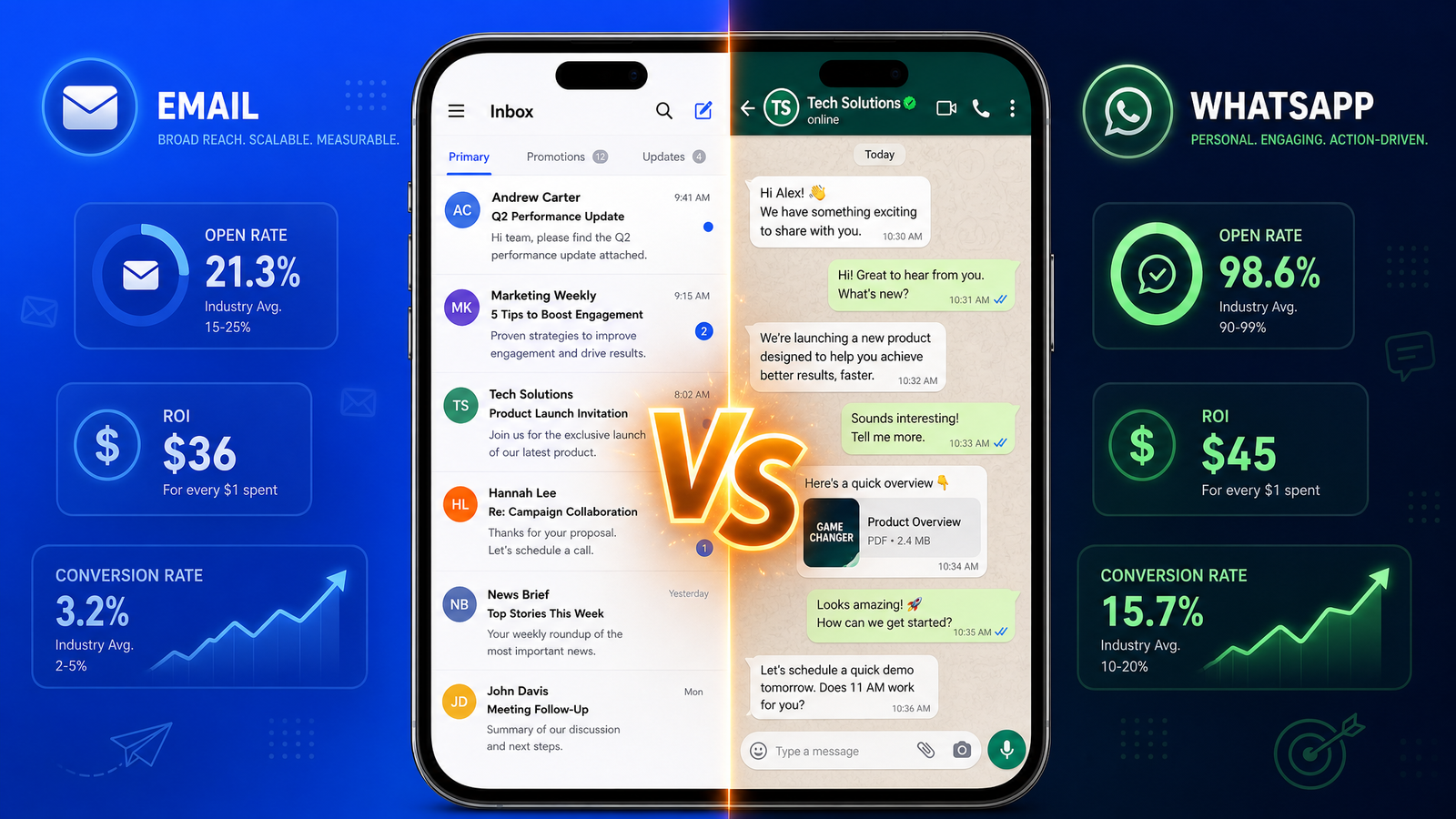
It's a fair question. Both channels have passionate advocates. Email marketers will show you the ₹42 ROI for every ₹1 spent. WhatsApp marketers will show you the 90%+ open rates. For more on this, see email marketing strategy.
But here's the truth: it's not an either-or decision. The smartest Indian businesses aren't choosing one over the other. They're using both, but for different purposes.
Email and WhatsApp are not competitors. They're complementary tools, each with distinct strengths and ideal use cases. Email excels at depth, detail, and long-form communication. WhatsApp excels at immediacy, intimacy, and short-form interaction.
This guide provides a head-to-head comparison of both channels — with real data from the Indian market — so you can decide when to use each one and how to combine them for maximum ROI. For more on this, see WhatsApp marketing guide.
Head-to-Head Comparison: Email vs WhatsApp
Let's put both channels side by side and compare what matters.
Open Rates
Email: 15-25% average open rate for marketing campaigns. Well-segmented lists can hit 30-40%. Welcome emails can hit 60-80%.
WhatsApp: 90-98% open rate. Messages are typically opened within 3 minutes of delivery. For more on this, see Google Ads comparison.
Winner: WhatsApp, by a massive margin. Nothing beats WhatsApp for getting your message seen.
The nuance: Email open rates look low, but consider the volume. A 20% open rate on a 50,000-person list means 10,000 eyes on your message. WhatsApp's 95% open rate on a 5,000-person list means 4,750 views. The larger email audience can make up for the lower rate.
Click-Through Rates (CTR)
Email: 2.5-5% average. Well-optimized emails with strong CTAs can hit 8-10%.
WhatsApp: 15-30% CTR for promotional messages. Higher for transactional messages (order confirmations, appointment reminders).
Winner: WhatsApp. People are more likely to click links shared on WhatsApp because they're already in an active conversation mode.
Conversion Rates
Email: 1-3% average for marketing campaigns. Cart abandonment emails can convert at 5-10%.
WhatsApp: 3-10% for marketing messages. Cart recovery on WhatsApp converts at 2-3x the rate of email.
Winner: WhatsApp, for direct response. Email wins for complex, considered purchases.
Cost Comparison
Email: ₹0.10-₹0.50 per email sent (depending on platform and volume). Or fixed monthly fee of ₹2,000-₹15,000.
WhatsApp Business App: Free (limited to 50-100 daily interactions).
WhatsApp Business API: ₹0.30-₹0.65 per conversation + ₹2,000-₹15,000/month platform fee.
Winner: Email is cheaper for large-scale communication. WhatsApp is cheaper for high-intent, targeted messaging.
Real cost comparison:
- Sending 50,000 marketing emails: ₹5,000-₹10,000 (email platform fees)
- Sending 50,000 WhatsApp messages: Not possible (policy limits) + would be ₹25,000-₹32,500
Email scales better for volume. WhatsApp is premium-per-touch.
Content Length
Email: 200-2,000 words. Long-form content works. Detailed product descriptions, tutorials, multi-section newsletters.
WhatsApp: 50-200 words max. Short, punchy, to-the-point. Nobody reads paragraphs on WhatsApp.
Winner: Email for depth. WhatsApp for brevity.
Audience Ownership
Email: You own your list. It's yours. Nobody can take it away.
WhatsApp: You don't own the list. WhatsApp's algorithms and policies determine how and when you can reach your contacts.
Winner: Email. This is email's biggest strategic advantage. Your email list is a permanent asset. Your WhatsApp list is a rented audience.
When Email Wins
Email is the better choice in these scenarios.
1. Long-Form Content and Education
If your marketing involves teaching, explaining, or demonstrating, email is the right channel. Product tutorials, industry insights, multi-part guides, and detailed case studies all work better in email.
Why: People expect long-form content in email. They read their inbox when they have time to focus. They open WhatsApp for quick exchanges.
Example: A financial advisory firm sends a weekly newsletter analyzing market trends. Each email is 800-1,200 words with charts and data. This works because subscribers have chosen to receive this content and are looking for depth. The same content on WhatsApp would feel intrusive.
2. Complex Sales Cycles
For B2B services, high-ticket products, or any sale that requires multiple touchpoints, email's drip campaign capability is unmatched.
Why: You can send 6-10 emails over 4-6 weeks, each building on the previous one. The lead can revisit old emails. They can forward them to decision-makers in their organization.
Example: A software company selling to Indian enterprises needs to educate prospects through a multi-step journey. Initial awareness → feature deep-dive → case study → ROI calculator → demo invitation. This works as a sequence over 3-4 weeks. On WhatsApp, you'd annoy them with 10 messages in a row.
3. Building Long-Term Relationships
Email allows you to send consistent, value-driven content over months and years. Quarterly market updates, monthly tips, annual check-ins. WhatsApp's intimacy makes constant contact feel like intrusion.
Why: An email newsletter that arrives every Tuesday at 10 AM becomes a habit. Subscribers anticipate it. They set aside time to read it. WhatsApp doesn't have this "ritual" quality.
4. Large-Scale Communication
When you need to reach 50,000 people simultaneously, email is the only practical channel. WhatsApp's business policies and quality controls prevent mass blasts.
Why: Email platforms are designed for volume. They handle deliverability, bounces, and compliance at scale. WhatsApp is designed for conversation, not broadcast.
5. Detailed Analytics
Email platforms provide granular analytics — who opened, when, what they clicked, what they bought. WhatsApp API provides conversation-level data but not the same depth of behavioral tracking.
Why: If attribution and ROI analysis matter to your business, email gives you more data to work with.
When WhatsApp Wins
WhatsApp is clearly superior in these situations.
1. Time-Sensitive Communication
Anything that needs to be seen and acted on quickly belongs on WhatsApp.
Why: 90%+ open rate within 3 minutes. Your message won't sit in an inbox for 4 hours.
Examples:
- "Your food delivery is arriving in 5 minutes"
- "Today's flash sale — 50% off, ends in 2 hours"
- "Your appointment is in 1 hour. Confirm or reschedule"
- "Last 3 units remaining at this price"
2. Transactional Updates
Order confirmations, shipping updates, payment receipts, appointment reminders. These messages serve a functional purpose and customers appreciate getting them on WhatsApp.
Why: These messages have near-100% relevance to the recipient. They want to receive them. And they want to respond quickly if something is wrong.
Examples from Indian businesses:
- An e-commerce brand sends "Your order has been shipped" with tracking link
- A clinic sends appointment reminders 24 hours and 2 hours before
- A coaching center sends "Tomorrow's class is at 4 PM instead of 5 PM"
- A salon sends "Your stylist is ready. Please arrive in 10 minutes"
3. Conversational Sales
When the sale involves back-and-forth discussion — questions about products, customization requests, negotiation — WhatsApp is the natural channel.
Why: It mirrors how people naturally buy. "Do you have this in blue?" "What's the delivery time?" "Can you do a discount?" These are conversations, not form submissions.
Use cases:
- Real estate agents sending property photos and answering buyer questions
- Boutique owners sharing product photos and taking orders
- Car dealers sharing offers and scheduling test drives
- Wedding planners coordinating with clients
4. Customer Support
WhatsApp has become the primary support channel for millions of Indian consumers. It's faster than email, less intrusive than a phone call, and allows rich media.
Why: Customers are already on WhatsApp. They can send photos of damaged products, screenshots of errors, or voice notes explaining their problem. Support agents can respond with videos or detailed instructions.
Example: An electronics brand in Delhi handles 60% of their customer support through WhatsApp. Average first response time: 2 minutes. Customer satisfaction score: 4.3/5.
5. Quick Surveys and Feedback
Want to know if a customer is satisfied with their purchase? A simple WhatsApp message with a thumbs up/down or star rating gets far more responses than an email survey.
Why: Low friction. No login required. No long form to fill out. Just tap and reply.
The Case for Using Both Together
Here's where it gets interesting. The businesses that get the best results use email AND WhatsApp as part of an integrated strategy.
How They Work Together
Email does the heavy lifting: Building relationships, educating prospects, nurturing leads over time, delivering detailed content, and driving traffic.
WhatsApp closes the deal: Following up on warm leads, sending time-sensitive offers, handling purchase conversations, providing support, and sending transactional updates.
The Combined Funnel
Consider this customer journey:
- Awareness: Customer finds you through Google search or social media
- Interest: They sign up for your email list with a lead magnet
- Nurturing: Over 3 weeks, they receive 5 educational emails about your product/service
- Warm Lead: They click "Book a Call" in email 4
- Conversation: The sales team contacts them on WhatsApp to discuss their needs
- Conversion: The sale happens through WhatsApp conversation
- Post-Purchase: They receive WhatsApp order confirmation and shipping updates
- Retention: Email sends a monthly newsletter. WhatsApp sends occasional exclusive offers
- Re-engagement: If inactive for 60 days, email sends a re-engagement sequence
Email built the trust. WhatsApp closed the sale. Both channels played their role.
Real Examples of Combined Strategy
A real estate developer in Gurgaon uses this exact approach:
- Email: Sends monthly market reports, locality guides, and new project announcements
- WhatsApp: Follows up individually with subscribers who click "I'm interested" in the emails
- Result: Email educates and qualifies. WhatsApp personalizes and converts. Combined conversion rate is 2x what either channel achieves alone.
An e-commerce brand uses:
- Email: Welcome series, abandoned cart recovery, weekly newsletter
- WhatsApp: Order confirmations, shipping updates, flash sale alerts
- Result: Email handles nurturing and retention. WhatsApp handles transactions and urgency.
A coaching center uses:
- Email: Course content previews, student success stories, enrollment reminders
- WhatsApp: Batch updates, class schedule changes, quick doubt-solving
- Result: Email sells the course. WhatsApp delivers the experience.
Channel Selection by Industry
Different industries have different communication needs. Here's a practical guide.
E-commerce
Primary channel: WhatsApp for transactional communication. Email for nurturing. WhatsApp: Order confirmations, shipping updates, delivery alerts, support, flash sales. Email: Welcome series, abandoned cart recovery, weekly new arrivals, seasonal campaigns. Split: 60% email, 40% WhatsApp.
Real Estate
Primary channel: WhatsApp for individual lead communication. Email for education. WhatsApp: Property photos and videos, site visit coordination, negotiation, follow-ups. Email: Market reports, locality guides, new project announcements, RERA updates. Split: 50-50. Both equally important.
Education / Coaching
Primary channel: Email for enrollment marketing. WhatsApp for student communication. WhatsApp: Batch updates, class reminders, schedule changes, doubt resolution. Email: Course brochures, success stories, enrollment campaigns, study resources. Split: 70% email (enrollment), 30% WhatsApp (delivery).
B2B Services
Primary channel: Email. WhatsApp plays a supporting role. Email: Thought leadership content, case studies, drip campaigns, newsletters. WhatsApp: Quick follow-ups, meeting confirmations, urgent updates, client support. Split: 80% email, 20% WhatsApp.
Healthcare
Primary channel: WhatsApp for appointment management. Email for education. WhatsApp: Appointment confirmations, reminders, follow-up instructions, lab result notifications. Email: Health tips, preventive care guides, new services announcements. Split: 40% email, 60% WhatsApp.
Hospitality / Restaurants
Primary channel: WhatsApp for immediate communication. Email for promotions. WhatsApp: Reservation confirmations, waitlist updates, menu sharing, feedback. Email: Special offers, event announcements, loyalty program updates. Split: 50-50.
Compliance Considerations for Both Channels
Email Compliance (DPDP Act)
India's Digital Personal Data Protection Act requires:
- Explicit consent before adding to your email list
- Clear privacy notice about data usage
- One-click unsubscribe in every email
- Data deletion on request
This is relatively straightforward for email. Most email platforms handle compliance automatically.
WhatsApp Compliance
WhatsApp's rules are stricter:
- Customers must explicitly opt in to receive marketing messages
- You cannot use phone numbers from purchased lists or public sources
- Business-initiated messages need pre-approved templates
- You must respect opt-out requests immediately
- High block rates can get your account suspended
- Certain industries (alcohol, tobacco, gambling, adult content) face restrictions
WhatsApp has been actively enforcing these rules in India. Non-compliance can result in permanent account suspension.
Compliance Tip
Build both channels with consent-first practices. Someone who opts into your email list isn't automatically opted into WhatsApp. Get separate permission for each channel.
Integration Possibilities
The real power comes when both channels work together through integration.
What Integration Looks Like
- Your CRM tracks a lead's communication history across both email and WhatsApp
- A lead gets 5 nurture emails, then triggers a WhatsApp follow-up when they reach a specific engagement score
- A customer's WhatsApp conversation can trigger a post-interaction email with detailed information
- All communication is logged in one place — no more switching between platforms
Tools That Integrate Email and WhatsApp
- HubSpot: Email + WhatsApp API (through third-party BSPs)
- Zoho CRM: Email + WhatsApp integration built in
- Interakt: WhatsApp API + native email integration
- Twilio: Programmable WhatsApp + email through SendGrid
The integration layer is getting better every year. Two years ago, combining email and WhatsApp required custom development. Today, most CRM platforms offer pre-built integrations.
Real Data Points from the Indian Market
Let's ground this in actual numbers from campaigns VidyaSaaS has managed and data from the Indian market.
Email Marketing Data (Indian Audience)
- Average open rate: 21.4% (slightly below global average of 23.8%)
- Average CTR: 3.2% (consistent with global benchmarks)
- Best send day: Tuesday, followed by Thursday
- Best send time: 10 AM-12 PM IST
- Click-to-open rate: 14.8%
- Unsubscribe rate: 0.18% per campaign
WhatsApp Marketing Data (Indian Audience)
- Average message open rate: 94% within 5 minutes
- Average CTR on broadcast links: 22%
- Average response rate: 28% for promotional messages
- Block rate: 0.8% for well-targeted campaigns (above 2% is concerning)
- Average conversation-to-sale conversion: 8-12%
- Best send day: Any day, but avoid Sunday evenings
- Best send time: 11 AM-1 PM or 5 PM-7 PM
The Combined Effect
Businesses using both channels see:
- 40% higher overall conversion rates than single-channel users
- 25% lower cost per acquisition (because nurturing via email is cheap, and closing via WhatsApp is effective)
- 35% higher customer retention (more touchpoints, more relevance)
Making the Decision: A Simple Framework
Still unsure which channel to prioritize? Use this framework.
Prioritize email if:
- Your sales cycle is 30+ days
- Your average deal size is ₹10,000+
- Your content is educational or informational
- You need to reach 10,000+ people regularly
- You want to build a long-term relationship
- Your customers are B2B or B2C with complex decision-making
Prioritize WhatsApp if:
- Your sales cycle is under 7 days
- Your average deal is under ₹5,000
- Your message is time-sensitive or urgent
- Your selling process involves conversation
- Your customers prefer instant communication
- You want high engagement in short bursts
Use both if:
- You have a long sales cycle that also needs quick touchpoints
- Your business involves both education AND conversation
- You want maximum reach AND maximum engagement
- You're serious about digital marketing ROI
For most businesses reading this, the answer is "both, but weighted differently." Very few businesses are so extreme in one direction that they can ignore the other channel entirely.
📚 Related Articles You Might Like:
Conclusion
Email vs WhatsApp is not a fight. It's a partnership.
Email brings depth, ownership, scale, and long-term relationship building. WhatsApp brings immediacy, intimacy, engagement, and conversational sales. Together, they cover the full customer journey from first touch to loyal advocate.
The businesses winning in 2026 aren't choosing one channel over the other. They're building integrated strategies where each channel plays to its strengths. Email nurtures. WhatsApp converts. Email educates. WhatsApp supports. Email retains. WhatsApp re-engages.
If you're currently using only one channel, the question isn't "which should I drop?" It's "which should I add?"
VidyaSaaS helps Indian businesses build integrated email and WhatsApp marketing strategies that work together. Whether you need help with automation setup, campaign strategy, or channel integration, we're here. Reach out at info@vidyasaas.com or call +91 97542 70102.
Want Results Like This?
Get a free digital marketing audit and custom growth plan for your business.
Get Free AuditVidyaSaaS Team
Super AdministratorPart of the VidyaSaaS team — a group of digital marketing strategists, content specialists, and growth experts helping businesses across India achieve measurable results through data-driven marketing.
More about our teamRelated Articles
Handpicked content to help you grow your business
Email Marketing in 2026: Why It's Still Your Most Profitable Marketing Channel
Email marketing still delivers ₹42 for every ₹1 spent. Learn how Indian businesses can build lists,...
Drip Campaigns Explained: How Automated Email Sequences Drive Sales on Autopilot
Learn what drip campaigns are and how to build automated email sequences that nurture leads, recover...
Ready to Grow Your Business?
Let's discuss how we can create a data-driven digital marketing strategy tailored to your goals.