
How Often Should You Publish Blog Posts? Finding the Right Publishing Frequency
How often should you publish blog posts? Quality vs quantity, industry benchmarks, SEO impact, and how to find the right publishing frequency for your business.
VidyaSaaS Team
Super Administrator
Introduction
I get asked this question more than almost anything else. "How often do I need to post on my blog?"
And the answer I give usually disappoints people, because they want a magic number. Post 3 times a week. Post daily. Post only when you have something important to say. Everyone has an opinion.
The truth? There's no universal right answer. But there is a right answer for your specific business. And finding it depends on your bandwidth, your industry, your goals, and the quality threshold you can maintain. For more on this, see our complete SEO guide.
What I can tell you is what the data says, what works for different types of businesses, and how to figure out your ideal publishing frequency without burning out.
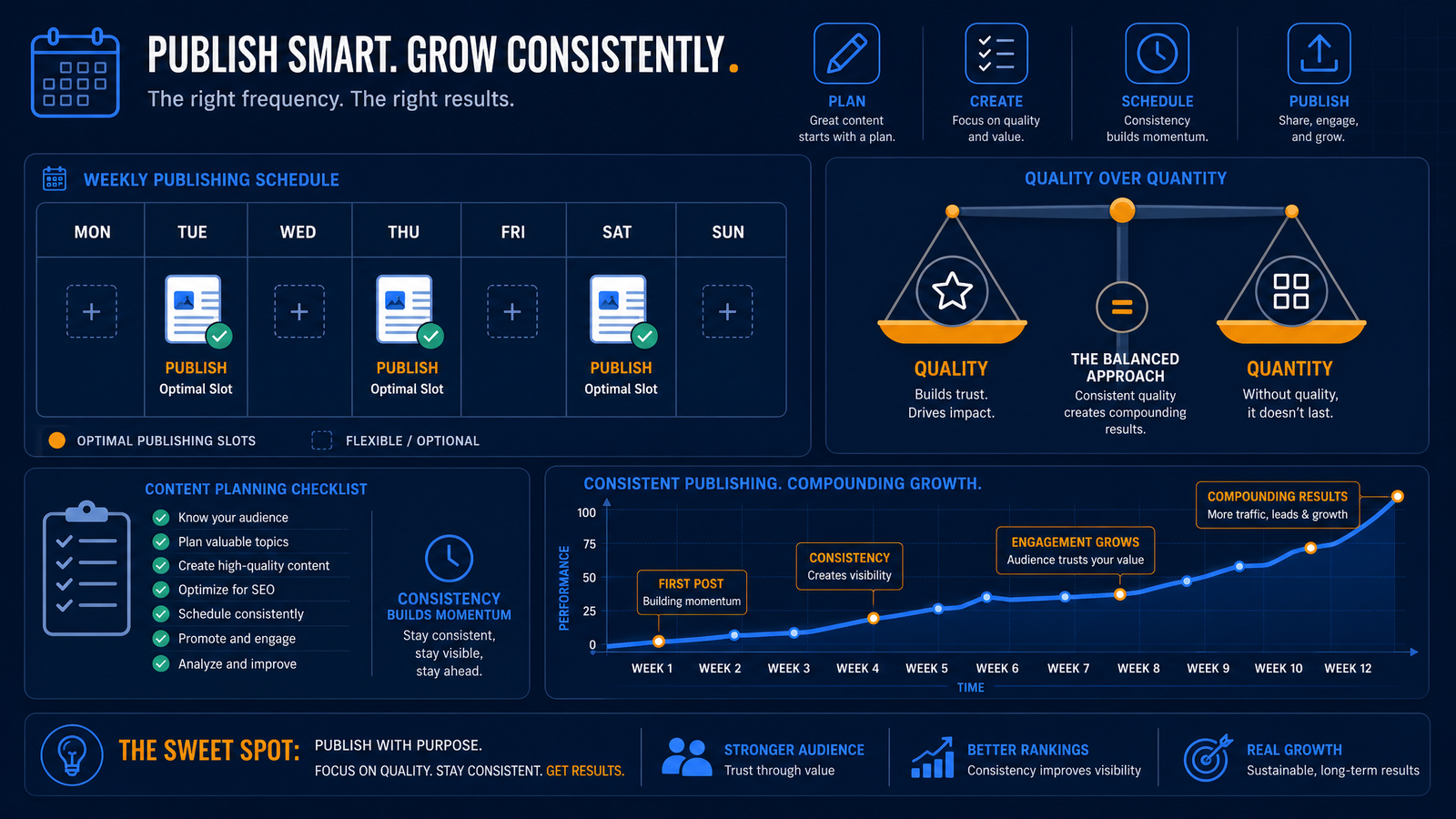
Let's start with the most important principle: consistency beats frequency. Posting once a week every week for a year is infinitely better than posting 10 times in one month and nothing for three months. Google rewards consistency. Readers reward reliability.
A blog you can sustain is worth more than a blog that burns you out. For more on this, see content marketing approach.
The Great Debate: Quality vs Quantity
The question of how often to post is really a question about quality vs quantity. And the answer is more nuanced than "quality over quantity."
Why Quality Wins
A single 2500-word, well-researched, deeply useful blog post can rank for multiple keywords, attract backlinks, and generate leads for years. Ten shallow, rushed posts that skim the surface will not.
Quality signals to Google that your content is authoritative. High-quality content gets more engagement — more time on page, more shares, more backlinks. These signals directly impact search rankings. For more on this, see how to create a social media content calendar that.
Quality also builds your reputation. When someone reads one of your posts and finds it genuinely valuable, they'll subscribe, they'll share it, they'll come back for more. One quality reader is worth more than a hundred accidental visitors.
Why Quantity Still Matters
But quantity has its place. Google's index has room for more content from your site. Each new post is another entry point for search traffic. The more quality content you have, the more keywords you can rank for, and the more traffic you can attract.
There's also a learning curve. The first ten posts you write will be worse than your 50th. You improve by creating. More reps mean better quality over time.
The Balance
The sweet spot is the maximum frequency you can maintain without sacrificing quality. If you can write one amazing post per week, do that. If your bandwidth allows two good posts per week without dropping quality, do that. But never sacrifice quality to hit an arbitrary number.
What Data Says About Publishing Frequency
Several studies have analysed the relationship between publishing frequency and results. Here's what the data shows.
Impact on Traffic
A study by HubSpot found that companies publishing 4+ blog posts per week got significantly more traffic than those publishing 3 or fewer. But the difference between 3 posts and 4 posts was much smaller than the difference between 0 and 1.
The biggest jump? From 0 to 1 post per week. Most businesses see a significant traffic increase just by publishing consistently once a week.
Impact on SEO Rankings
The relationship between frequency and rankings is indirect. More posts mean more keywords targeted, more internal links, and more opportunities for backlinks. But a monthly post that's excellent quality will outperform weekly posts that are mediocre.
Google's John Mueller has said multiple times that publishing frequency is not a ranking factor. What matters is content quality, relevance, and user engagement. Frequency helps you accumulate content. It doesn't directly boost rankings.
Impact on Email List Growth
More content means more opportunities to encourage email signups. Each post is a new chance to convert a reader into a subscriber. Higher frequency correlates with faster list growth — but only if the content quality justifies the subscription.
Industry Benchmarks
B2B Companies
- Recommended frequency: 1-2 posts per week
- Why: B2B buyers need comprehensive, trust-building content. Quality matters more than volume. Weekly posting builds authority over time.
- Top performers: Publish 2-3 times per week with deep, long-form content (2000+ words)
B2C Companies
- Recommended frequency: 2-3 posts per week
- Why: B2C content is often shorter, more frequent, and more promotional. Volume can help with brand presence.
- Top performers: Publish 3-5 times per week with mixed content (short tips, listicles, product features)
E-commerce
- Recommended frequency: 1-2 posts per week
- Why: Focus on product-related content — buying guides, reviews, use cases. Quality over volume for SEO.
- Top performers: Publish 2-3 times per week with product-focused content
SaaS Companies
- Recommended frequency: 3-4 posts per week
- Why: The market is highly competitive for organic traffic. More content means more entry points for keywords.
- Top performers: Publish daily with a mix of educational, thought leadership, and product content
Local Service Businesses (Agency, Salon, Clinic, etc.)
- Recommended frequency: 1 post per week
- Why: You need enough content to establish authority in your local market. Weekly is sufficient to rank for local keywords and build trust.
- Top performers: 2 posts per week with hyper-local content
Signs You're Publishing Too Much or Too Little
Signs You're Publishing Too Much
- Quality has dropped. Your recent posts are shorter, less researched, and less useful than older ones.
- You're burning out. Writing feels like a chore. You dread sitting down to create content.
- You're skipping promotion. You publish but don't distribute because you're too focused on creating.
- Comments are down. Fewer people are engaging even though you're posting more.
- You have no time for other marketing. Blogging consumes all your content bandwidth.
Signs You're Publishing Too Little
- Traffic from existing content is flat or declining. Your content library isn't growing.
- You have no content to promote. Social media feeds are empty because there's nothing new to share.
- Your email list is stagnant. You're not giving people new reasons to subscribe.
- Competitors are outranking you. They're covering topics you should be covering.
- You're over-optimising each post. Spending 20 hours on a blog post when 5 hours would produce something equally valuable.
The Fix
If you're publishing too much: cut frequency by half. Focus on quality and promotion. Your results will likely improve.
If you're publishing too little: double your frequency. Even if each post is slightly less polished, the volume will help you learn and grow.
The HubSpot Model vs the Basecamp Model
Two very different approaches to content publishing frequency. Both work for different situations.
The HubSpot Model (High Volume)
HubSpot publishes multiple times per day across multiple blogs. They have a massive content team, researched workflows, and aggressively repurpose content.
Pros:
- Dominates search results for thousands of keywords
- Massive organic traffic
- Brand authority in their space
- Extensive content library
Cons:
- Requires a large team and budget
- Risk of producing average content at volume
- Not replicable for most businesses
Best for: Large companies, serial content entrepreneurs, content agencies
The Basecamp Model (Low Volume, High Quality)
Basecamp (now 37signals) famously published a single, high-quality article per week. Their "Signal v. Noise" blog was one of the most influential business blogs with a fraction of the volume of competitors.
Pros:
- Most posts are above-average quality
- Each post gets real promotion attention
- Sustainable for small teams
- Builds real authority, not just volume
Cons:
- Slower to build traffic
- Fewer keywords targeted
- Harder to show "consistency" to Google's freshness signals
Best for: Small businesses, agencies, consultants, service providers
Which One for Indian Businesses?
For most Indian businesses, the Basecamp model (or somewhere in between) is the right approach. You need quality to compete with established publications. You need consistency to build momentum. But you don't need HubSpot's volume to get meaningful results.
SEO Impact of Publishing Frequency
Let's clear up a common misconception. Publishing more frequently does not directly improve your SEO rankings. Google doesn't score based on how often you publish.
But Frequency Does Affect SEO Indirectly
More content = more keywords. Every new post targets keywords. More posts mean more opportunities to rank.
More content = more internal links. Each new post can link to older content, distributing link equity throughout your site.
More content = better topical authority. A site with 100 posts on one topic signals expertise better than a site with 10 posts on the same topic.
Freshness signal. Google considers fresh content for certain queries (news, trends). For evergreen topics, freshness matters less.
More content = more crawl opportunities. Search engines crawl more pages on sites that update frequently.
The Sweet Spot
For SEO purposes, 1-2 quality posts per week is enough to show Google that your site is active and growing content. Beyond 2-3 posts per week, the incremental SEO benefit diminishes unless you're maintaining the same quality level.
Finding Your Ideal Frequency
Here's a practical process to find your ideal publishing frequency.
Step 1: Assess Your Bandwidth
- How many hours per week can you realistically dedicate to content creation?
- Break it down: research, writing, editing, formatting, image creation, promotion
- A 2000-word blog post typically takes 4-8 hours total (research + writing + editing + formatting + images)
Step 2: Assess Your Quality Threshold
- What's the minimum quality you're comfortable publishing?
- Are you willing to publish a "good enough" post, or does every post need to be excellent?
- Be honest — if you can't publish without perfectionism, lower frequency
Step 3: Start Conservatively
- Begin with 1 post per week
- Commit to this for 3 months minimum
- Track traffic, engagement, and lead generation
Step 4: Evaluate and Adjust
- After 3 months, review the data
- Is traffic growing steadily? If yes, maintain frequency
- Is quality consistent? If yes, consider increasing frequency
- Are you struggling to maintain quality? Cut back
Step 5: Scale Responsibly
- If 1 post/week is working smoothly, try 2 posts/week
- Keep quality measurement consistent
- If quality drops, go back to the previous frequency
Content Depth Over Frequency
This is the principle I come back to most often. Depth beats frequency in almost every content marketing scenario.
A deep, comprehensive post on a single topic will:
- Rank for more keywords (especially featured snippets)
- Get more backlinks (people link to thorough resources)
- Generate more engagement (people read and share valuable content)
- Convert more visitors (detailed content builds trust)
- Stay relevant longer (comprehensive content ages well)
A shallow post on the same topic will:
- Be quickly forgotten
- Not get backlinks
- Generate minimal engagement
- Need replacement within months
How Deep Should Each Post Be?
Cover the topic completely. If someone reads your post, they should not need to search for additional information on that specific topic. Include examples, data, step-by-step instructions, and actionable takeaways.
If your post is 800 words and barely scratches the surface, you'd be better off not publishing it. Save the topic for when you can give it the depth it deserves.
How to Scale Content Production
If you want to increase publishing frequency without dropping quality, you need a system.
Repurpose Everything
One core piece of content (a YouTube video, a podcast, a webinar) can become 2-3 blog posts. Transcribe your video, turn it into a written post, then extract key points for additional posts.
Batch Create
Set aside 3-4 hours once a week to write multiple posts. Content writing has a flow state — once you're in it, it's easier to keep going. Write three posts in one sitting instead of one post over three separate sessions.
Use Guest Writers
Invite industry peers, team members, or clients to contribute guest posts. This gives you fresh perspectives, builds relationships, and fills your content calendar without all the writing being on you.
Hire Help
When you're stretched thin, consider hiring a freelance writer. Provide them with topic outlines, keywords, and your brand voice guidelines. Review and edit their work. This scales your content production while maintaining oversight.
Create an Editorial Calendar
Plan content 1-3 months in advance. Knowing what you're writing ahead of time removes decision fatigue and keeps you consistently productive.
Republishing and Updating Strategies
You don't always need to create new content. Republishing and updating old content can be more effective than creating from scratch.
When to Update
- Posts with declining traffic (they once ranked well, now they're slipping)
- Posts with outdated information (statistics, examples, recommendations that have changed)
- Posts with high traffic but low conversions (improve the content and add better CTAs)
- Posts that cover topics you can now cover better (your knowledge has grown)
How to Update
Refresh statistics. Add new examples. Improve structure and readability. Update internal links to include newer relevant content. Add a "last updated" date. Promote the refreshed post as if it were new.
Republishing
For content that's evergreen but never got the distribution it deserved, consider republishing. Update it significantly, change the publishing date, and promote it again through all your channels.
📚 Related Articles You Might Like:
Conclusion
There's no magic number for blog publishing frequency. The right frequency for your business depends on your bandwidth, your quality standards, your industry, and your goals.
The most important rule is simple: publish at a pace you can sustain. One quality post per week that you can maintain for a year will outperform ten posts in one month followed by silence. Consistency compounds. Quality compounds. Together, they're unstoppable.
Start with once a week. Track your results. Adjust based on data. And never let frequency compromise quality.
Need help with your blog strategy or content creation? At VidyaSaaS, we help Indian businesses create and maintain consistent, high-quality blog content. Check out our Content Marketing services or get in touch for a free consultation.
Want Results Like This?
Get a free digital marketing audit and custom growth plan for your business.
Get Free AuditVidyaSaaS Team
Super AdministratorPart of the VidyaSaaS team — a group of digital marketing strategists, content specialists, and growth experts helping businesses across India achieve measurable results through data-driven marketing.
More about our teamRelated Articles
Handpicked content to help you grow your business

Sangli Turmeric City Digital: Content Marketing for Maharashtra Agriculture and Education Hub
Sangli produces India finest turmeric and exports grapes to Europe. Its sugar cooperatives shaped In...

Nanded Sachkhand to Startups: Digital Marketing Strategy for Maharashtra Pilgrimage and Industrial City
Nanded hosts one of Sikhism holiest shrines and a growing industrial belt. But its digital strategy...

Sagar MP Heartland Goes Digital: Marketing Strategy for Bundelkhand Education and Agriculture Hub
Sagar hosts Dr Harisingh Gour University — central India oldest — and anchors Bundelkhand agricultur...
Ready to Grow Your Business?
Let's discuss how we can create a data-driven digital marketing strategy tailored to your goals.